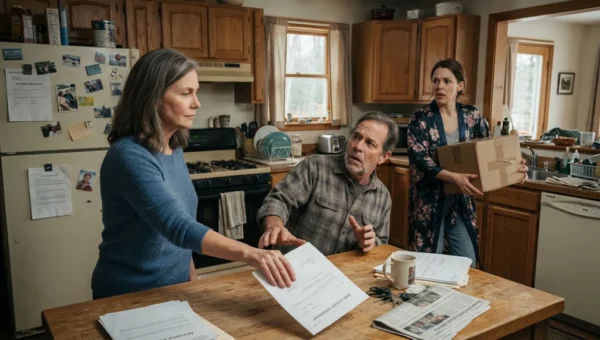
I was holding a cardboard sign with my brother’s name on it when he stopped short of the finish line and handed me his race bib.
He was supposed to keep running. The banner was right there. Instead, he looked at me and said, “I can’t finish until you promise to read what’s pinned behind this.”
I hadn’t spoken to Wade since the hospital, except for a few flat sentences about the funeral. So I said, “You’ve got to be kidding me.”
He shook his head. His face was wet with sweat, and his right leg kept twitching like it might give out. The crowd was yelling his name. I turned over the bib.
The handwriting was Mom’s.
My sister, Ruth, had spent years believing Mom would come around. When Mom was alive and sick, Ruth would call after visits and say, “She’ll get stronger. She just needs time.” I got mad at her for saying it. I got mad at everybody who hoped for something I thought I could see wasn’t coming.
That was a long time before Dad’s hospital room. But the same argument found us there.
Wade and I grew up racing down the hill behind our house. It wasn’t a steep hill, but there was a dip near the bottom, and if you hit it wrong you’d go down on your hands.
Wade was faster. I’d complain that he’d started early, and he’d tell me I was just slow.
We made a deal that neither of us would quit before the other one did. It was kid talk, the kind you forget you ever said until years later, when it comes back with a job to do.
Three weeks before the marathon, Wade called me.
I almost let it go to voicemail. I was standing at the kitchen sink, rinsing a coffee mug, and I watched his name flash on my phone until it stopped. Then he called again.
I picked up.
“I’m running the city marathon,” he said.
“I know. Ruth told me.”
“I’d like you to come.”
There was a pause. I kept rubbing the same spot on the mug.
“Why?”
“I want you there.”
That wasn’t an answer, but I said I’d think about it. We both knew what we weren’t saying.
At Dad’s hospital, Wade had agreed with the doctor that we should take Dad off life support. I’d said there was still a chance. Wade had said Dad wouldn’t want to be kept alive like that.
I called Wade cold. I told him he’d decided Dad was already gone because it was easier for him. He didn’t argue much. Maybe he didn’t know how. Or maybe he thought I needed to hear myself.
At the funeral, he sat three rows ahead of me. I watched him fold the program into a small square and keep it in his pocket. I could have sat beside him. I didn’t.
I went to the marathon anyway. Ruth said Wade had trained before work for months, and she didn’t want him crossing the finish line with no family there. I told her I wasn’t going to make a big show of it. I found a piece of cardboard in my garage and wrote his name with a black marker.
I made the letters too big. The last one ran off the edge.
The race took hours. People crowded the barriers, shouting for runners they knew and runners they didn’t. I kept checking my phone even though Ruth had texted me the race tracker. I didn’t know what I was expecting. Some sign that Wade had changed his mind and didn’t want me there after all, maybe.
When I saw him, I almost didn’t recognize him. His shirt was stuck to his back, his face red from the run. He was moving slowly, but he was still moving. I lifted the sign.
He looked straight at me.
Then he stepped out of the line of runners and stopped.
The people behind him went around. Someone called, “Keep going, man.”
Wade held out his hand. His race bib was pinned to his shirt. He pulled it free and pressed it into my palm.
“I can’t finish until you promise,” he said.
“Promise what?”
“Read the back.”
His voice was rough. He was out of breath, and he had to take a few seconds before he could talk again. The race bib felt damp in my hand. A folded piece of paper was pinned behind it.
I could see Mom’s handwriting through the thin paper. She used to write grocery lists in that same tight slant, putting the last word in a smaller hand when she ran out of room. I knew it before I read a single line.
“Where did you get this?”
“Dad’s Bible,” Wade said. “I found it when I was sorting his things.”
I looked at the paper and then at my brother. His chest was still working hard from the race.
“Why didn’t you tell me?”
“I tried to.”
“No, you didn’t.”
He looked down. “You wouldn’t have heard me.”
I hated that he was right. I also hated that he’d brought this to the finish line, with strangers clapping around us and his race unfinished. It felt unfair to put something this big in my hands there. It felt like he’d picked the one place where I couldn’t walk away without everyone seeing me do it.
I started to say that. Then I remembered the hospital.
Dad’s room smelled like hand soap and the burnt coffee from the waiting room. The monitor made a short sound at steady intervals. I’d counted those sounds without meaning to. Wade stood by the window, holding Dad’s phone and reading the notes from the doctor. I wanted him to look up and tell me there was another plan.
Instead, he said, “Dad told me what he wanted.”
I told him Dad couldn’t talk anymore.
“He told me before this.”
“And you just took his word for it?”
Wade’s mouth tightened. “I took it seriously.”
I thought he was giving up on Dad. I thought he was doing it because he couldn’t stand to keep watching. I had no way to know whether that was true. I didn’t ask. I was too busy being certain that I was the only one fighting for Dad.
Mom’s note was folded twice. The small safety pin holding it to the bib scraped my thumb as I opened it.
It was dated years earlier, during her illness. Her writing got shaky toward the bottom, but I could read every word.
“If I can’t know you or come back to you, let me go.”
I stopped there.
The crowd noise kept going. Wade had one hand braced on his knee. I read the next line.
“Don’t keep me here because you’re afraid to say goodbye.”
Then the last part.
“Don’t make my children carry the guilt of keeping me alive.”
I read it again. Not because the words were hard to understand. Because they weren’t.
The note said Mom didn’t want any of us to mistake a machine keeping her body going for a life she could still share with us. She wrote that Dad knew what she wanted. She wrote that she’d asked him to let her go if there was no way back. Dad had kept the note in his Bible, where Wade found it after the funeral.
I could hear the hospital monitor again. I’d told myself Wade had made the choice alone. But Dad had said what he wanted, and Mom had been clear about what she wanted years before him. Wade hadn’t told me because he thought the note would make it easier. Or maybe because he knew I’d hear it as one more person telling me to stop hoping.
I looked at him. “You knew this when Dad was in the hospital?”
“No,” he said. “I found it after.”
“Then why did you make the choice?”
“Because Dad had told me what he wanted. I didn’t want him to go through what Mom did.”
He swallowed, then said, “I thought you knew that.”
“I didn’t.”
“I should’ve told you.”
“Yes.”
He nodded. The race clock kept changing behind him. Some runner crossed the finish while we stood there with Mom’s note between us.
“I was so mad at you,” I said.
“I know.”
“No, I mean I stayed mad. I wanted you to feel bad.”
Wade looked down at his shoes. One lace had come untied.
“I did feel bad,” he said. “I just didn’t know how to fix it.”
I had spent years saying I’d been protecting Dad. That wasn’t all of it. I was protecting myself from the part where I’d been wrong, and from the fact that Wade had been there too, loving Dad in a different way. I made my anger into a wall and then acted surprised when my brother stayed on the other side.
“I’m sorry,” I said.
Wade’s eyebrows lifted, almost like he hadn’t expected those words from me.
“I should’ve asked you what Dad said,” I went on. “I should’ve listened.”
He reached for the bib, but I didn’t let go right away. We both held it by the edges, the damp paper between our hands.
Then Wade pulled me in.
I wrapped my arms around him. He was shaking from the run. I could feel his breath catch against my shoulder, and I started crying, which annoyed me because I hadn’t cried at the hospital. I had saved it all for later, apparently.
“I thought you were done with me,” he said.
“I wasn’t done.”
“You stopped calling.”
“I know.”
We let go. A race volunteer waved Wade toward the medical tent, but he said he needed a minute. I walked with him to the exit chutes. We sat side by side on a metal curb and shared a bottle of water. He drank first, then handed it to me.
I told him Ruth deserved to hear about Mom’s note from both of us. He said he’d call her that night. I said I’d be there when he did.
The race bib rested between us. Mom’s note was still pinned behind it, finally read by the two sons she’d tried to spare.
Neither of us quit first.