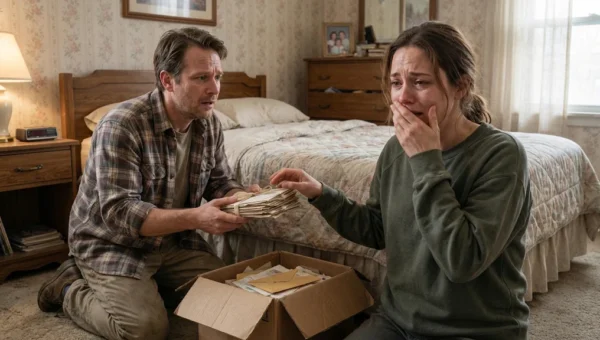
PART 1
My mother passed away on a Tuesday morning in October, three days after the hospice nurse told us her lungs were beginning to shut down. I had spent fourteen months sleeping on a twin cot in her downstairs sewing room, waking up every two hours to turn her, check her oxygen lines, and crush her pain medicine into applesauce.
My knees were bruised from kneeling beside her low bed, and my hands were permanently dry from washing sheets twice a day.
When the lawyer, Donald Vance, called us into his office on Elm Street two weeks later, the whole family assumed it was a formality. My sister had passed away twelve years ago, my father died back in 1998, and I was Mom’s only surviving child. I had taken an unpaid leave from my job at the county records office to move into her split-level on Maple Lane. I gave up my apartment, put my furniture in storage, and drained nearly four thousand dollars of my own savings on groceries, medical supplies, and ramp repairs that insurance refused to cover.
My cousin Brenda showed up to the reading in a neat navy blazer, her blond hair pinned back, carrying a beige leather shoulder bag. She sat across the mahogany table from me with her husband, Kevin.
Brenda worked as an office manager for a dental clinic three miles away. During those fourteen months, she came by twice a week, usually on Tuesdays and Thursdays on her lunch break. She would bring Mom little gifts: blueberry muffins from the grocery store bakery, soft fuzzy socks, and hand creams. She sat by the bed, held Mom’s hand, and listened to her talk about the old days. I was always grateful for those visits. It gave me forty minutes to run to the pharmacy or just sit on the front porch with a cup of black coffee without worrying that Mom would choke or try to climb out of bed alone.
Mr. Vance adjusted his reading glasses, cleared his throat, and laid the paperwork flat on the desk.
“I have here the Last Will and Testament of Evelyn Claire Miller, executed nine months ago,” he said.
He read the boilerplate clauses first, his voice dry and steady. Then he reached the distribution of real property.
“To my niece, Brenda Lee Holloway, I give, devise, and bequeath the real property located at 414 Maple Lane, including all fixtures, land, and improvements, free and clear of encumbrance, provided she assumes the remaining utility and tax liabilities.”
The room went completely silent.
I looked at Mr. Vance, waiting for him to correct the name. The split-level had been in our family since 1974. My father built the wooden back deck with his own hands. The yard had two apple trees we planted when I was in junior high.
“Excuse me,” I said, my voice barely above a whisper. “Did you say Brenda?”
Brenda immediately dropped her eyes to her lap. She folded her hands tightly around her purse strap, but she did not look surprised. Her husband, Kevin, shifted in his leather chair and looked toward the window.
“That is what the document states, Laura,” Mr. Vance said gently. He looked at me with genuine sympathy. “The personal property within the house, including clothing and household goods, is left to you.
The remaining checking account balance, after outstanding medical bills and estate administration fees are settled, is also designated to you.”
Brenda leaned forward, her voice soft and trembling. “Laura, please don’t be angry with me. Aunt Evelyn told me she was worried about what would happen to the house after she was gone. She knew Kevin and I were looking for a place with a yard for the kids. I didn’t ask her for it. I swear on my life I didn’t ask her. She just wanted to keep it in the family, and she thought you would want to move back into town near your work.”
The sting was sharp and heavy in my chest. Everyone at church, my neighbors, and the hospice workers had all told me how lucky Mom was to have a daughter who sacrificed everything to care for her. Now, sitting in that cold office, I felt like I had been erased.
Yet Brenda had been good to Mom. Mom had been confused and frightened during those last few months, slipping in and out of lucidity. Maybe in her weakened state, she convinced herself that Brenda needed a family home more than a single fifty-six-year-old woman did. I swallowed the bile rising in my throat and nodded.
“I won’t contest it,” I told the room, looking Brenda straight in the face. “If this is what she signed, I won’t drag her name through probate court. I just want my things, and I want her personal keepsakes.”
Brenda let out a small breath and gave me a tearful, relieved smile. “Of course. You take whatever you want. We’re having an estate tag sale company come in on the twenty-fourth to clear out the rest of the furniture so we can paint, but you take your time.”
Mr. Vance closed the thick blue folder. As Kevin and Brenda stood up to shake his hand, Mr. Vance held up one finger.
“Just a moment, Laura. Before she signed this revised will, your mother asked me to hold a separate envelope for you. It was not filed with the court because it contains no testamentary language. She simply instructed me to hand it directly to you after the reading.”
He reached into the top drawer of his desk and pulled out a small, pale yellow envelope. Across the front, written in my mother’s shaky, arthritic cursive, were three words: *Kitchen only.*
Brenda stopped mid-step. She looked at the envelope, her eyes narrowing slightly. “What is that?”
“Personal note,” Mr. Vance replied evenly. “Addressed solely to Laura.”
I slipped the envelope into my coat pocket without opening it. My hands were shaking so hard I could barely zip my jacket.
Brenda walked me out to the parking lot. She offered to buy me lunch at the diner down the road, but I told her I was too tired. She gave me a long, tight hug that smelled of lavender lotion, told me she loved me, and reminded me that the garage keypad code was still the same if I needed to pack my clothes before the weekend.
I drove straight to Mom’s empty house.
The rooms were quiet, holding that faint, familiar smell of rubbing alcohol, old wool blankets, and dried flowers. I walked into the kitchen, sat down at the yellow Formica table where I had eaten breakfast every morning of my childhood, and pulled the yellow envelope from my pocket.
I slit the flap with Mom’s old butter knife from the drawer.
Inside was a small, brass flat-headed cabinet key taped to an index card. On the card, Mom had written out her recipe for lemon pie in her old, clear handwriting from years ago, before her arthritis twisted her fingers. At the very bottom of the card, written in fresh, jagged blue ink with the unsteady tremor of her final months, was a single sentence:
*Use the key where we kept the flour.*
PART 2
I stared at the recipe card until the ink blurred.
Where we kept the flour.
Our house on Maple Lane had an old floor-to-ceiling wooden pantry built into the wall beside the basement door. When my father renovated the kitchen back in the late seventies, he installed a massive, zinc-lined pull-out flour bin at the bottom. It held twenty-five pounds of King Arthur unbleached flour, balanced on heavy iron rollers. Mom had baked bread and pies out of that bin every Saturday morning for forty years. When she got sick, the bin sat empty, smelling faintly of dry grain and cedar.
I stood up, walked over to the pantry, and yanked the heavy bin open until it stopped on its iron tracks.
I leaned inside with the flashlight on my phone. The zinc bottom was clean and dusted with old white powder. Nothing looked out of the ordinary. But when I reached my hand behind the wooden frame where the box slid back into the wall cavity, my knuckles hit cold steel.
I got down on my knees on the linoleum. Tucked deep inside the hollow framing, completely hidden unless the bin was pulled to its maximum extension, was a heavy steel utility box screwed directly into the wall studs. In the center of the box sat a small keyhole.
My heart was pounding in my throat. I peeled the small brass key off the index card and pushed it into the slot. It turned smoothly with a heavy, mechanical click.
The front plate dropped down like a breadbox door.
Inside sat a thick stack of blue and white bank envelopes from First Community Bank, bound together with thick rubber bands that had grown dry and cracked with age. On top of the stack lay a small spiral notebook with my mother’s handwriting filling the pages.
I took the bundle over to the kitchen table and sat down.
The top bank statement was dated November of the previous year, just one month after I moved in to take care of Mom. I opened it. It was the monthly summary for Mom’s primary checking account, the one where her monthly teacher’s pension and my father’s small company annuity were deposited.
Every statement showed the same pattern. On the second and fourth Thursday of every single month, exactly matching Brenda’s lunchtime visits, there was an over-the-counter counter withdrawal of eight hundred dollars in cash.
Sixteen hundred dollars a month.
I flipped backward through the blue envelopes. The withdrawals went back three full years. In some months, there were additional withdrawals: twelve hundred dollars for “home repairs,” nine hundred dollars for “specialist consultations.”
Then I looked at the copies of the counter withdrawal slips tucked inside each envelope.
My mother had signed the bottom of the slips, but the handwriting on the date, the amount, and the memo lines was not hers. It was rounded, looping, and neat, written with a fine-point purple gel pen. Brenda had used that exact purple pen every single Tuesday to fill out Mom’s medication chart on the refrigerator.
At the bottom of every slip, in the line marked *Authorized Representative / Cash Received By*, was my cousin’s neat signature: *Brenda L. Holloway*.
I opened Mom’s spiral notebook. The first few pages were written in her normal hand from three years ago:
*Brenda says the roof needs flashing. Gave her cash to pay the contractor.*
*Brenda says the county taxes went up. She took the check to town hall.*
*Brenda says Laura is struggling with her own debts and cannot know about the house expenses or she will put me in a home.*
My stomach dropped through the floor.
I turned the page. The entries became shakier, written during the final summer while I was downstairs washing laundry and cooking suppers:
*Brenda told me today that Laura complained to the neighbors about changing my bandages. She says Laura wants to sell the house to a developer the minute I close my eyes. Brenda says if I deed the house to her, she will keep it safe for the family and give Laura her share in cash later so Laura doesn’t lose it to creditors. I don’t know what to believe. My head hurts so bad. Brenda brought the lawyer to the bedside while Laura was at the grocery store.*
I sat at that yellow table in the empty house, holding my dead mother’s words in my hands, and I wept.
Mom hadn’t cut me out because she favored Brenda. She had been systematically isolated, frightened, and manipulated by a woman who brought her bakery muffins while draining her life savings and poisoning her mind against the only person breaking her back to care for her.
I pulled out my calculator. Over thirty-eight months, Brenda had withdrawn a total of seventy-four thousand two hundred dollars in cash from my mother’s accounts.
And then she had taken the house.
PART 3
The next morning at eight-thirty, I walked into the downtown branch of First Community Bank with Mom’s death certificate, my paperwork as the designated executor of her personal estate, and the stack of bank statements.
I met with the branch manager, Mrs. Arlene Gable, a woman who had known my mother since the 1990s.
“Laura, I am so sorry for your loss,” Mrs. Gable said as she closed her office door. “Your mother was a wonderful lady.”
I laid the counter slips on her desk. “Mrs. Gable, I need to know how these cash withdrawals were approved. My mother was bedridden for the last fourteen months of her life. She did not leave that house.”
Mrs. Gable put on her glasses and examined the slips. Her expression tightened as she pulled up the account records on her computer terminal.
“Three years ago, your mother signed a limited third-party withdrawal authorization naming Brenda Holloway,” Mrs. Gable said, reading from the screen. “It allowed Brenda to make cash withdrawals up to one thousand dollars per transaction for household maintenance and medical care. But look here.” She pointed to the signature verification card on her screen. “The original authorization required a medical receipt or utility invoice attached to any withdrawal exceeding five hundred dollars. That was bank policy for elderly account holders.”
She clicked through several screens, her frown deepening. “There are no receipts attached to any of these forty-eight counter slips. None. Brenda was dealing with one of our junior tellers, Megan, who happens to be Brenda’s sister-in-law’s niece. The documentation was bypassed entirely.”
Mrs. Gable looked up at me, her face pale. “This is a severe compliance violation. If this money was not applied to your mother’s care or authorized with proper receipts, this is grand larceny and bank fraud.”
“Give me copies of every record,” I said. “Every transaction log, every teller ID, and the original signature cards.”
By two o’clock that afternoon, I was sitting back in Donald Vance’s law office.
When Mr. Vance saw the notebook entries and the bank audit logs Mrs. Gable had printed, his face turned the color of chalk.
“Good Lord,” he whispered, running a hand over his mouth. “Brenda called me nine months ago. She told me Evelyn was distressed because you were threatening to put her in memory care and sell the house. She said Evelyn wanted an emergency revision to her will. I came to the house on a Wednesday morning. You weren’t there.”
“Because Brenda asked me that morning to drive forty miles to the medical supply warehouse in Canton to pick up a specialized pressure mattress,” I said, my voice dead and steady. “She planned the whole thing.”
“Evelyn was weak, but she answered my questions,” Mr. Vance said, his hands shaking slightly. “She told me she wanted Brenda to have the house to protect it. But under state law, a will executed under fraudulent inducement and undue influence is completely void. If Brenda procured this conveyance by misrepresenting financial facts and isolating the testator, it is invalid on its face.”
“I don’t just want the will overturned, Mr. Vance,” I said. “I want her to look me in the eye.”
We scheduled a meeting for Friday morning at ten o’clock at the house on Maple Lane, under the pretense of reviewing the estate tag sale inventory.
Brenda arrived right on time, wearing jeans, work gloves, and carrying a box of green plastic trash bags. Kevin was with her, carrying a clipboard.
“Morning, Laura!” Brenda called out cheerfully as she walked through the front door. “We brought boxes for the linen closet. If you haven’t gone through Mom’s winter coats yet, we can help you pack them up.”
I was standing at the kitchen counter. Mr. Vance was sitting quietly at the yellow Formica table. On the counter sat the yellow envelope, the recipe card, the small brass key, the spiral notebook, and the four-inch stack of bank statements.
Brenda stopped when she saw Mr. Vance. Her smile faltered. “Oh. Donald. Is there more paperwork we need to sign?”
“Come in, Brenda,” I said. “Shut the front door.”
Kevin stepped into the kitchen behind her, looking uneasy. “What’s going on here?”
I picked up the small brass key and held it between two fingers.
“Do you know what this opens, Brenda?”
Brenda looked at the key, then at the empty flour bin pulled out against the pantry wall. Her jaw tightened, the color instantly draining from her cheeks until her lips looked almost gray.
“I have no idea,” she said, her voice dropping an octave.
“It opens the metal lockbox behind the flour bin,” I said. “The one Mom put in with Dad thirty years ago. The one where she kept every single bank statement you brought back to her, along with the little notebook where she wrote down everything you told her while you were feeding her muffins.”
Brenda took a half-step back toward the hallway. “Laura, I don’t know what lies she wrote down when she was losing her mind, but I took care of her.”
“You took seventy-four thousand two hundred dollars in cash,” I said. “You had your niece-in-law bypass bank regulations on forty-eight separate occasions. You told Mom I was going to put her in a home. You told her I was in debt. You told her I wanted to sell her house to developers.”
“That’s not true!” Brenda shouted, her voice cracking. “She gave me that money! She wanted to help us!”
“Then why did you write ‘roof repairs’ and ‘county taxes’ on the memo lines?” Mr. Vance interrupted, standing up from the table. “I have the county tax records right here, Brenda. Evelyn’s property taxes were paid directly via automatic escrow from her pension account. You took cash to pay taxes that had already been paid. That is conversion and fraud.”
Kevin turned to stare at his wife. “Brenda? What is he talking about? You told me your aunt gave us twenty thousand dollars from an old life insurance policy for our kitchen remodel.”
“Shut up, Kevin!” Brenda hissed, her face contorting with rage.
“She didn’t give you anything, Kevin,” I said. “She paid for your new quartz countertops and your trip to Florida out of my mother’s checking account while Mom lay in that back bedroom with bedsores, crying because she thought her only daughter hated her.”
Brenda lunged toward the counter, reaching for the notebook, but Mr. Vance stepped between her and the counter with surprising agility.
“Do not touch those documents, Brenda,” Mr. Vance said firmly. “I spoke with the county prosecutor’s elder abuse division this morning. With the bank’s transaction audit, the teller statements, and your signatures on those counter slips, this qualifies as Class B felony exploitation of an endangered adult.”
Brenda stopped. Her chest was heaving. Her hands, still wrapped in cheap cotton work gloves, were trembling violently.
“What do you want?” she whispered.
ENDING
The house was completely still except for the low hum of the refrigerator.
“Here is what happens,” Mr. Vance said, pulling three prepared legal documents from his briefcase and laying them on the table beside the recipe card.
“First, you execute this voluntary deed of disclaimer and renunciation. You surrender any and all claim to the real property at 414 Maple Lane, acknowledging that the bequest was procured through mistake and undue influence. The house passes immediately to Laura as sole heir under the prior valid will.”
Brenda stared at the paper as if it were on fire.
“Second,” Mr. Vance continued, “you will execute a promissory note and confession of judgment in the amount of seventy-four thousand two hundred dollars, secured by a second mortgage on your personal residence on Oak Street. You will pay Laura nine hundred dollars a month at five percent interest until every single dollar stolen from Evelyn Miller’s estate is repaid in full.”
“Nine hundred dollars a month?” Kevin gasped, his face bright red. “We can’t afford that! We’ll lose our own house!”
“Then you should have asked where your wife was getting stacks of hundred-dollar bills every other Thursday,” I told him without blinking.
“And third,” Mr. Vance said, his voice cold as iron, “if this deed and this confession of judgment are not signed, notarized, and delivered to my office before four o’clock this afternoon, I will personally file the criminal referral with the prosecutor’s office, and First Community Bank will pursue their own criminal complaint against you and the teller who processed the fraudulent slips.”
Brenda looked at me. The polite, sweet niece with the lavender lotion and the bakery muffins was completely gone. In her place was a cornered, bitter woman whose greed had run out of road.
“You always thought you were better than me,” Brenda spat, her voice shaking with venom. “Just because you went to college. Aunt Evelyn always bragged about you, and you left her alone in this house for years before she got sick.”
“I was here when she died, Brenda,” I said softly. “I held her hand while she took her last breath. And you were busy checking the calendar to see when you could hire a painter.”
Brenda pulled off her work gloves, threw them onto the floor, picked up the pen Mr. Vance offered, and signed the disclaimer. Her hand shook so badly the last letter dragged off the signature line.
Kevin didn’t wait for her. He walked out the front door, got into his truck, and slammed the door so hard the kitchen windows rattled. Brenda followed him five minutes later, walking down the gravel driveway with her head down, clutching her beige purse against her ribs.
It took six months to settle the estate properly.
Mr. Vance filed the renunciation with the county probate court, and the deed to 414 Maple Lane was officially transferred into my name. Every month on the first, a certified check for nine hundred dollars arrives in my mailbox from Brenda’s bank, drawn against her wages and the equity in her house. I don’t spend a single cent of it on myself. I set up a dedicated trust account that pays for the groundskeeping at the cemetery and funds a small annual respite-care grant through our local hospice organization, so other family caregivers can take a break without losing their minds.
I decided not to move back into town.
I left the records office, took a position at the local library five minutes away, and stayed right here on Maple Lane. I painted the kitchen walls a warm, bright cream and had Dad’s wooden back deck sanded and sealed.
Every Saturday morning, I pull the heavy zinc flour bin open on its iron tracks. I scoop out three cups of King Arthur flour, roll out the dough on the yellow Formica table, and bake my mother’s lemon pie using the recipe she taped that key to.
She knew what she was doing when she wrote that note. She knew she had been tricked, and even when her body was failing and her voice was gone, she left me the one tool I needed to bring the truth into the light. The house is quiet now, but it is finally clean.