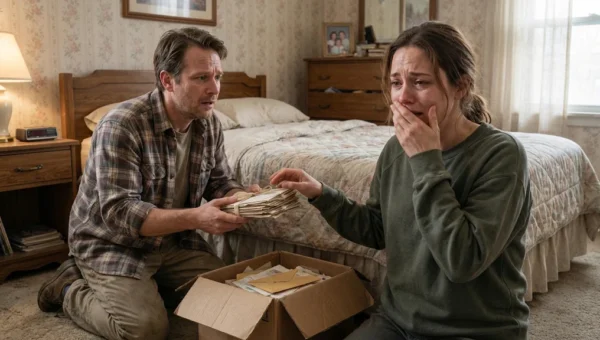
At six o’clock on Sunday, Aunt Clara told my nine-year-old son he wasn’t special like her kids. Twelve adults heard her. I took Leo by the hand and left before anyone could ask me to keep the peace.
I wish I could say that was the first time I’d seen how my family ranked people. It wasn’t. I’d just kept finding ways to call it something else.
Grandma’s dining room was crowded, like it always was when the whole family came over. There were serving dishes between the plates, kids’ school awards on the sideboard, and talk about college plans and new houses. Clara’s two kids were doing well in school, and she could work that into any subject. I used to smile and pass the potatoes.
Leo was quieter than his cousins. He drew little maps and made up games with rules nobody else understood. He could spend a long time building a world out of blocks, then explain the whole thing to me while I tried to get dinner on the table. I thought those things were special. I didn’t say that enough around my family.
Clara had been talking about her daughter’s grades. She said the school had put her in an advanced group, then mentioned how proud she was of her son’s sports award.
I was glad for them. I really was. But Grandma nodded along like this was the only kind of good news worth hearing.
Leo reached for a dinner roll. Clara smiled at him, then said, “You’re not special like our kids.”
She didn’t shout. That was part of why it took a second to land. My fingers were on my fork, and I remember the green beans had gone cold on my plate. Nobody said anything. Not Grandma, not the cousins’ dad, not the aunt who’d been passing the gravy a minute earlier. Twelve adults, and nobody found a word.
I’d spent years telling myself it was better not to make a scene. Clara could be sharp, but she was family. People were proud of their kids. I’d made excuses for the little comments, the way Leo’s stories got interrupted, the way gifts for his cousins were discussed as if he should be impressed.
I did it because I wanted him to have a big family. I didn’t stop to ask what that family was teaching him.
He looked at me. I pushed my chair back, took his hand, and walked out. I didn’t grab my coat. I didn’t say goodbye. Behind us, somebody shifted a plate, and then the front door shut. That was all.
The car smelled like the cinnamon gum Leo kept in the cup holder. I started it, then sat with both hands on the wheel because I didn’t trust myself to say anything useful yet. He was looking at his shoes. I could see his dinner roll still in his hand.
At about 6:30, he asked, “Mom, am I really not special to them?”
I wanted to give him an answer big enough to cover every year I’d let those little cuts pass. Instead, I turned toward him and told him he was special to me, not because he won awards or got the best grades, but because he was Leo.
Then I said I was sorry I hadn’t made it clear sooner.
He didn’t answer right away. He pinched a loose thread on his sleeve. I had to sit there and let him feel whatever he felt, instead of rushing to tell him the whole family loved him. I wasn’t sure I believed that myself anymore.
I told him I was done asking him to sit still while people made him feel small. It was a vow, sure, but it was also something I should’ve said a long time ago. He leaned his head against my shoulder for a second. I kept my arm around him until he sat back up.
I drove us home first. The house felt too quiet, and I could still picture the table, all those adults looking down at their plates. I kept thinking I should text my mother and tell her what Clara had done. Then I pictured the replies I’d get. Clara didn’t mean it. You’re making this bigger than it was. Just let it go.
I had let it go plenty. That was the problem.
At 9:00, we pulled into the late-night retail center where the GameStop was still open. I didn’t plan to spend what I spent. I knew that before we went inside. I also knew the savings buffer I’d built was supposed to be for emergencies, and this was not an emergency in the way a broken furnace was an emergency. But a child asking whether his own family thought he mattered felt urgent enough to me.
Leo asked why we were there. I told him I wanted to make his room into a place that belonged to him. Not a reward for being good. Not a way to buy his feelings back. I said I wanted him to choose things he’d enjoy, and that we’d look at the prices before we bought anything.
He didn’t rush around grabbing boxes. He walked the aisles slowly, reading the labels and checking the pictures. He asked if he could get a console, then looked at me like he expected me to change my mind. I told him to pick one he’d actually use.
We got the console, two controllers, a headset, a charging dock, a gaming chair, and a monitor. He picked games he’d talked about for months, plus a small drawing tablet because he wanted to make characters for his own games someday. I let him put each item in the cart, and we checked the total together. By the time we got to the counter, it was $2,374.06.
I could feel the number. I’m not going to pretend I didn’t. It took a bite out of my savings, and I knew I’d have to rebuild that cushion. But Leo was holding the receipt with both hands like it was some kind of certificate. On the drive home, he kept reading the item list to me, even though I’d been standing right there when we bought it.
We got home late, and the boxes filled most of his room. He wanted to help set everything up, so I let him, even when he kept handing me cords I’d just put down. We moved his desk to the wall and made space for the monitor. He pulled his drawings off the shelf so they could go above it.
I’m not good with cable management. Leo was better at it than I was, which he found funny. For a while, we were just two people on the floor sorting cords and trying not to step on the controller boxes. The dinner at Grandma’s started to feel less close. Not gone. Just not the only thing in the room.
At 9:45, I took a picture of the receipt and opened the family chat. I’d never posted anything there that wasn’t a birthday greeting or a photo of Leo. My thumb hovered over the keyboard long enough that the screen dimmed.
Then I typed: “This is what I spent tonight making sure Leo knows he matters. Twelve adults heard Clara tell him he wasn’t special, and nobody said a word. Don’t contact us to tell me I embarrassed the family. You were all there.”
I attached the receipt and hit send.
The chat stayed quiet. I expected Clara to answer first. Instead, I saw that the message had been read by several people, then the typing dots showed up and disappeared. I sat on the edge of Leo’s bed. He was testing the headset and smiling at something in the game menu.
At 10:00, my phone started ringing. I didn’t pick up. One call ended, and another came in. Then a text from my mother: “You need to delete that.”
A cousin wrote, “This is a private family matter.” Clara sent, “I was joking. You know how I talk.” I read them all. I didn’t reply to any of them.
The messages weren’t about Leo. Nobody asked if he was okay. Nobody said they were sorry he’d been sitting there while the adults watched. They were upset that I’d put the receipt and the words together where everyone could see them. They wanted me to take it down before somebody outside the family saw what they’d let happen.
That was the part I had been trying not to know. They hadn’t stayed quiet because they didn’t understand. They stayed quiet because speaking up would have meant admitting what kind of family we were.
The calls kept coming. Some were angry, some were soft, some were just more of the same dressed up as concern. I could hear my phone buzzing on the counter while Leo asked me to look at the screen he’d set up. I went to him instead.
By midnight, I had 94 missed calls. Ninety-four. I took a screenshot because I knew I’d be tempted later to tell myself it hadn’t been that bad. Then I blocked the numbers and left the family chat.
I didn’t do it to punish them. I did it because I knew what the next day would sound like. They’d tell me Clara didn’t mean it, that I’d gone too far, that I was being dramatic over one sentence. Then I’d spend my energy proving that the sentence mattered, while Leo listened from the next room.
I’d spent years acting like peace meant nobody got called out. It didn’t. It meant Leo had to swallow whatever hurt so the adults could finish dinner without feeling uncomfortable. I couldn’t keep asking him to pay for that.
The next morning, we made pancakes. The first one tore when I tried to flip it, and Leo said it looked like Ohio if Ohio had been stepped on. I laughed harder than the joke deserved. He laughed too, and I was glad to hear it.
My phone was facedown on the kitchen counter. I knew the calls would stop eventually. I knew there’d be practical things to deal with, and my savings were lower than they’d been the night before. I wasn’t sorry about the purchase, but I also wasn’t going to pretend a receipt fixed everything.
Leo’s room was different now. Not expensive-looking. Just his. His drawings were above the desk, his games lined up where he could reach them, and the new chair squeaked whenever he leaned back. He sat there playing, then turned to show me a little character he’d made on the drawing tablet.
I didn’t tell him he’d won anything. I didn’t tell him the family was wrong in a way he had to carry around. I told him I liked the character’s crooked hat. He grinned and went back to work.
The relatives didn’t come over after that. I didn’t go to their dinners. Some quiet traditions started up instead, just the two of us. It wasn’t the big family life I’d wanted for him. It was safer than asking him to keep earning a place at a table where nobody had defended him.
By the time I got back to the kitchen, the phone was still facedown. Leo was at his desk, laughing at his game, surrounded by the things he’d chosen. He didn’t look toward the counter once.