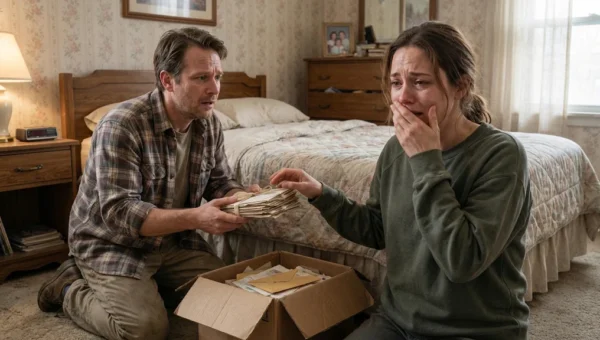
The truck keys were cold against my palm outside the ambulance station, even though I’d been holding them only a second. My husband, Dale, had one end of the ring. Our son, Owen, had the other. Dale had come all the way there to say something, and I was still sure I knew what it would be.
A month earlier, Owen told us he was leaving our construction business to train as a paramedic.
Dale said it was a waste of everything we’d built. I told Owen to wait one month before making it official. I thought I was keeping one hard conversation from turning into a family break neither of us could fix.
Owen waited. Dale stopped talking to him.
I drove Owen to the station on the morning of his first ride-along because Dale hadn’t offered. I figured the month had done what I’d asked it to do. It hadn’t. Not the way I meant.
Dale started the business thirty years ago with an old pickup, a borrowed mixer, and a toolbox he still keeps in the garage. I can’t tell you how many times I’ve heard him say that a good wall stays put because somebody took the time to set it right. He taught Owen the trade before Owen was tall enough to carry a full bucket. He’d talked for years about passing him the company truck.
So when Owen said he wanted to leave, Dale didn’t hear a career choice. He heard thirty years of work being turned down. At least, that’s what I thought he heard.
“Give him a month,” I told Dale the night of the argument. “Just let him finish the month.”
Dale looked at me, then at Owen. He didn’t answer. Owen nodded, because I’d asked him to. I remember thinking that was the mature thing to do. I also remember feeling relieved, which embarrasses me now. A month sounded like a neat little fix. Like waiting could make a choice smaller.
The first week, I kept finding reasons to bring them into the same room. I asked Owen to look at a crack in the shop floor. I asked Dale if he needed help hauling a load. They both did what I asked, but neither spoke to the other. A tape measure would pass from one set of hands to another without a word.
I told myself Dale was cooling off. Owen told me he was fine. He said it while looking at his dinner plate, and I let him get away with it because I didn’t want another fight.
That was my part in it. I kept making quiet sound like peace.
Owen had been careful about the decision. He’d researched the training and talked with people who worked on an ambulance. He wasn’t running off after one bad day. Still, I asked him to wait because I wanted Dale to come around before the family had to name the choice out loud.
By the second week, Dale was leaving before breakfast and coming home after Owen had gone upstairs. He wasn’t shouting. He wasn’t saying anything cruel. He just acted like our son had become part of the furniture.
I told Owen, “Your dad needs time.”
Owen said, “I gave him time.”
I had no good answer. So I said I knew, and went to rinse a clean plate that didn’t need rinsing.
Then Dale started spending evenings in the garage with the company truck. I heard the air hose, then a ratchet, then the garage door closing late. When I asked what he was doing, he said he was fixing a few things. I assumed he was getting it ready for work. He’d always kept that truck in better shape than our kitchen.
There was a small first-aid box behind the driver’s seat, tucked beside the old gloves. It had been there for years. Dale’s work kit always included things he never taught the crew to use: gauze, a flashlight, a pair of shears. I’d seen it plenty of times and never asked why he kept replacing the supplies.
I wish I could say I understood then. I didn’t.
The wreck happened years ago, on a wet stretch of highway, with too many cars involved and not enough room to stop. Our older boy, Ben, was badly hurt. He survived. I don’t want to make that sound small. We spent weeks learning how to talk about what he could and couldn’t do next, and years learning not to flinch at every siren.
Dale was there before the rescue crews. He got out of his truck and ran toward the wreck. He never told me much about those minutes. I knew he’d tried to help. I knew responders got Ben out and kept him alive. I knew Dale didn’t like to hear the story brought up.
What I didn’t know was how much of the story he’d kept inside himself. I thought he was proud, and maybe he was. I thought he was angry that Owen was leaving the work they’d shared. That was true, too. But I mistook the part I could see for the whole thing.
The month ended on a Tuesday. Or maybe a Wednesday. I’m pretty sure it was Tuesday because Owen had his paperwork folded in his jacket pocket, and he’d been checking it every few minutes during the drive. We didn’t talk much. The heater smelled like dust, and the turn signal clicked all the way down the hill.
I was afraid he’d change his mind just to spare us. I was also afraid he wouldn’t. That’s not a very generous thing for a mother to admit, but I wanted both my boys safe, and I wanted Dale to feel like the life he’d built still mattered.
I pulled up outside the station. Owen opened the door, then stopped when Dale’s company truck came around the corner. Dale parked behind us and walked over holding the keys.
“You forgot something,” he said.
Owen reached out. Dale didn’t let go.
I was ready for Dale to ask him to stay. I’d been waiting a whole month for some version of that. Instead, Dale looked at Owen and asked, “When Ben was under that guardrail, what did you see?”
Owen’s hand stayed open between them. He looked at his father, then at me. Nobody rushed to fill the space.
“I saw the responders get to him,” Owen said. “I saw them keep him alive.”
Dale’s mouth moved once before he got the words out. “I couldn’t move.”
He said it so plainly, like he was telling us he’d misplaced a wrench. His eyes stayed on Owen, but his fingers were still closed around the key ring.
I understood then why the first-aid box had stayed in the truck. Why he’d spent all those late hours getting it ready. Why he’d let the month go by without one word to his son. Dale had been building walls around a fear he’d never said out loud. He’d watched strangers do what he couldn’t do that night, and now Owen was choosing to run toward the same kind of trouble.
I’d told myself the month would cool Dale down. I hadn’t seen that he was scared enough to go silent.
Owen said, “I know you were there, Dad.”
Dale blinked hard. His grip eased, but the keys didn’t drop. “I thought if I didn’t talk about it, it couldn’t happen again.”
Nobody had to explain what he meant. We all knew it didn’t work that way.
He’d been working on the truck during the silence. The back seat was cleared, and he’d made room for Owen’s gear. The first-aid box was stocked again. I could see the fresh roll of tape through its clear lid. He’d done all that without telling either of us, which was very Dale. Fix the thing you can reach. Keep the rest to yourself.
I was angry with him for the silence. I was angry with myself for calling it patience. But I was also standing there watching a man who’d spent thirty years teaching our son how to build something sturdy, trying to give him what he’d never known how to say.
Dale let the keys go.
Owen closed his hand around them. For a second, neither of them moved. Then Dale pulled him in, awkward and hard, and Owen held on. I started crying, which I’d been trying not to do since we left home. Dale’s sleeve smelled like sawdust and the soap from our laundry room.
The truck stayed with Owen. Dale had fixed it up so it could carry his gear, and Owen took it to training and then to work. The business stayed open. Dale still has crews to run, jobs to bid, and a habit of checking every load twice.
But he started taking Sundays off. At first he sat on the porch and acted like he was doing us a favor. Later, he started talking about the wreck. Not all at once. A little bit at a time, usually when one of us asked something simple and didn’t push.
On Owen’s first ride-along, the station tones dropped while we were still standing outside. Owen looked down at the keys in his palm, then headed for the bay doors. Dale came to stand beside me.
The rescue rig pulled into the morning light, and Dale’s shoulder stayed against mine.