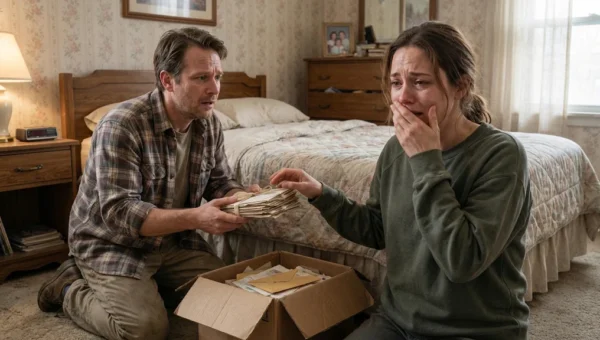
My granddaughter returned the birthday gift her mother said I could not afford. She brought it back in the same cardboard box I had carried to her house, and she would not look at me while she did it.
The gift was a small wooden writing desk.
It had belonged to my son Daniel, who died when he was twenty-seven.
He had scratched his initials beneath the drawer and once spilled an entire bottle of blue ink across the top.
I had spent three months sanding it and two weeks trying to find a chair that did not wobble.
Nora was sixteen. She wrote stories in the margins of her math homework and kept a notebook under her pillow.
“Your mother said you needed something new,” I told her.
She held the box against her chest.
“She said you cannot afford to give me furniture.”
“It is not new.”
“She said that too.”
Her mother, Dana, stood behind her in the doorway.
“Mom, this is not the time.”
“I agree,” I said. “It is her birthday.”
Dana crossed her arms.
“We do not need charity.”
“I did not bring charity.”
“Then what did you bring?”
I looked at Nora.
“A place to write.”
Dana laughed once without humor.
“You always turn everything into a lesson.”
Nora held out the box.
“I’m sorry, Grandma.”
She said it so softly that I almost did not hear.
I took the box.
“You do not have to apologize for what someone else decided.”
Dana’s face changed.
“Do not speak to her about me as if I am not standing here.”
“Then do not speak for her as if she is not standing here.”
Nora looked between us.
“Please stop.”
I carried the desk back to my car.
The cardboard box was heavier the second time.
Inside the drawer was a sealed envelope. I had placed it there the morning Daniel died, after finding it in the pocket of his winter coat.
He had written Nora’s name across the front.
She had been three years old.
I had kept the letter because Dana had been too broken to read it. Over the years, every birthday seemed like the wrong birthday. At thirteen, Nora was too young. At fifteen, Dana said she was having a difficult year.
Sixteen had seemed old enough to know that love could be unfinished without being absent.
I had taped the envelope inside the desk drawer.
Now the desk was back in my garage.
I sat on the lid of the box and stared at Daniel’s handwriting.
Mom, if you give this to Nora, please tell her I tried.
I had not told Dana about the letter.
That was my second mistake.
My first was believing silence could protect anyone.
The next afternoon, Nora came to my house alone.
She stood on the porch with her hands in the pockets of her sweatshirt.
“Mom thinks I should return the envelope too,” she said.
“She knows about it?”
“She saw it when you opened the drawer.”
I let her inside.
“Do you want to read it?”
She looked toward the garage.
“Is it from my dad?”
“Yes.”
“Why didn’t you give it to me before?”
“I was afraid.”
“Of what?”
“Of hurting your mother. Of giving you something I could not explain. Of waiting too long.”
She swallowed.
“Mom said you never liked him.”
I leaned against the kitchen counter.
“I did not like the way he handled money. I did not like that he disappeared for days. I did not like the friends he brought home.”
“Did you like him?”
“He was my son.”
“That is not the same answer.”
I looked at her.
“Yes. I loved him. I was angry with him. Both things were true.”
She nodded as if she had expected that.
“Mom said you wanted him to leave us.”
I took the envelope from the drawer.
“He left because he entered a treatment program in another state. He told me he wanted to get well before he came back. I paid for the bus ticket.”
Nora stared at the envelope.
“He went to treatment?”
“Yes.”
“Mom said he ran away.”
“He did run away. He also tried to come back.”
I had never told Dana the whole story because Daniel had asked me not to.
He had called me three days before the accident from a pay phone outside a clinic.
“Mom,” he said, “I have a letter for Nora. Don’t give it to her until she can understand that I loved her even when I was not safe to be around.”
“You can tell her yourself.”
“I am going to.”
He never got the chance.
Nora sat at the kitchen table.
“What does the letter say?”
“You should read it.”
Her fingers shook when she took it.
She opened the envelope carefully, as if the paper might break.
Daniel’s letter was four pages long. He told her about the first time he saw her sleep, with one fist closed beside her cheek. He told her that he had been sick in a way that made promises difficult to keep. He said her mother had loved him enough to leave when he was not safe, and that Nora should never confuse a boundary with a lack of love.
The last page said, If you ever wonder whether you were worth coming back for, the answer is yes. I was the one who did not know how to return.
Nora read the sentence twice.
Then she folded over the letter and cried.
I sat beside her but did not touch her until she leaned against me.
“Why did Mom never tell me?”
“I don’t know.”
The garage door opened.
Dana stood there.
She must have followed Nora or seen her leave. Her face was pale.
“You gave her that?”
Nora looked up. “Why didn’t you tell me Dad tried?”
Dana gripped the door frame.
“Because trying was not enough.”
“He wrote that you left because he was not safe.”
“He was not safe.”
“But you told me he just left.”
“You were three.”
“I am sixteen.”
Dana looked at me.
“You had no right to keep this from me.”
“You had no right to return it without asking what was inside.”
She flinched.
“I thought it was another way for you to make him important.”
“He was important.”
“He hurt us.”
“Yes.”
“He made promises and disappeared.”
“Yes.”
“I spent thirteen years explaining why he was not coming back.”
“I know.”
“No, you do not know.”
The anger in her voice was old enough to have become part of the walls.
“I know I was not there for every year,” I said. “I know I sent money when you would not accept my calls. I know you returned the checks. I know you told people I did not care because it was easier than saying you were afraid I would tell Nora something you could not survive.”
Dana’s face crumpled.
Nora stood up.
“Did you hide letters from her?”
Dana looked at me.
“How many?” Nora asked.
“Three,” I said.
Dana covered her mouth.
“He wrote three letters after the funeral. I returned them.”
“Why?”
“Because I hated him.”
Nora turned away.
“You told me he never wrote.”
“I know.”
“You told me Grandma was the one who did not want him around.”
“I know.”
The garage was full of ordinary things: a rake, a box of Christmas lights, an old bicycle. The truth did not arrive with thunder. It stood between us in the smell of sawdust and cardboard.
Dana sat on the edge of the desk.
“I was twenty-four,” she said. “I had a baby and no money and a husband who kept disappearing. I thought if I admitted he had tried to get better, I would have to admit I still loved him.”
Nora looked at her.
“Do you still?”
Dana wiped her face.
“I love who he was before the drugs. I hate what he did. I miss him. I am angry he died before I could decide what to do with all of that.”
Nora sat beside her.
“I have all of that too.”
“You should not have to.”
“It is already mine.”
No one argued with her.
Dana picked up the first letter she had kept.
“He wrote this one after the treatment center,” she said.
Nora held out her hand.
Dana did not give it to her immediately.
“He asked if I wanted to bring you to see him,” Dana said. “I said no.”
“Why?” Nora asked.
“Because I did not know whether he would stay well.”
“You could have told me he asked.”
“I thought it would make you wait for him.”
“I waited anyway.”
Dana closed her eyes.
“I know.”
The second letter was from six months later. Daniel wrote that he had found steady work at a repair shop and was saving for a small apartment. He asked whether Nora liked school and whether she still slept with the stuffed rabbit he had given her.
Nora did not remember the rabbit.
“I threw it away,” Dana said. “I could not stand seeing it.”
“You could have put it in a box,” Nora replied.
“I should have.”
The third letter was never mailed. It ended with a sentence Daniel had written twice.
I am trying to become someone my daughter can know.
Nora pressed the page flat on the desk.
“Did he become that person?”
I answered before Dana could.
“He was trying. He was not finished.”
“Is that supposed to make me feel better?”
“No. It is supposed to be true.”
Dana gave a short, tired laugh.
“Your grandmother has always believed truth was a form of medicine.”
“Sometimes medicine hurts,” Nora said.
“Yes.”
“But lies hurt too.”
Dana folded the letters.
“I am sorry.”
Nora looked at her.
“For which part?”
Dana’s eyes filled.
“For telling you a version that made me less ashamed. For making your father into a villain because I did not know how to grieve him. For making your grandmother carry the truth alone.”
I looked down.
“I carried it because he asked me to.”
“And because you wanted to be the one he trusted.”
The words were gentle, but they were not easy.
“Yes,” I said. “That was part of it.”
Nora leaned back in the chair.
“Everybody loved him in a way that made me do the work.”
Neither of us corrected her.
“What work?” Dana asked.
“Figuring out who he was. Deciding whether to miss him. Deciding whether being angry meant I did not love him.”
Dana covered her eyes.
“You should never have had to do that alone.”
“I did not want to do it with a story you had chosen for me.”
“Then choose your own now,” I said.
Nora looked at the desk.
“I choose to know everything you are willing to tell me. Not just the good parts.”
Dana nodded.
“I can do that.”
“And if you cannot, tell me that too.”
“I will.”
The desk stayed in my garage for three days. Dana asked if she could take it to Nora’s room, but Nora said she wanted to decide.
On the fourth day, Nora came back with a screwdriver.
“I want to fix the drawer,” she said.
The bottom had warped over the years. We sanded it together at my kitchen table. Dana sat nearby, sorting through the three unopened letters she had kept in a box beneath her bed.
She had not thrown them away.
That was not an excuse. It was only another truth.
Nora read them one at a time. She did not forgive her mother that afternoon. She did not condemn her either.
She asked questions.
Dana answered the ones she could.
At the end of the week, Nora placed the desk in her bedroom.
She taped Daniel’s letter beneath the drawer instead of inside it.
“Why there?” I asked.
“So I know it is there, but I do not have to look at it every day.”
“That is wise.”
“I am sixteen.”
“Sixteen-year-olds can be wise.”
“Not when their mothers are watching.”
Dana heard her from the hallway.
“I am trying not to watch.”
Nora turned in the chair.
“Then sit down.”
Dana sat.
The three of us stayed in that room until dark. We talked about Daniel, but not only about the worst parts. Nora wanted to know whether he sang. He did, badly. She wanted to know whether he liked dogs. He was afraid of them until he met a beagle named Frank.
She wanted to know what he had been like before he became a story people used to explain their anger.
I told her.
Six months later, Nora submitted a story to the school magazine. It was about a girl who inherited a desk with a broken drawer. The girl did not become happy because she learned the truth. She became less alone because she no longer had to imagine it.
Dana read the story before it was published.
“Is this about your father?” she asked.
“It is about me,” Nora said.
That distinction mattered.
Dana began seeing a counselor. I did too. We learned that love does not require us to agree about the dead.
We also learned not to use Nora as the messenger between us.
If Dana was angry with me, she called me. If I was worried about Nora, I asked Nora’s mother instead of asking Nora to carry the question. It felt awkward at first, like learning to walk in a house where the furniture had been moved.
Nora noticed.
“You two are talking directly now,” she said one evening.
“We are trying.”
“It is less dramatic.”
“That is the goal.”
She smiled and returned to the desk.
The truth had not made us a perfect family. It had made us a family with fewer secret jobs for the youngest person in the room.
The writing desk is still in Nora’s room. The ink stain is still visible beneath the polish. The drawer sticks when the weather is damp.
Every birthday, Nora writes one page there.
Last year, she gave me an envelope.
“For when you are old enough,” she said.
I opened it immediately.
Inside was a note.
Grandma, thank you for telling me the truth even though it did not make anybody look perfect.
I read it twice.
The gift her mother said we could not afford had cost me almost nothing. The desk came from a closing school. The chair was from a neighbor’s garage sale. The envelope had been waiting in a drawer for thirteen years.
What it cost was the courage to let a girl see her father as a whole person and her mother as a wounded one.
Nora did not need a perfect family.
She needed the truth placed where she could reach it.
And when she was ready, she needed the freedom to decide what to do with it.
That was the part none of us could give her as a gift. She had to write it herself.