PART 1
For fifteen years, Barbara made sure I understood my place in her family, which was somewhere near the bottom. If I cooked a roast, she told the table Michael liked it more tender. If I planted flowers along the walkway, she remarked that Michael’s first girlfriend had an eye for real gardening. If I bought a dress for church, she asked if the seamstress had run out of fabric around the waist.
Michael never stepped in. He would chew his food, look down at his plate, or give a tiny nervous laugh like his mother was just being lively. Whenever I tried to bring it up in the car on the way home, his shoulders would tense. He would tell me she was getting older, or that she grew up in a different era, or that I was being overly sensitive. It became easier to keep my mouth shut, nod, and swallow the bitterness until my throat burned.
When Michael’s fiftieth birthday came around, I decided to do something genuine for him anyway. He had been working sixty hours a week at the transit office, tired down to his bones, and I wanted him to feel celebrated in our home. I spent two solid days in the kitchen preparing his favorite dinner and baking a three-layer caramel cream cake from scratch. It was the recipe my late mother taught me before she passed, the one she made for my dad every milestone year.
The sugar had to be browned slowly in cast iron so it would not scorch, and the custard had to chill overnight. I worked until my ankles swelled, but I wanted it to be right.
By five o’clock on Saturday, the dining room was full of Michael’s siblings, cousins, and old coworkers. We had twenty-two people crowded around the long folding tables. Then the front door opened, and Barbara marched in.
She carried a massive, two-tiered bakery box with a silver satin ribbon. She set it dead center on the buffet table, right beside my covered cake stand, and clasped her hands together.
“Michael, darling,” Barbara announced, her voice ringing over the noise of the room. “I could not let you turn fifty without the real family recipe. A proper butter rum torte from Miller’s. It cost an arm and a leg, but only the best for my boy.”
Several of his cousins chuckled and clapped. Michael stood up, grinned from ear to ear, and hugged her tight around the neck. “Thanks, Mom,” he said, beaming like he was eight years old again. “You always remember.”
I stood by the kitchen door with an oven mitt still in my hand. Barbara caught my eye across the buffet, gave me that tight, knowing smirk she always saved for when company was watching, and promptly grabbed the serving knife. She sliced into her store-bought cake and handed the first plate directly to Michael. Everyone lined up, plates in hand, praising Barbara for being such a devoted mother.
Nobody touched my cake. Nobody even looked under the glass dome.
I did not scream. I did not make a scene. My chest felt cold and still, the way water freezes over a pond in dead winter. I turned around, walked down the short hallway into our bedroom, and shut the door behind me.
In the bottom drawer of our nightstand, tucked beneath my old nursing licenses, was an envelope I had kept sealed for three years. It was an official estate closing statement sent by our family attorney after Michael’s father died.
Barbara had insisted Michael never see the original paperwork, claiming it was too painful for him to handle his dad’s debts. But there had been no debts. There was only a six-figure trust fund that had been drawn down completely to buy real estate in Barbara’s personal name.
I took the envelope, walked into the pantry, and fetched a tube of dark gel icing from my baking caddy.
When I stepped back into the dining room, people were laughing, licking frosting off their plastic forks, and Michael was telling a story about his first car. I walked straight to the buffet, picked up my handmade cake, and carried it into the center of the room.
Barbara glanced over, ready to dismiss it. Then her eyes landed on the top layer. Her smile did not just fade. It evaporated. Her face turned the color of damp chalk.
Written across the pristine white caramel cream were six words in bold, dark icing:
“Michael, ask your mother about-“
Before anyone else could read the final word, Barbara’s chair screeched loudly against the hardwood floor. She stood straight up, knocking over her glass of iced tea.
PART 2
The iced tea spread across the cream tablecloth, dripping off the edge onto the floor, but nobody moved to grab a napkin. The dining room fell completely quiet.
“Linda, put that ridiculous thing away,” Barbara snapped, her voice trembling with an anger she could barely disguise. “You are embarrassing yourself in front of our guests.”
Michael looked up from his plate, caught completely off guard. “What is going on? Linda, what does the cake say?”
I held the cake steady. I did not raise my voice. I did not shake. “It says, ‘Michael, ask your mother about Walter’s trust.'”
Walter was Michael’s father. He had passed away three years earlier after a long battle with emphysema. At the time, Barbara had told Michael and his younger sister, Karen, that Walter’s medical bills had wiped out whatever life insurance and savings existed. She cried at the kitchen table, telling them Walter had left behind twenty-eight thousand dollars in unpaid hospital debts that she had to scramble to settle using her own widow’s pension. Michael had felt so guilty that he sent his mother six hundred dollars every month out of his paycheck to help her pay her heating bills and grocery tabs.
Karen stood up from the far end of the table, frowning. “Linda, what are you talking about? Dad didn’t have a trust. Mom dealt with all the estate stuff.”
“Your father did have a trust,” I said, setting the cake down gently on the sideboard. “It was established in 2011 with proceeds from the sale of the family’s hardware store in town. It had three hundred and forty thousand dollars in it. It was designated to be split equally between Michael and Karen upon Walter’s passing, with Barbara receiving interest income for life.”
“That is a bold-faced lie!” Barbara shouted. Her neck was mottled red. “You are a spiteful, jealous woman who has tried to tear this family apart from the day Michael brought you home. How dare you bring up Walter on his son’s birthday!”
“I have the closing statement from Arthur Vance’s office, Barbara,” I replied quietly.
Arthur Vance was Walter’s longtime attorney. Everyone in the room knew his name. He had attended Walter’s funeral and had sat in the front row.
“Arthur Vance retired two years ago,” Barbara spat, clutching her purse against her stomach like a shield. “You don’t know what you’re talking about. Michael, are you going to sit there and let your wife accuse your mother of stealing?”
Michael looked back and forth between us, his mouth slightly open. For fifteen years, he had defaulted to his mother’s side because it kept the peace. But hearing his father’s name and hearing Arthur Vance mentioned shook him in a way I had never seen before.
“Linda,” Michael said, his voice quiet, almost pleading. “Where did you get that?”
“Three years ago, Arthur Vance mailed the formal accounting to this house because Walter had Michael listed as the primary co-executor on the original 2011 draft,” I explained, looking straight at my husband. “Barbara was staying here that week while her furnace was being replaced. She intercepted the certified letter from the mail carrier. But what she didn’t know was that Arthur’s paralegal mailed a second copy the following week because the first signature card had been signed by Barbara, not by you.”
Barbara lunged forward and grabbed the edge of the dining room table. “I handled your father’s wishes! I protected you from the burden! You don’t know the sacrifices I made for this family!”
“You didn’t sacrifice anything, Barbara,” I said. “You used Walter’s power of attorney six weeks before he passed away, while he was on heavy oxygen and morphine, to transfer the entire three hundred and forty thousand dollars into a single-member LLC in your name. Then you told your children there was no money left, and you let Michael send you six hundred dollars a month out of his overtime pay to keep you afloat.”
PART 3
A collective gasp went around the dining room. Karen turned to look at her mother, her face pale.
“Mom?” Karen whispered. “Is that true? Did Dad leave us money?”
“Don’t listen to her!” Barbara cried, her voice cracking into a shrill pitch. “Linda has always hated me! She’s making this up to ruin Michael’s milestone! Michael, tell her to stop!”
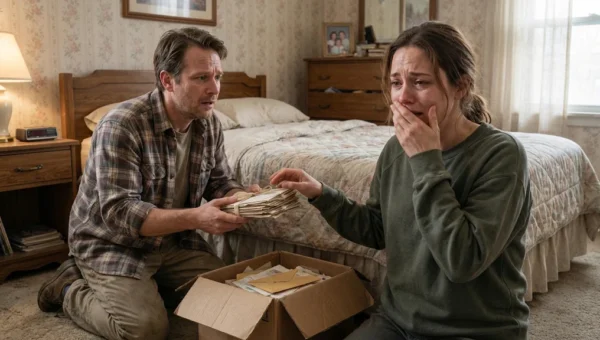
Michael stood up slowly. He was a big man, broad-shouldered from years of depot work, but he looked smaller right then, like someone had pulled the floor out from under his boots. He walked past Barbara without looking at her, walked down the hallway into our bedroom, and came back twenty seconds later holding the envelope I had laid on top of the dresser.
He pulled out the tri-fold legal documents. The room was so quiet you could hear the crinkling of the bond paper.
Michael read the first page. Then he flipped to the second page. His face lost every ounce of color. He looked at the bottom of the page where the transfer signature was dated. It was dated twelve days before his father slipped into a coma.
“This is Dad’s name,” Michael said, his voice barely audible. “That isn’t Dad’s handwriting. Dad couldn’t hold a pen by October.”
“Michael, please,” Barbara said, reaching for his arm. “You don’t understand the legalities. Taxes would have taken half of it. I did it to keep the money safe for when you needed it later.”
“You let me pay your electric bill,” Michael said, pulling his arm out of her reach. His voice was not angry yet; it was cracked open, hollowed out by disbelief. “I took night shifts at the yard last winter because you said you couldn’t afford heating oil. I missed our anniversary trip because I sent you two thousand dollars for your dental work.”
“I was going to give it back to you!” Barbara stammered, looking around the room for support. “Karen, tell him. Family sticks together. You don’t air dirty laundry in front of everyone.”
Karen took two steps back from her mother, shaking her head. “You took Dad’s money. Dad told me before he died that we wouldn’t have to worry about our kids’ college tuition. When you said there was nothing left, I thought he had been confused from the medication. You lied to us.”
Michael’s cousins began quietly gathering their coats from the front closet. Nobody asked for another piece of Barbara’s bakery cake. Within five minutes, the guests were slipping out the front door, muttering apologies and casting uncomfortable glances at the floor.
Barbara stood alone by the ruined buffet table, her fingers digging into the strap of her handbag.
“You ruined this family, Linda,” Barbara hissed, glaring at me with raw venom. “You planned this. You waited until today just to tear us down.”
“No, Barbara,” I told her, meeting her gaze squarely. “I waited three years because every time I tried to talk to Michael in private, he couldn’t bear to doubt you. You made him believe he was a bad son if he didn’t sacrifice for you. Today, you brought that cake in here to humiliate me one more time in front of his family. You wanted to prove that even on his fiftieth birthday, you were the only one who mattered. I just gave you the floor.”
ENDING
Barbara left our house that evening without another word. She slammed the front door so hard the glass pane rattled in the frame.
The cleanup took hours. Michael did not eat either cake. He sat at the kitchen table with the papers spread out under the overhead light, reading through every bank transfer, every notarized document, and every check stub Arthur Vance’s office had provided. He did not say much that night, but for the first time in fifteen years, he did not tell me I was being sensitive. He did not defend her.
On Monday morning, Michael took a personal day from work. He and Karen drove over to Arthur Vance’s successor at the firm in town. The lawyer confirmed what the documents showed: the transfer had been executed under a questionable power of attorney while Walter was incompetent, and the funds had been moved into a private account Barbara used to purchase a rental townhouse two towns over, collecting twelve hundred dollars a month in rent that she kept entirely for herself.
Karen and Michael retained counsel that afternoon. They did not file criminal charges, but they gave Barbara a clear legal choice: either transfer the deed of the rental townhouse into their joint names and repay the twenty-one thousand dollars Michael had given her in monthly stipends over the previous three years, or they would petition the probate court to freeze her assets and investigate the transfer for elder financial abuse.
Barbara fought it for two months through her own attorney, calling Michael repeatedly, leaving voicemail messages accusing him of being an ungrateful son who let his wife poison his mind. But Michael did not back down. For the first time in his life, he saw his mother clearly, not as the fragile widow she claimed to be, but as a calculating woman who had exploited her own children’s love to line her pockets.
She signed the settlement agreement the first week of November. The townhouse was sold, the funds were split evenly between Michael and Karen, and Barbara’s monthly check from Michael stopped immediately.
We do not see Barbara anymore. She spends holidays with an out-of-state sister, telling anyone who will listen that her children abandoned her over a misunderstanding. Michael still carries a deep sadness about his father, but the heavy, nervous tension in our home is gone.
On Sunday evenings now, the kitchen is quiet. Michael comes in while I cook, sets the table without being asked, and sits down across from me. He knows what real loyalty looks like now, and it did not come from the woman who spent fifteen years trying to make me feel small.