PART 1
Maya was eight years old when I married her father, Richard. For the first few years, we were genuinely close. During summer thunderstorms in Ohio, she used to run across the hall in her flannel pajamas and climb right into my lap on the recliner, burying her face under my chin until the rumbling passed. I helped her with spelling words, braided her hair for school pictures, and packed notes in her lunchbox.
Then she turned thirteen, and everything shifted.
The warmth evaporated almost overnight. She started pulling away, keeping her bedroom door shut and answering my questions with one-word shrugs. Whenever Richard and I sat down for dinner, Maya would ask to eat in her room. When I tried to plan our annual family beach trip to North Carolina, she flatly refused to go, claiming she had too much track practice or that she hated long car rides.
Richard always stepped in with an easy explanation. He would pat my hand at the kitchen table and tell me to let it go. “She’s just a teenager, Claire,” he insisted year after year. “Girls push their stepmoms away. It’s totally normal. Give her space. If you keep pushing, you’ll only drive her further into her shell.”
So I backed off. I told myself I was being respectful. Over the next five years, I stopped inviting her on weekend outings.
I stopped knocking on her closed bedroom door to ask how her day went. I gave her room to breathe, quietly hurting on the other side of the house while Richard seemed to manage their private relationship without any trouble at all.
Her biological mother, Evelyn, had vanished from the picture right around the time Maya turned nine. Evelyn struggled with stability, and according to Richard, she simply decided she could not handle being a parent anymore. Richard told me that Evelyn had signed away her visitation rights, moved out of state, and asked never to be contacted again so Maya could have a clean slate. I felt terrible for Maya back then, but Richard warned me never to bring Evelyn up. He said digging into the wound would only cause Maya more pain.
Last month, Maya packed her bags for college. Richard was down at the local auto shop getting the front tires replaced on his truck so we could drive her down to the dorms the next morning.
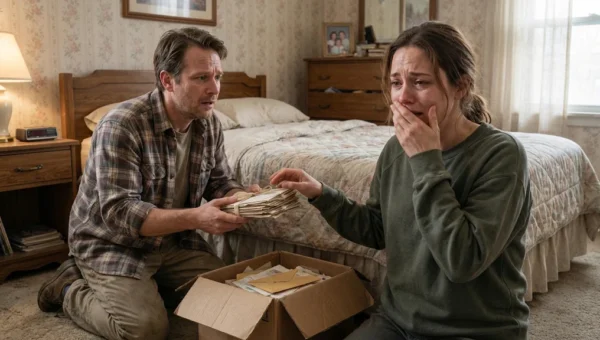
Maya came into my bedroom carrying an old, taped-up shoebox. Her hands were shaking, and her eyes were rimmed in red.
“I couldn’t say this in front of Dad,” she whispered, setting the box down gently on my floral quilt. “I never could.”
Before I could ask what she meant, she turned around and walked briskly back down the hallway to her room.
I sat on the edge of the mattress and pulled the lid off. Inside lay twenty-four birthday cards, organized chronologically with worn rubber bands. One for every year of her life, and several from the years she had known me. Some were store-bought Hallmark cards with pre-printed rhymes, completely blank inside without a single signature. Others had handwriting inside that did not belong to Richard.
I picked up a card from her tenth birthday. On the back, written in blue ballpoint ink near the barcode, was a handwritten date: August 14th.
My breath caught. August 14th was the exact day Evelyn stopped visiting our house seven years ago.
Underneath the date, in trembling cursive that matched the handwriting inside the card, was a short sentence: “Richard made me promise to leave these with him for you. He said you asked him to make me stay away.”
PART 2
I sat frozen on the bed, staring at those words. My hands turned ice cold.
I began opening every single card in the stack. There were eight cards written in Evelyn’s handwriting, covering birthdays nine through sixteen. Every one of them was addressed to Maya with heartfelt messages, recounting small memories of Maya’s early childhood, sending love, and asking how school was going. None of them had postmarks because they had never been mailed through the post office. They were handed directly to someone.
Tucked behind the sixteenth birthday card was a folded piece of lined notebook paper. It was written in Maya’s teenage handwriting, dated three years ago.
“Dad told me when I was nine that Claire gave him an ultimatum,” the note read. “He said Claire wouldn’t stay married to him if Mom kept coming around, and that Mom agreed to stop visiting so Dad could keep his new family together. He told me Claire threw Mom’s cards in the trash every year, but he saved a few in the garage workshop so I would know Mom tried. He made me swear never to bring it up to Claire because Claire would leave us both.”
A sickening rush of nausea hit me.
For seven years, I had believed Evelyn walked out of her daughter’s life out of sheer selfishness. For seven years, Maya had believed I was the cruel stepmother who forced her real mother out and tossed her birthday cards in the garbage. Richard had orchestrated the entire divide. He had manufactured my distance and fed Maya’s resentment, using each of us as a shield against the other while playing the martyr in the middle.
I grabbed the box and walked straight into Maya’s bedroom. She was folding a pile of jeans, her back to the door.
“Maya,” I said, my voice shaking so hard I could barely form the syllables.
She turned around, defensive, crossing her arms over her chest. “You looked at it.”
“I did,” I said, stepping into the room and closing the door behind me. “Maya, I swear on everything I have ever loved, I never told your mother to stay away. I never saw these cards until five minutes ago. I never asked your father for an ultimatum. He told me your mother walked away and signed papers giving up visitation.”
Maya scoffed, her eyes filling with angry tears. “Right. That’s what you’d say now. Dad kept those in his toolbox out in the garage for years. He showed them to me when I was twelve because I was crying about Mom on my birthday.”
“Come look at my desk right now,” I said firmly.
I led her into my home office where I kept our family records. I pulled out my personal filing cabinet, where I keep twenty years of household financial records and calendars. I pulled out my old pocket day planners from 2019 and 2020. In the margins, in my own handwriting, were notes from seven years ago: “Richard meeting Evelyn at diner to discuss Maya’s schedule.” “Evelyn didn’t show.” “Richard said Evelyn called, moving to Arizona, wants no contact.”
Then I pulled open the top drawer of the desk and showed her the joint checkbook register from that same year.
There was a carbon copy of a check written to an attorney’s office for fifteen hundred dollars, dated two days before August 14th, with Richard’s signature. The memo line read: “Custody modification filing.”
Maya stared at the desk. Her breath hitched. “Dad said there were no lawyers. He said you guys couldn’t afford to fight her, so you just made a deal behind closed doors.”
“We had savings,” I told her, looking right into her eyes. “I never saw that check copy until tax time that year, and Richard told me it was just for updating our wills. Maya, look at me. Did I ever once treat you like I wanted your mother erased?”
Maya looked down at the desk, her lips trembling. “You stopped coming to my track meets. You stopped talking to me.”
“Because your father told me you hated me,” I said, tears finally spilling down my cheeks. “He told me you asked him why I was always in your business, and he begged me to leave you alone so you wouldn’t feel smothered. I thought I was protecting you.”
Maya collapsed onto the office chair, covering her face with her hands, letting out a sharp, ragged sob that sounded like the eight-year-old girl who used to hide from the thunder.
PART 3
We sat in that room for nearly two hours piecing together seven years of lies.
The picture became brutally clear. Richard had never wanted to share custody or pay the travel costs associated with Evelyn’s shared schedule. When Evelyn lost her job in 2019 and fell behind on her share of medical expenses, Richard used it as leverage. He threatened her with legal action he knew she could not afford, telling her that if she did not step back voluntarily, he would drag her through court and ensure she was declared unfit.
To keep Evelyn from fighting back through family or mutual friends, he convinced her that I had deep financial resources and was pushing him to seek full custody. To keep Maya from asking questions, he told her I resented Evelyn. And to keep me from reaching out to Evelyn woman-to-woman, he told me Evelyn was unstable and had explicitly warned him that if I contacted her, she would cause a scene that would traumatize Maya.
He had isolated all three of us in separate rooms of the same burning house.
While Maya and I were sitting on the office floor, we heard Richard’s truck pull into the gravel driveway. The front door opened, followed by the heavy thud of his work boots in the entryway.
“Claire? Maya? Truck’s ready to go. Got a fresh spare mounted on the back,” his voice echoed down the hall, hearty and cheerful.
I looked at Maya. She was pale, her jaw set tight. She picked up the shoebox from the desk and walked down the hallway first. I followed right behind her.
Richard was in the kitchen, pouring himself a glass of iced tea from the pitcher in the fridge. He turned around with a wide smile that instantly died when he saw our faces and the shoebox in Maya’s hands.
“What’s going on?” he asked, his voice dropping an octave. “You guys look like somebody died.”
Maya set the shoebox down on the granite counter right next to his glass.
“Why did you tell Mom that Claire wanted her gone?” Maya asked. Her voice was terrifyingly calm.
Richard blinked, his eyes darting from Maya to me, and then down to the box. The color drained from his face, replaced by a defensive flush along his neck.
“Maya, whatever you think you’re doing, this isn’t the time,” Richard said, waving his hand dismissively. “We’ve got to load the truck. You’re starting college tomorrow. Let’s not bring up old family drama.”
“It’s not old drama, Richard,” I said, stepping up beside Maya. “I read the cards. I saw the notes. You told our daughter that I threw her mother’s birthday cards in the trash. You told me Evelyn abandoned her. You told Evelyn I was forcing you to push her out.”
Richard set his glass down hard on the counter, splashing tea onto the stone. “You don’t understand the situation back then, Claire. Evelyn was a mess. She was going to drag Maya through hell. I had to protect this family. I had to create stability for Maya, and you were giving her that. I did what a father had to do.”
“You lied to me for seven years!” Maya yelled, her voice breaking into a scream. “You made me hate Claire! I spent my entire high school life thinking the woman living in my house hated my mother and resented me! You let me sit alone in my room for five years thinking nobody wanted me around!”
“I protected you!” Richard shouted back, his face darkening with rage. “You had a good life! You had food on the table, a nice house, and you got into college! Evelyn couldn’t even pay her rent back then! If I hadn’t pushed her out, your childhood would have been chaos!”
“You didn’t protect me from chaos,” Maya said, her voice dropping to a harsh whisper. “You just made sure you were the only one who got to control me.”
ENDING
That night, Richard did not drive Maya to college.
I rented a twelve-foot cargo van from the depot on the edge of town using my own credit card. Maya and I spent until two in the morning carrying her boxes, her clothes, and her desk lamp out to the driveway while Richard locked himself in the den, refusing to come out or help.
The next morning, Maya and I drove five hours south together. We barely listened to the radio. For the first two hours, we drove in complete silence, but by the time we hit the state line, Maya started talking. Really talking. She told me about the track meets I had missed, about the boy she had liked in tenth grade who broke her heart, and about how terrifying it was to think about living on her own.
I listened to every single word. I did not offer unasked advice, and I did not make excuses for the lost years. I just let her speak, apologizing whenever the weight of my own past blindness became too heavy to hold in silence.
Before we arrived at her campus, Maya asked me to pull over at a roadside rest stop. She took out her phone and searched through an old email thread she had kept hidden on a secondary account since she was fifteen. It was an email address for Evelyn’s sister, her Aunt Sarah.
Maya dialed the number on speakerphone. When Sarah answered, Maya asked for her mother’s current number.
Twenty minutes later, Maya was standing near a picnic bench by the tree line, talking to Evelyn for the first time in seven years. I stayed in the van, watching her through the windshield. I watched her shoulders drop, watched her wipe away tears, and saw her nod repeatedly as words crossed seven years of silence.
When Maya got back into the passenger seat, she didn’t say much about what was said, but she reached across the console and took my hand. She held it tight, the exact same way she used to hold my fingers when the thunder rattled the windowpanes in Ohio.
“Mom wants to meet me for lunch next weekend,” Maya said quietly. “She asked if you’d be okay coming with me.”
“I’ll be there,” I said.
Three days after I returned home from moving Maya into her dorm, I had Richard served with divorce papers at his office.
He tried to call me forty times that evening. He left voicemail after voicemail claiming he had only done what any devoted husband and father would do to keep a home intact. He called me ungrateful. He accused me of letting a teenager’s emotional outburst destroy twenty years of adult partnership.
I never answered the phone.
I packed two suitcases, took my legal documents from the desk, and moved into an extended-stay apartment downtown while my lawyer initiated the sale of the house. Walking away from a twenty-year marriage at fifty-six years old was terrifying, but living in a house built entirely on manufactured cruelty was something I could never do again.
Yesterday afternoon, my phone buzzed with a text from an unsaved number. It was an address for a small diner halfway between Maya’s campus and Evelyn’s town in Indiana, along with a short message:
“Thank you for keeping her safe. See you Saturday at noon. — Evelyn”
I have lost seven years of my daughter’s childhood to a lie I never knew existed. But as I look at that address on my screen, I know the next chapter will be built on the truth.