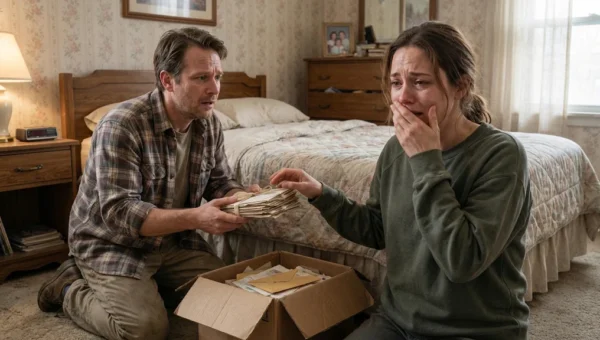
Detective Vance texted at 6:12 on a Tuesday morning: “Don’t go to that address alone.” I had spent the day before trying to clean an old mirror I bought at a flea market for $80. I knew the address from the last Polaroid. I didn’t know why Vance knew it too, or why he was scared enough to text me before sunrise.
I was forty-one. My sister Joanie had been eighteen when she disappeared in 1999. I was fourteen, old enough to know something was wrong and young enough to believe the adults would fix it. They never did. For twenty-seven years, our family had to live with the word missing.
The mirror was sitting on my apartment floor because I’d brought it home myself. It was too heavy for one person, but I didn’t want to leave it behind. The seller said it came from a house cleanout and didn’t know much else. I liked the plain wooden frame. Joanie had one like it in her room when we were kids.
I was wiping dust from the glass when I noticed a narrow gap along the back. It looked like a bad repair. I almost left it alone. Then I remembered how our old dresser used to catch on loose nails, and I went looking for a flat screwdriver.
The backing gave with a small crack. A stack of Polaroids slid onto the floor.
There were a lot. More than twenty, I think. Each showed a young woman asleep in a bed. I recognized the floral wallpaper before I recognized her. Pink flowers with tiny blue centers. My childhood bedroom.
The woman was Joanie.
I sat down hard on the floor. One picture had the date June 18, 1998, written on the white border. Another said July 3. In every shot, the camera looked out from the closet. I could see the edge of the closet door in one. Whoever took them had been standing inside our house while my sister slept.
I didn’t call my parents first. My mother died years ago, and my father’s memory had gone in and out before he died. I put the pictures between two pieces of cardboard, wrapped them in a dish towel, and drove to the precinct.
I knew Detective Vance was retired, but I still had his number from the last time I asked about Joanie’s case.
He met me in a small office at the station. His hair was almost all white now. He took one Polaroid, then another.
“Where did you get these?”
“Inside a mirror.”
He looked at the dates again. Then he checked the back of one, like he expected another answer there. His hands didn’t shake. His mouth did.
I’d seen Vance at our kitchen table in 1999, asking my father about Joanie’s friends. He was not a cruel man. He was also not a careful enough one. At the time, he said the bedroom showed no sign of a break-in. He said Joanie may have left on her own.
Now he was looking at pictures taken from inside the closet.
“You knew the room,” I said.
“I knew the house.”
“Then how did you miss this?”
He set the Polaroid down. “I missed more than I should have.”
That was not an answer, but it was the first honest thing I’d heard from him.
He pulled the old case file from storage. The paper had a dry, dusty smell I still connect with the school library.
I watched him turn through the forms and photographs. The first search notes said there had been no forced entry. A latch window near the back hall had been checked from outside. Nobody had written down whether it was locked.
Vance looked at the new pictures again and studied the camera angle.
“This closet backs onto the side hall,” he said. “There was a window there.”
“Could somebody get in?”
“Yes.”
I could hear my own voice going sharp. “So the old search was wrong.”
He didn’t argue. He took a slow breath and said the department had been short-staffed that summer. There had been pressure to clear out open files. He said he had thought Joanie left because she wanted to. He said he was sorry.
I didn’t tell him it was fine. It wasn’t. I also knew I was asking a man to fix something he’d failed to fix twenty-seven years ago, and I wanted him to do it anyway.
He turned over the last photo.
There was an address in black marker: 14 Quarry Lane.
Vance stopped moving. I saw him recognize it before he spoke.
“Who lived there?” I asked.
“Cal Rusk. He rented the room over our detached garage that summer.”
I knew the name. Cal had been nineteen, a friend of our father’s who did odd jobs around the house. He’d carried bags of mulch and fixed a sticking door. I remembered him laughing at our kitchen table. I had not thought of him in years.
“Did you search his room?”
Vance looked down at the file. “No.”
The words sat between us. That was the place the address had been waiting to point to. The place someone should have checked.
Vance called the department from his office. He didn’t make a big speech. He gave them the dates, the photos, and Cal’s name. The cold case was reopened that afternoon. Before we went anywhere, the police got a warrant. I asked to come along.
“You don’t have to,” Vance said.
“I know.”
The address led to an old workshop behind a house on Quarry Lane. Cal was seventy-six and still living nearby. Police found him in the workshop, sorting small tools into a metal drawer. He looked at the Polaroids in my hands, and his shoulders dropped.
I held up the picture of Joanie asleep.
“Did you take these?”
He didn’t answer right away. Detective Vance stepped between us, not to keep me from seeing, but to keep me from getting close.
Cal rubbed his thumb along the drawer handle. “I was stupid.”
“That isn’t what I asked.”
“Yes,” he said. “I took them.”
He’d had a key. He told the officers he used it to get into the house at night. He said Joanie found out and told him she was going to tell our parents. I wanted him to say he was sorry. He didn’t. He said, “I panicked,” like that word could cover what came after.
The detectives searched the workshop. Under a loose section of floor, they found a small box with Joanie’s class ring and a piece of her jacket. They also found a notebook with dates and short entries about when he’d gone into our house. The last pages were from the week she disappeared.
Cal finally told them what he had done. He took Joanie from the house that night, killed her, and buried her beneath the workshop. Police found her remains after he showed them where to dig. DNA confirmed it.
I had spent years imagining every possible reason she might have left. I had made myself mad at her for not calling. I had defended her to people who said she’d run away, then gone home and wondered if they were right.
She had been in our house. Somebody had been watching her there. She’d tried to stop him.
Cal was arrested. The case was charged as kidnapping and murder. Vance gave a statement about the original investigation and the missed search. He didn’t ask me to forgive him. Months later, Cal pleaded guilty. The case file was corrected, and Joanie was no longer listed as a missing person.
After the police finished with the mirror, I took it to my dining table and removed the glass and the backing. The photos were evidence now. The wooden frame was empty.
I remembered Joanie leaving a snack on my bed before school when I was little, usually a peanut butter cracker wrapped in a paper napkin. She did it without saying anything. I used to think she was just trying to get rid of the extras from her lunch. I didn’t understand until much later that she knew I was too embarrassed to ask for food when I forgot mine.
I don’t know what she meant to do with the address. I know she wrote it herself. I know the last picture was hidden where I might find it, and I know she had once made sure I wouldn’t go hungry at school. That was the part that stayed with me when all the official words were finished.
The empty wooden frame sat on my clean table, catching the clear afternoon light.