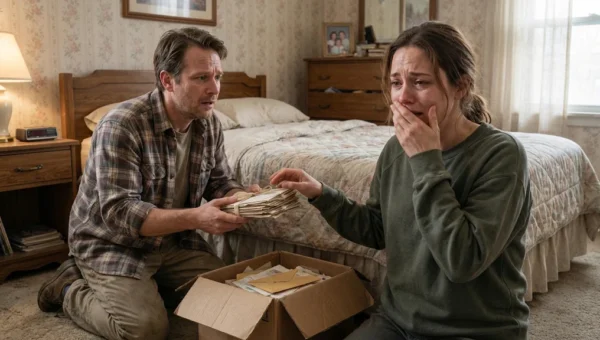
I thought getting sober would be the same as coming back to my daughter. I was wrong. The morning after my wife took our kids, I found a crayon drawing on my pillow, and I couldn’t make myself pick it up.
The night before, Lucy had said, “Daddy, you smell like the bad place again.” She was seven. I told her I was tired and went to the kitchen for another drink.
I said that kind of thing a lot. I thought I was keeping the ugly parts away from the kids by not yelling. That was how I made excuses for being there without really being there.
I was supposed to pick Lucy up after school that rainy night. I forgot. I didn’t forget the time by a few minutes. I got drunk at home and lost the whole afternoon. Lucy waited four hours on a stranger’s porch after the school staff got someone nearby to take her in. Ruth, my wife, was the one who found her. She came home with the kids, packed what they needed, and left.
I woke up alone. The house had that sour smell from old beer cans and wet coats, and I could hear the refrigerator humming. Ruth had taken the kids’ toothbrushes and their shoes by the door. She’d left my work boots. I don’t know why I noticed that.
Then I saw the drawing.
Lucy had drawn herself and her little brother, Owen, holding hands. They were bright red, yellow, and blue. I was off to one side, colored gray. Not a little gray line for my shirt. All of me. I sat on the bed with the paper in my hands. I kept looking at that part.
I went to the kitchen and poured every bottle down the sink. I didn’t get some big rush of courage. My hands were shaking, and the whiskey smelled sweet when it hit the drain. I called the number for county detox because I knew quitting cold at home could be dangerous. I spent the next few days there, mad at everybody and mostly mad at myself.
Ruth answered when I called. I said, “I’m going to stop drinking.”
She said, “You need help, not promises.”
“You’re right.”
I wanted to tell her I loved the kids. Like that was new information.
I wanted her to come back and say we could work it out. She didn’t. She said the kids were safe, and she needed space. I didn’t argue. I had used up my share of being believed.
After detox, I went to meetings in a church basement where the folding chairs pinched the backs of my legs. I hated saying my name and admitting I was an alcoholic. I hated it less than the thought of another morning like that one. A man named Art gave me his number and told me to call before I picked up a drink, not after.
The first weeks were mostly work, meetings, and trying to sleep. I got a job stocking parts at a farm supply place. The pay was lower than the railroad job I’d lost, but the manager gave me regular hours. I kept a little card with meeting times in my wallet. It got soft around the edges from me carrying it everywhere.
At night, when the house went quiet, I wanted a drink so badly I could taste it. I’d call Art and say, “I’m thinking about it.”
He’d say, “Then stay on the phone.”
Sometimes we talked about nothing useful until the feeling passed. Sometimes I got through the night and felt no better in the morning. I kept going anyway. That was the whole job. One shift at a time.
Ruth and I started talking about the separation paperwork after a few weeks. I didn’t like seeing my name beside the word separated. I didn’t like paying support when I was still trying to catch up on rent. None of that meant Ruth was wrong to protect the kids. I knew it. I also knew I could make a person tired just by explaining myself.
At three months, she agreed to meet me with the kids at a park. One hour. She stayed the whole time.
I got there twenty minutes early and sat in my truck until I saw them. I worried that arriving early would look like I was trying too hard, which was ridiculous. Then I worried that walking toward them would scare them. So I waited until Ruth waved.
Lucy stayed close to her mother. Owen kept looking at the gravel. I had brought a ball, but I couldn’t tell if they wanted it. I held it against my leg like an idiot.
“Hi, Lucy,” I said.
“Hi.”
I asked about school. She said, “It’s okay.” I asked if she still liked drawing. She shrugged. Ruth watched me, but she didn’t jump in to fill the gaps. The silence felt earned. I wasn’t owed a happy afternoon because I had managed three months without drinking.
When the hour was up, I said, “Thanks for letting me see them.”
Ruth said, “Be on time next week.”
“I will.”
I was. The next visit was at the park again. Then we had a short visit at a library. Ruth stayed nearby. She checked my meeting attendance and talked to Art once. I didn’t love the feeling of being watched, but I didn’t complain. I had given her good reason not to trust me.
At six months, Owen saw me in the parking lot and ran over before Ruth could get his coat zipped. He grabbed my hand and started telling me about a toy truck. I wanted to pick him up. I asked first.
He nodded, so I lifted him. He was heavier than I remembered. Or maybe I had just missed enough days that my arms weren’t used to him anymore.
Lucy watched us. Then she walked over and said, “Can we go see the ducks?”
That was all. I said yes, and we went.
I kept that moment to myself. I didn’t call Ruth later and say, “See, he’s fine with me.” I had learned that a good visit wasn’t a receipt I could wave around. Lucy and Owen were allowed to feel good one day and scared the next. I was the one who had to keep being steady.
There was a bad patch around month eight. I had a school event on my calendar and mixed up the time. I got there after the class had finished showing their projects. Ruth was standing by the door with Lucy’s coat. Lucy was holding a paper plate with a piece of cake on it.
She looked at me and said, “You missed it.”
“I did. I’m sorry.”
Ruth didn’t yell. That made it worse. “This is why I need you to check the time twice.”
“I will.”
I wanted to say I hadn’t been drinking, that I had the wrong time written down, that it wasn’t the same thing. But it didn’t matter to Lucy. I had made her wait before. Now I had missed something she wanted me to see. So I shut up and listened.
I put every visit and school event in my phone after that. I set two alarms. I asked Ruth to text me the night before, even though it embarrassed me. I wasn’t going to turn a basic reminder into some grand test of my progress.
By month nine, Ruth let the kids stay with me for longer stretches. She came by once to check the place and make sure I had beds and food. I had beds. I had food. I also had a clean sink, which shouldn’t have mattered, but I wanted her to see I could manage an ordinary house.
She didn’t move back in. We still had separate homes and legal separation papers. That part stayed hard. But she began sitting with us for dinner sometimes. We talked about the kids’ school, the car, bills. Not us. Not yet.
One evening, after the kids were in the other room, Ruth said, “I can see you’ve kept at it.”
I didn’t say, “I told you.” I hadn’t told her anything she could rely on.
She added, “They need this to keep being true.”
“I know.”
I wanted to ask if she thought we’d be a family again. I wanted an answer that would stop the ache in my chest. Instead, I let the question stay where it was. I couldn’t make my recovery a bargain she had to accept.
At the one-year mark, Lucy was eight. The kids were at my place, and Ruth had stayed for dinner. She was in the kitchen, rinsing plates, while Owen and Lucy were in the next room laughing about something I couldn’t quite hear.
Lucy came to the table with a drawing. She set it in front of me, then kept one finger on the corner, like she wasn’t sure I was allowed to touch it yet.
I saw the colors first. Red, yellow, blue, green. Owen was there. Lucy was there. I was there too, in the middle this time. She’d colored my shirt orange and my pants blue. My face was a little lopsided. She’d used green on one side of my hair.
I didn’t ask why she had drawn it. I was afraid I’d make the answer about me.
She looked up and said, “Because you’re you again, Daddy.”
I held the picture by the edges. My fingers were still rough from work, and I was careful not to smudge the marker. Ruth was at the sink. The kids laughed in the next room. Sunlight caught the bright strokes on the kitchen table.