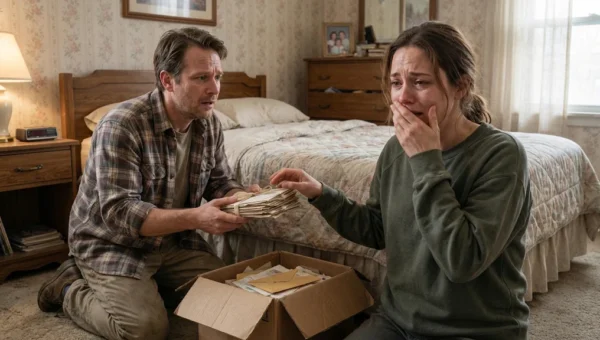
PART 1
My daughter-in-law moved into my home, and before her first day was even over, she pointed toward the backyard and shouted, “This house belongs to me now! Take your dinner outside and eat with your friend!” She looked so pleased with herself, convinced she’d finally put me in my place. I didn’t argue or shed a single tear.
Instead, I smiled, reached for the telephone, and made one call. Moments later, the confidence on her face disappeared completely.
The aroma of slow-cooked beef stew, fresh rosemary, homemade bread, and burning candles still filled my dining room when Linda decided to announce her new authority. Dylan froze with his spoon suspended in the air. Sarah immediately stopped laughing, and my son, Edward, suddenly became fascinated with the food on his plate. Linda extended one finger toward the rear entrance, treating me as though I were an unwanted employee she had every right to dismiss.
I was sixty-eight, standing in the same brick house in Chicago that my beloved late husband, Anthony, and I had worked nearly our entire lives to afford. We were both teachers, and buying that house had required years of careful budgeting and countless sacrifices. We collected grocery coupons, passed up family vacations, and continued driving our unreliable secondhand car long after we could have justified replacing it.
We endured four additional Chicago winters with that old vehicle because every dollar we saved brought us closer to financial security. Eventually, we paid the mortgage in full. The property taxes were registered under my name, and every legal document confirmed that the home belonged to me. Edward had never owned a single portion of it. And Linda certainly hadn’t.
Yet I had welcomed them without hesitation when my son telephoned me at precisely 10:42 on a Tuesday morning. His voice sounded defeated as he explained that he’d lost his job. I could hear the embarrassment in every word. Before he could even ask whether his family could stay with me, I offered. I shared the security code for the front entrance, prepared the spare bedroom, and filled the kitchen cupboards with Dylan’s favorite treats. I assured Edward that paying rent was the last thing he needed to think about.
He could focus on finding another position and getting back on his feet. That was what family was supposed to do for one another.
On their first evening, I wanted everyone to feel comfortable and welcome. So I prepared the hearty beef stew Edward had loved since childhood, the same meal he used to request whenever he came home exhausted from soccer training. I baked bread, cut it into thick slices, arranged two candles in the center of the dining table, and brought out the beautiful china Anthony and I had received on our wedding day. I had imagined a peaceful family dinner. Perhaps we’d talk about Edward’s next steps, reassure the children, and remind everyone that difficult circumstances didn’t have to last forever.
Unfortunately, Linda had developed an entirely different vision for our living arrangement. By the middle of that afternoon, she’d already begun inspecting my house as though she were evaluating a property she’d recently purchased.
First, she complained that the guest bedroom wasn’t spacious enough. Then she criticized the lighting in the upstairs bathroom. Next came the closets, which she declared completely inadequate for her belongings. I listened patiently, believing she was simply frustrated by the sudden disruption to their lives. But then she informed me that she and Edward would be taking my bedroom instead. According to Linda, giving them the largest room was simply the most practical arrangement. I looked directly at her and refused. She responded with a pleasant little smile, the kind someone gives when they believe an objection is merely a temporary inconvenience. I should have recognized that expression for what it was.
Later that evening, once everyone had gathered around the dining table and begun eating, Linda carefully placed both hands beside her dinner plate. She straightened her posture and surveyed the room before speaking. “Since we’re all living together now, I want everyone to understand something,” she announced. “I’m the person running this household from now on.”
Edward shifted uncomfortably but kept his gaze lowered. He didn’t challenge her. He didn’t even look in my direction.
Then Linda turned toward me and gestured at the back door. “You can take your food outside and eat with your friend. This is my house now.”
For several seconds, nobody spoke. The disrespect was painful enough, but what truly broke my heart was watching my own son sit there without defending me. Edward knew what that house meant to me. He knew how hard his father and I had worked to purchase it. He knew every room contained memories of the life Anthony and I had built together. Yet when his wife attempted to banish me from my own dining room, he simply stared at his plate.
For years, I had convinced myself that tolerating Linda’s behavior was the best way to preserve our family relationships. When she made insulting remarks during holiday gatherings, I ignored them. When she complained about our plans, I rearranged everything to accommodate her. Whenever disagreements arose, I was usually the first to apologize, even when I’d done nothing wrong. I told myself that making small sacrifices was preferable to putting Edward in an uncomfortable position between his mother and his wife.
But sitting at that table, listening to Linda claim ownership of everything Anthony and I had spent decades building, I realized something important. Avoiding conflict wasn’t the same as maintaining harmony. And allowing someone to mistreat me wasn’t an act of love. It was surrender.
I glanced at my son one final time. I could have reminded him about the countless mornings I’d prepared his school lunches before rushing to my own classroom. I could have mentioned every forgotten permission form I’d delivered, every sleepless night I’d spent worrying about him, and every soccer match I’d attended in freezing rain while Anthony worked late. I could have explained how painful it was to see the child I’d raised remain silent while someone humiliated his mother. But I decided against it. There was nothing left to explain.
I didn’t shout at Linda or demand that she apologize. I didn’t slam my hands against the table or threaten to throw anyone out. Instead, I gave her a calm, almost cheerful smile. Then, at exactly 6:48 that evening, I quietly slid my chair backward, stood, and walked into the kitchen.
The old telephone was still mounted on the wall. I picked up the receiver and began dialing. From the dining room, I could see Linda reclining comfortably in her chair, wearing the satisfied expression of someone who believed she’d just won an important battle. She probably assumed I was contacting a neighbor to ask whether I could eat my dinner at their place.
Edward, however, seemed to sense that something was different. He finally raised his head. “Mom? Who are you calling?”
I didn’t answer him. I simply finished dialing a telephone number I’d kept safely stored for several years.
The person on the other end picked up after the second ring. “Hello?”
“Gabriella,” I said in a steady voice, looking directly toward my daughter-in-law. “It’s time. I’m ready.”
Linda’s smug smile immediately began to fade. She sat forward, suddenly paying close attention.
Then Gabriella asked me a single question over the phone. I answered with one simple word. “Yes.”
And that was all it took. Edward shot up from his seat so abruptly that his chair dragged loudly across the hardwood floor. For the first time that evening, my son looked genuinely frightened. Linda stared at him, clearly unable to understand what had just happened. She had entered my home believing she could take everything from me. What she didn’t realize was that Anthony and I had prepared for something like this long before he passed away. And the woman I’d just called knew exactly what needed to happen next.
PART 2
Edward dropped his fork onto his plate with a sharp clatter. “Mom, please tell me you didn’t just call Gabriella Ramos.”
“Who on earth is Gabriella?” Linda demanded, looking between us. She crossed her arms, still trying to sound like the person in charge. “Edward, sit down. Don’t let her play mind games in our house.”
“Linda, shut up,” Edward said. His voice was barely above a whisper, but the panic in it was real.
“Don’t you dare talk to me like that!” Linda snapped. “She is an old woman on a fixed pension, and you are the only heir to this property. I saw the papers in your drawer last year. You told me this place was practically yours already!”
I hung up the kitchen receiver and stepped back into the dining room. I didn’t raise my voice. I looked at my twelve-year-old grandson, Dylan, and my nine-year-old granddaughter, Sarah. Both of them had stopped eating. Dylan had his arm tucked quietly around his little sister’s shoulders.
“Dylan,” I said gently. “Would you take Sarah upstairs to the sitting room? There are fresh chocolate chip cookies in the tin by the bookcase, and you can turn on the television.”
Dylan nodded immediately. He was an observant kid, and he knew something ugly was happening. He took Sarah’s hand, helped her out of her chair, and guided her toward the stairs without asking a single question.
Once the sound of their footsteps faded down the hall upstairs, the dining room felt suffocatingly quiet.
“What papers did you show your wife, Edward?” I asked, looking right at him.
Edward couldn’t meet my eyes. He stared down at the linen placemat, his hands trembling slightly. “Mom, that was before. We were struggling. When the boutique Linda wanted to start failed, we lost twenty-five thousand dollars of our savings, and then my firm laid off twelve people last month. We were three weeks away from an eviction notice on the rental. I had to tell her we had security somewhere.”
“You told her this house was your backup plan?” I asked.
“He told me the house was in your name only because of some old tax arrangement,” Linda interrupted, her voice rising in pitch. “He said you were leaving it entirely to him in your will. He told me that when we moved in, we were taking over the expenses, which meant we took over the property. I sold half our furniture, Martha! I gave up my lease! You can’t just call some lawyer friend to scare me out of my family’s future!”
“Gabriella Ramos isn’t just an estate attorney, Linda,” I said evenly. “She was Anthony’s first cousin. And she has managed our family trust since 2014.”
Linda gave a sharp, nervous laugh. “A trust doesn’t change anything. A son inherits from his parents. That is how the law works.”
“Not when the son already took his inheritance,” I replied.
Edward flinched as if I had struck him across the face. “Mom, don’t. You promised we would never bring that up again.”
“I promised I would never hold it over your head so long as you respected this family and lived an honest life,” I said. “I never promised I would let you hand my home over to someone who orders me into the backyard like a stray animal.”
Linda looked from me to Edward, her brow furrowed with sudden suspicion. “What is she talking about? What inheritance?”
Edward sank back into his chair, covering his face with both hands. He didn’t speak.
The truth had been buried for seven years. When Anthony became ill in the autumn of 2016, Edward came to us with an urgent plea. He was thirty-two, deep in credit card debt, and facing a potential lawsuit after a failed commercial partnership in Schaumburg. He wept at our kitchen table, the same table where we were now sitting. He begged his father for help, swearing that if we bailed him out, he would never ask for another cent.
Anthony and I had thirty-eight years of combined savings, along with a modest commercial bond Anthony had inherited from his own father. It was worth exactly one hundred and forty-five thousand dollars. It was supposed to fund Anthony’s private medical care and give us a comfortable cushion for the rest of our lives.
Anthony cashed in that bond. Every single penny of the $145,000 went directly to pay off Edward’s debts and keep him out of court.
Before Anthony went into surgery that November, he called Gabriella to his hospital bedside. He knew his son’s weaknesses better than I wanted to admit back then. Anthony had loved Edward fiercely, but he knew Edward was easily led, easily frightened, and prone to taking the easiest way out of hard situations.
Sitting in that hospital room, Anthony signed the final paperwork establishing the Anthony and Martha Vance Irrevocable Living Trust. Every legal right to the house on North Oakley Avenue was transferred into that trust. The deed was recorded with the Cook County Recorder of Deeds in December of 2016.
According to the trust agreement, the house belonged entirely to the trust. I was the sole lifetime trustee and beneficiary. Edward was not an heir to the property. Anthony had specifically inserted an advancement clause: the $145,000 Edward received in 2016 was formally designated as his full and complete accelerated share of the family estate. Upon my passing, ownership of the home did not go to Edward at all. It was deeded to go directly into an educational trust for Dylan and Sarah, with Gabriella serving as the independent successor trustee.
Edward had signed the acknowledgment himself in Gabriella’s downtown office. He had agreed to it in writing, signed before a notary public, in exchange for the cashier’s check that saved him from bankruptcy.
He had simply chosen never to tell his wife.
PART 3
“You signed what?” Linda’s voice cracked. She stood up, her face flushed with fury, staring down at Edward. “You told me you were getting a five-hundred-thousand-dollar house in Lincoln Square! You told me your mother was just holding the title until she moved into assisted living!”
“I panicked, Linda!” Edward yelled, finally looking up. “You kept telling me I was a failure because we couldn’t buy a home in the suburbs! Every day it was another complaint about how your sister’s husband bought a four-bedroom house in Naperville, while we were stuck renting an apartment! When I lost my job, you told me you were leaving and taking the kids if I didn’t have a plan! What was I supposed to tell you?”
“The truth,” I said quietly.
Both of them stopped shouting.
“You should have told her the truth seven years ago, Edward,” I continued, feeling a steady calm settle over me. “And you should have told her the truth this morning before you carried your suitcases through my front door.”
The doorbell rang.
It was exactly 7:15 PM.
I walked to the front foyer, opened the heavy oak door, and found Gabriella standing on the porch. She was sixty-five, wearing a charcoal wool coat and carrying a thick leather briefcase. She didn’t look like an imposing stranger; she was family. But when she worked, she was meticulous.
“Evening, Martha,” she said softly, stepping inside out of the chilly October wind. “Is everyone in the dining room?”
“They are,” I said.
Gabriella walked in, set her briefcase flat on the dining table right next to Linda’s half-eaten stew, and clicked open the brass latches. She didn’t offer a friendly greeting to Edward, and she didn’t introduce herself to Linda. She pulled out a clean manila folder containing certified copies of the 2016 Cook County deed, the trust declaration, and the signed advancement receipt bearing Edward’s signature.
She laid the documents on the table, side by side.
“Linda,” Gabriella said in a crisp, professional tone. “I understand you have been informing Martha that this property belongs to you. To ensure there is no legal misunderstanding that might require law enforcement intervention tonight, I want you to read lines four through eight on page twelve.”
Linda stared at the paper. She didn’t want to touch it, but her eyes scanned the bold black print: *The beneficiary, Edward Anthony Vance, acknowledges receipt of $145,000.00 as full and final distribution of his prospective interest…*
“This isn’t real,” Linda muttered, stepping backward. “You’re trying to push us onto the street. We have two children upstairs! You can’t just kick family out!”
“Nobody was kicking you out, Linda,” I said, walking over to the head of the table. “I opened this house to you. I bought groceries for your children. I spent all afternoon preparing a warm meal so your family would feel safe after a terrible week. All I asked for was basic human decency.”
“I was just stressed,” Linda said quickly, her arrogance collapsing into hurried excuses. “I had a headache from the move. People say things they don’t mean when they’re under pressure, Martha. You know how it is. It was just a joke about eating outside.”
“It wasn’t a joke,” I replied. “You looked me in the eyes and told me this house belonged to you. You treated me like a trespasser in the home I bled for.”
I looked over at Edward. He was crying now, silent tears running down his cheeks, looking less like a grown man of forty and more like the frightened boy who used to hide in his bedroom whenever he broke something valuable.
“Mom,” Edward choked out. “Please. Where are we supposed to go? I have four hundred dollars in my checking account. That’s all we have left.”
For a second, the old habit kicked in. That maternal instinct, the reflex that spent forty years shielding him from the consequences of his own bad choices, told me to soften. It told me to say it was all right, to tell them they could sleep in the guest room, to sweep this under the rug just to keep the peace.
Then I looked at the dining room chairs. I remembered Anthony working seventy hours a week when the school district froze teacher wages. I remembered wearing winter coats with frayed cuffs so Edward could have braces. And I remembered the absolute coldness in Linda’s voice when she pointed at that back door thirty minutes ago.
If I gave in now, I would spend the rest of my life walking on eggshells in my own home, waiting for them to find another way to strip away my dignity.
“You have until nine o’clock tomorrow morning to pack your personal belongings,” I told Edward.
Linda gasped. “Tomorrow morning? That’s impossible! We have nowhere to go!”
“You have a credit card with an available balance, Linda, because you bragged to me at three this afternoon about the new purse you ordered on it,” I said without anger. “You can stay at the budget motel near the expressway while Edward looks for work. And while you do that, you can figure out how you’re going to treat people who try to help you.”
“Edward, do something!” Linda shrieked, tugging at his arm. “Say something to her!”
Edward pulled his arm free from her grip. He looked up at me, his eyes swollen and red. He didn’t argue. For the first time in his life, he didn’t try to make an excuse.
“She’s right, Linda,” he whispered. “She’s completely right.”
ENDING
That night was the longest night of my life.
I didn’t sleep a wink. I sat downstairs in Anthony’s old leather armchair in the den, listening to the muffled sounds of drawers opening and suitcases zipping upstairs. Gabriella stayed with me until midnight, drinking black coffee at the kitchen counter, making sure there were no arguments or angry outbursts while they packed their clothes.
At eight in the morning, I heard small footsteps coming down the stairs.
I walked into the kitchen and found Dylan standing by the counter. He looked tired, his hair messy from sleep. He looked up at me with his grandfather’s dark, serious eyes.
“Are we leaving, Grandma?” he asked.
My heart tightened, but I kept my voice warm and steady. “Your mom and dad need to find their own place, sweetheart. But you and Sarah are always welcome here. Always.”
I made the two children scrambled eggs and buttered toast, just like I did every Saturday when they were little. Linda came down twenty minutes later, completely silent. She avoided looking at me, her eyes fixed on the floor as she carried her bags out to their car. The smugness that she had carried into my home the day before was entirely gone, replaced by a quiet, brooding embarrassment.
Before they loaded into the sedan, Edward came back up the front porch steps alone. He stood on the welcome mat, his hands shoved deep into his coat pockets. The cold morning air was sharp, smelling of damp fallen leaves and lake moisture.
“I’m sorry, Mom,” he said, his voice cracking. “I let her talk like that because I was ashamed. I thought if I pretended everything was fine, it would somehow become fine.”
“Ashamed of losing a job is one thing, Edward,” I told him. “Being ashamed doesn’t give you permission to let someone erase your parents.”
He swallowed hard and nodded. “I know. Can I… can I still call you?”
“When you have found a job and a place to live, you can call me,” I said. “And we will talk. But you are going to stand on your own two feet now, Edward. Your father and I gave you your start. We gave you your rescue. The rest has to come from you.”
He stepped forward, gave me a brief, trembling hug, and walked down the steps.
I stood on the porch and watched their silver sedan pull away from the curb and turn the corner onto Montrose Avenue.
When I stepped back inside, the house was completely still. The silence wasn’t lonely; it was peaceful. The dining room table was cleared. The candles from the night before were cold, their white wax hardened into clean, smooth pools.
I walked into the kitchen, picked up Anthony’s favorite ceramic mug, poured myself a fresh cup of coffee, and sat down at the table by the window. The morning sun was just beginning to hit the backyard garden, lighting up the yellow mums Anthony had planted along the fence the year before he died.
I was sixty-eight years old. I was alone in my house, and I still had bills to pay and winters to face. But as I took a sip of hot coffee, I knew one thing with absolute certainty: nobody was ever going to tell me to eat outside again.