Owen’s text was still on my phone when I pulled up at the stop sign.
“Why did you take the roast? Everyone’s waiting.”
I read it once, then put the phone facedown on the passenger seat. The roast was buckled in beside me, still warm under its foil. I remember that more clearly than the road home, which is probably because I’d put the seat belt around the pan like it was a person.
That text came after I’d been told there wasn’t a chair for me.
I’m Dorothy. I’m sixty-four, retired from the county records office, and I live in a paid-off adobe house near a little municipal airfield. The planes make a high whining sound when they circle to land. My kitchen window rattles a bit when the wind kicks up. Nothing fancy, but it’s mine.
For years, I thought being useful was how I stayed close to Owen. His father, Frank, left when Owen was nine. I raised him alone, and after he was grown, I wanted to make life easier where I could. I paid the family phone bill, kept Owen’s car on my insurance, and sent $400 each month to help with Maya. I didn’t ask for receipts. That felt mean to me.
I also cooked when they asked. So when Owen called on a Wednesday and asked for my apricot-glazed roast, I was glad.
“Christa’s parents are coming Sunday,” he said. “She told them you make the best one.”
I took that as an invitation to dinner. Maybe that was foolish. I pictured Maya telling me about school while I passed her potatoes. I even got out my little spiral notebook to keep track of what had to stay warm.
I cooked for two days. The roast, green chile potatoes, pear salad, cornbread dressing. I drove across town with everything packed into coolers and carriers. A training plane went over as I pulled into Owen and Christa’s driveway.
Christa opened the door before I knocked.
“Smells amazing,” she said, taking the cooler.
I relaxed. I did. I thought, good, this is going to be a nice afternoon.
The sunroom table was set for five. Owen, Christa, Maya, and Christa’s parents, Gerald and Elaine. Yellow flowers in the middle. A dessert cart at the far end. I counted the chairs twice.
“Should I bring in another one?” I asked.
“No, Dorothy. You don’t need one.”
I waited for her to laugh, or add something. She pointed toward the refrigerator.
“There’s food in there. You can eat after my parents leave.”
I remember the refrigerator door was open. I could see a half-empty tub of noodles and a plate with foil over it. I turned toward Owen. He had one hand on the blind cord. He looked at me, then down at the floor.
“Christa, I cooked the meal.”
“Yes, and we’re grateful. But you can have some later.”
The guests were laughing in the next room. Maya came in with napkins and stopped.
“You’re asking me to wait in the kitchen while everyone eats what I brought?”
Christa’s mouth tightened. “Please don’t make this uncomfortable. My parents are our guests.”
I had the chance to say something sharp. I wanted to. Instead, I looked at Owen again. He didn’t say a word.
That was the bad decision that started the rest of it. Not the roast. Owen’s silence. I’d spent years making excuses for him, telling myself he was tired, or trying to keep peace, or just not good at speaking up. I knew what silence could do to a room. I’d worked in records long enough to know what was there mattered more than what somebody wished had been there.
“Okay,” I said.
Christa turned back to the table, relieved. I packed the food back into the carriers. The roast was still hot, so I lifted it with a folded dish towel. Maya stood near the doorway.
“Grandma?”
“Have a nice dinner, sweetheart.”
“You’re leaving?”
“I am.”
Owen stepped away from the window. “Mom, ”
I turned, and he stopped there.
I carried the roast out to my car and buckled it into the passenger seat. I know it looked silly. It also felt less silly than leaving it on their counter so everyone could eat it while I waited in the kitchen.
Owen’s text came at the stop sign. He didn’t ask if I was all right. He asked about the roast.
At home I set the food on my own counter. The refrigerator hummed, and a small plane came in over the roofs. I sat at the kitchen table with my bank statements and the folder where I kept bills. The $400 transfer was there again. So was the phone bill. So was the insurance payment.
One item at a time, it had all seemed manageable. Together, it was a second household. I wasn’t sorry I’d helped them. I was sorry I’d treated help like proof that I belonged.
The next business day, I called the phone company and arranged to move Owen and Christa’s lines into their own account. I gave them notice. I called my insurance agent and set Owen’s policy to end at the renewal date, with the date sent to him in writing. Then I canceled the automatic transfer.
I wasn’t trying to hurt Maya. I was trying to stop making my love look like a bill that came due every month.
I called a locksmith, too. Owen and Christa had a spare key from when I’d been away. I’d never asked for it back. The locksmith changed the front and back locks while I sat on the porch and listened to planes.
That evening Owen called.
“Mom, what’s going on with the phone account?”
“I set up the transfer.”
“Christa says we have to take over the whole bill.”
“That’s right.”
“And the insurance?”
“It stays until renewal. You’ll need your own policy after that.”
He let out a breath. “We’ve always counted on you.”
“I know.”
“Is this about Sunday?”
I looked at the roast cooling in its pan. “Sunday was part of it.”
“Christa said she was sorry it got awkward.”
“Did she say she was sorry she told me to eat leftovers?”
He didn’t answer.
“Mom, she just wanted her parents to have a good evening.”
“And what did you want?”
Nothing from him for a few seconds. Then he said, “I don’t know.”
I didn’t fix the silence for him. We hung up without solving anything.
A few days later Christa drove into my driveway. I was in the side yard trimming dry stems from the rosemary bush. She came to the porch and tried her old key.
It scraped against the new lock.
“You changed it?”
“Yes.”
“Without telling us?”
“It’s my house.”
She looked at the key in her hand. “Owen said you were changing the accounts. I didn’t realize you were changing everything.”
“I’m changing what’s mine to change.”
“What about the monthly money?”
“I canceled it.”
She looked at me differently then. Not sad, not worried. More like she was doing sums in her head.
“You’re really cutting us off over one dinner?”
“I’m ending payments I chose to make.”
“Do you know how this affects Maya? We’ve been counting on that money.”
I thought about Maya holding the napkins in the doorway. “I love her. I’ll still take her to lunch. But I’m not sending an automatic payment to your household.”
“So this is about money.”
“It started with a dinner I spent two days making. You told me to eat leftovers after your parents left.”
“My parents were important guests.”
“And I was family.”
She looked toward the driveway. I kept my voice level.
“You didn’t ask if I was hurt. You came here to ask where the money went.”
“That’s unfair.”
“Maybe.”
She said I was making things harder for Owen and Maya. I said Owen could manage his own expenses. Then she asked if I thought this would make him visit more.
That landed where she meant it to. I felt the old fear. I’d been scared for years that if I stopped helping, I’d stop seeing them.
“I hope he visits because he wants to,” I said. “Not because I’m covering his bills.”
She left with the key still in her hand. I went inside and shut the door. I didn’t call after her. I didn’t offer money to soften the conversation.
Three weeks passed. Owen didn’t call. Maya sent me a picture of a school project, a cardboard model with painted hills and a tiny paper airplane. I wrote back that I was proud of her. I put the picture on my refrigerator.
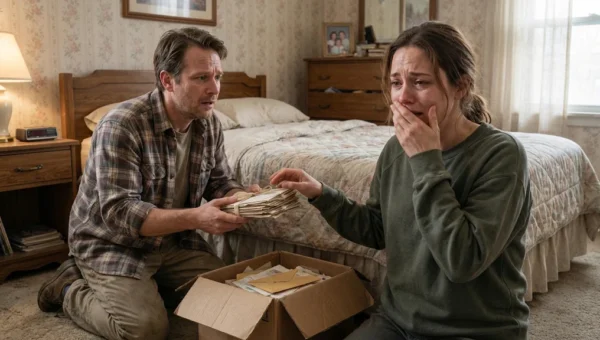
One evening Owen knocked. He stood alone on the porch, looking tired. He had a creased manila envelope in both hands.
“Can I come in?”
I stepped aside. He came to the kitchen but didn’t sit. The envelope had a crease along one edge, like he’d carried it around for a while.
“What is it?”
“Mom, there’s something I should have told you years ago.”
He put the envelope on the table and pushed it toward me.
Inside was a paper with my name written in a hand I knew. Frank’s. Under it was a date from twenty years earlier. The line that caught my eye said, “Final lump-sum settlement for Owen; mother not to be notified.”
I read it twice.
“What does this mean?”
Owen sat down. “Dad put forty-five thousand dollars aside for me. I got it when I turned twenty-one.”
I looked at the attached bank ledger. The amount had been paid out to Owen thirteen years ago. The date was familiar. It was the same year he and Christa bought their split-level house.
“You used it for the house.”
“For the down payment,” he said. “Most of it.”
I put the paper down. I didn’t raise my voice. “And you let me think you were struggling.”
“Yes.”
“Why?”
He rubbed his hands together. “Christa said telling you would make you feel like you weren’t needed. She said you’d be hurt that Dad had paid and you hadn’t known. I thought I was protecting you.”
“That’s what you told yourself?”
He looked at the table. “Yes.”
Then he told me the rest. Christa had managed the household budget around the money I sent. The $400 checks helped cover bills, but some months they went toward trips with Gerald and Elaine. My phone plan and the car insurance were treated as things I would keep paying because I always had.
He said it like he hated hearing himself say it.
“Why didn’t you tell me at dinner?”
“I was ashamed. I’ve been ashamed for years. I saw you buckle that roast into the car, and it was so plain. You were leaving with the meal you made, and I still didn’t say anything.”
He rubbed his thumb along the envelope’s crease. “Maya asked me later why Grandma got treated like a hired cook.”
I set my hand flat on the table. That hurt in a different place.
“She said that?”
“Yes.”
Owen explained that Christa wanted him to come by and get the insurance situation fixed. He’d driven over intending to talk about it. Instead, he brought the envelope.
“I’m not asking you to take me back like nothing happened,” he said. “I just couldn’t keep hiding this.”
There was another paper in the envelope. A certified cashier’s check made out to me for $24,000, the total of the monthly payments I’d sent over five years.
“I saved it,” he said. “I want to pay it back.”
I looked at the check. Then I slid it back toward him.
“I’m not cashing this.”
“Mom, I owe you.”
“You owe me honesty. The check can’t pay for that.”
He stared at it.
“Put it in an account for Maya,” I said. “In her name alone. For school. Don’t make it something Christa can spend.”
He nodded. “I can do that.”
“I’m serious, Owen. No more phone plan. No insurance. No monthly money. I’m not giving Christa a new key, either.”
“I understand.”
“I want to see Maya. I want to see you. But I need you to come here as my son, not as somebody who needs me to cover a bill.”
His eyes filled, but he didn’t ask me to make it easier for him. I let him sit with it.
He took the check home. The next week, he showed me the paperwork for an account in Maya’s name. I checked the name and the amount. Then I handed it back. It was his job to keep it honest.
Christa stayed distant. She didn’t come back to my house, and I didn’t invite her. Owen kept the accounts separate and got his own insurance. The locks stayed changed.
The following Saturday, Maya came with a grocery bag and asked if we could bake cookies. Owen came too. He sat in the sixth chair at my kitchen table, drinking black coffee and peeling apples. Nobody asked me to cook a special meal for guests who wouldn’t make room for me.
My apricot-glaze recipe was on the counter in my neat handwriting. Maya measured flour beside me. Owen kept peeling.
I passed him the bowl.