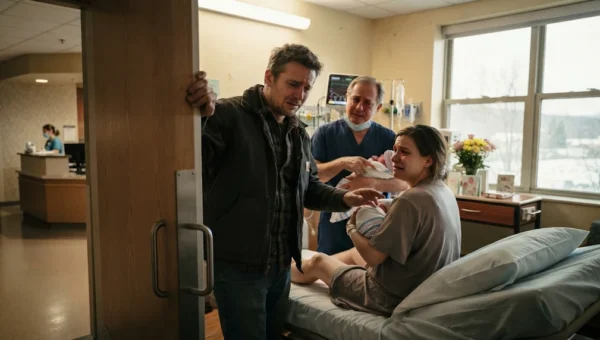
Why did I keep the cottage key on my ring after that day? I asked myself that for a long time. It was a small silver key with a blue plastic tag, the kind my parents had handed me when I was sixteen and old enough to be trusted with the screen porch. I’m getting ahead of myself. The key matters at the end.
The first thing I remember is metal hitting the floor.
Not a pan clattering in the ordinary way, with someone laughing and reaching for a towel. This was a hard, ugly crash from the kitchen, loud enough to stop my breath on the screened porch. By the time the sun went down, I’d be racing my four-year-old daughter toward a hospital, one hand on the wheel and the other reaching back for her. I didn’t know that yet.
That morning, I thought we were having breakfast at my parents’ cottage. I’d brought Emma because the weekend was supposed to be easy. Pancakes, coffee, the lake beyond the screens. A few hours where I could let my shoulders drop.
Emma wore her yellow hoodie. Her curls were still damp from washing her hands at the sink, which she’d insisted on doing by herself. She kept asking if the syrup was “the good kind” while my mother put plates on the table.
My niece Lily had a place by the window. She always did. The chair looked like the others, but my family treated it like a reserved seat. I knew that. I don’t know why I didn’t say anything when Emma climbed into it.
I was carrying a folded blanket in from the porch when I heard the crash. Then a short, strangled gasp.
I dropped the blanket and ran.
Emma was on the floor beside a tipped stool, her face turned toward the cabinets. The skillet lay on its side nearby, steam still lifting off the dark surface. A plate had broken beneath the table. Syrup streaked across the floor, bright against the wood.
Vanessa stood beside the counter. Mom was at the sink. Dad had one hand around his coffee cup. Lily sat very still, looking down at her plate.
“Emma.” I dropped to my knees and touched her shoulder. “Baby, can you hear me?”
She didn’t answer.
I wanted to turn on Vanessa. I wanted to ask how she could do this to a little girl.
Then Emma made a small, breathy noise, and I had to put that anger somewhere else. I slid an arm beneath her as carefully as I could. Her skin was hot through the hoodie. I was scared to move her, and more scared to leave her there.
Vanessa watched me lift her.
“She took Lily’s seat,” she said.
I stared at her. “What?”
“She sat in Lily’s window spot and started eating off her plate. I told her to stop.”
“You threw a skillet at a four-year-old?”
Mom turned from the sink with a dish towel in her hands. “Rachel, don’t start screaming. Take her home and clean her up.”
I waited for concern to show on her face. It didn’t.
Dad set down his mug. “You’re making this bigger than it needs to be.”
“Emma is unconscious.”
“She’s breathing,” he said. “Don’t turn one bad moment into a family disaster.”
Vanessa gave a little shrug. “She could’ve listened.”
That was the first clue I didn’t want to see: none of them reached for a phone.
Not Mom. Not Dad. Not Vanessa. I had spent years thinking the cottage was safe because I knew which floorboards creaked and which cabinet stuck. I’d learned the family rules there, too. Don’t contradict Vanessa. Don’t upset Mom. Don’t make Dad choose sides. If I did, I was the one who ruined the day.
For half a second, those rules came back. Maybe I was yelling. Maybe I was making it worse. Maybe if I got Emma out quietly, everyone would calm down.
Then Emma’s cheek pressed against my shoulder, too hot and too still.
She wasn’t a mood. She wasn’t a seat at a table. She was my daughter.
I carried her past my parents without asking permission. Mom said my name like I was being rude. I kept walking.
Outside, the lake shone between the trees. I fumbled with the car door, holding Emma against me until I got it open. Strapping her in took three tries. My fingers shook so badly I had to stop and press them against the seat.
I called the hospital as I pulled away from the cottage. I told the person who answered that my child had been hit by a hot skillet and wasn’t responding. I was told to come straight in.
At the intake desk, a nurse took one look at Emma and called for a pediatric team before I’d finished spelling her name. A form slid across the counter. The question about what happened was printed in small black letters. My pen hovered over the line.
For years, I’d softened anything that made my family look bad. “There was a misunderstanding.” “Everyone was upset.” I could hear Dad telling me not to cause trouble.
I wrote: Vanessa threw a hot skillet at Emma during breakfast.
The nurse read it, then looked at me. “Who threw it?”
“My sister,” I said.
They took Emma through double doors. A nurse stopped me before I could follow and said they needed room to treat her. I stood in the corridor with my hands empty. My phone began to buzz.
Mom called twice. Dad left a voicemail. Vanessa sent a message I couldn’t bring myself to open. I turned the phone facedown on my lap. The screen kept lighting up, then going dark again.
A doctor came out later. Emma was stable, she said, but the injuries were serious. They’d sedated her so they could treat her safely. Because of Emma’s age and what I’d told the staff, the hospital had opened an incident report.
I nodded. I was trying to hold on to one word: stable.
When they let me into the room, Emma looked impossibly small beneath the hospital sheet. A band circled her wrist. Clear tubing ran to her arm. Dressings covered part of her face, neck, and shoulder. I sat beside her and took the hand the nurse had left free.
“Mommy’s here,” I whispered.
Her eyes stayed closed.
A social worker came in with a folder. Her name was Sarah Harris. An officer, Miller, waited by the doorway. Sarah asked me to tell her what had happened in my own words.
So I did. I told her about Lily’s usual seat, the plate, the crash, and where I found Emma. I told her what Vanessa said. I told her Mom urged me to leave and Dad said not to make it a family matter.
My voice shook, but I didn’t change a word.
Sarah wrote as I spoke. When I finished, she asked if I had anything that could support what I’d told her. Messages, photos, or information from the people who’d been there.
My phone buzzed in my hand.
Vanessa’s name appeared above a new message.
I looked at Sarah. She was still waiting. For once, I didn’t feel the need to check what Vanessa wanted in private first. I unlocked the screen and handed the phone over.
Sarah read the message. Officer Miller leaned in to see it. Then she turned the screen toward me.
“Tell triage she reached up and snagged the handle off the stove herself,” Vanessa had written. “Do not make this something it isn’t. You will ruin Lily’s life if you lie about this.”
I read it twice. She wanted me to say Emma had pulled the skillet down herself. She put Lily’s life in the message, too, as if that made what happened less real.
“Can you preserve this?” I asked.
“We can document it,” Officer Miller said. “Please don’t delete anything.”
I handed over the phone. The whole thing. The texts, the missed calls, and Dad’s voicemail. He’d left it while I was in the hospital, and I hadn’t listened yet. Miller asked before playing it. I said yes.
Dad’s voice came out of the phone, low and familiar.
“Rachel, just agree with Vanessa’s story so the state doesn’t get involved. We can handle this privately.”
I’d heard some version of that my whole life. Keep it private. Don’t make it worse. Let Vanessa cool down. Dad said it like he was offering me a way out, but the way out always meant I had to carry the lie.
Sarah logged the message and the voicemail. Miller said the state would be notified and that he needed to follow up at the cottage. I wanted to ask if Vanessa would be arrested. I didn’t. I wanted Emma to wake up first.
Dr. Aris came in with the medical assessment a little while later. She spoke plainly and didn’t try to scare me. The burn pattern spread downward and sideways, she said. The mark on Emma’s temple matched the hard edge of the skillet. Emma was only about thirty-six inches tall. The injuries didn’t fit with a child reaching up and pulling a pan down.
“It looks like the pan came across the counter,” Dr. Aris said. “The force and direction matter.”
I looked at the dressing near Emma’s temple. I didn’t need a diagram. I needed to hear that I hadn’t made up what I saw.
Officer Miller wrote down the findings. The skillet hadn’t just fallen. Vanessa had thrown it. The small things I’d ignored, the way nobody reached for a phone, the way Vanessa blamed Emma before asking if she was alive, the message telling me exactly what to say, were all pointing the same way.
I stepped out to get water. I hadn’t had any since the cottage. Mom and Dad were in the waiting area.
Mom stood as I came over. Dad was holding a folded piece of paper. I knew before he spoke that it wasn’t for me to read. It was probably something he’d brought along to make the family version look official.
“Tell them it was an accident,” Mom said. “This has gone far enough.”
“It wasn’t an accident,” I said.
Dad held out the paper. “You need to sign that you misunderstood what happened.”
I didn’t take it.
“Vanessa is Lily’s mother,” Mom said. “Think about what this will do to her.”
“I am thinking about Emma.”
“She was being defiant,” Mom said. “You’re turning one bad moment into a public mess.”
I said, “She was four.”
Dad lowered the paper. “You’ve always made things harder than they need to be.”
I used to hear that and wonder what I’d done wrong. I’d replay a whole day, looking for the point where I could have stayed quieter. At the hospital, with Emma behind two doors and burn dressings on her face, the words sounded different. What Dad meant was that I wasn’t going to help him hide this.
“Vanessa threw a skillet at my child,” I said. “I told them what happened.”
Mom’s mouth tightened. “We’re your parents.”
“I know.”
“You’d do this to your sister?”
“I’m not doing this to her. She did it to Emma.”
Dad said the state would make the family’s life miserable. Mom said Lily would lose her mother. I know Lily was a child in all this, too. I felt sorry for her. But keeping Vanessa out of trouble wouldn’t make Lily safer. It would just teach her what I’d been taught: that everyone else had to adjust around her mother.
“I’ll testify against Vanessa in court,” I said.
Dad looked at me for a few seconds. “You can’t take that back.”
“I’m not taking it back.”
Security came over after Sarah called. My parents were told they couldn’t go into Emma’s room. Mom cried then, but she didn’t ask how Emma was doing. She said I’d cut off my own family over one breakfast.
I told them not to come near Emma.
The county deputies went to the cottage. Vanessa was arrested there on charges related to the assault and reckless endangerment. I didn’t see it happen, and I didn’t need to. I was in a chair beside Emma’s bed, answering Miller’s questions and signing my statement. I gave him the phone records and the messages without leaving anything out.
The deputy explained the emergency protective order. Vanessa and my parents weren’t to approach us, and the hospital removed their access to Emma’s wing. I signed the papers. My hand cramped by the last page.
There was no speech. No dramatic promise. I just stopped giving my family a way to reach my daughter.
Later, when the room had gone quiet, I sat by Emma and watched the numbers on the monitor. I’d grown up with a clock-radio alarm that clicked twice before the music came on. I used to lie there and count the clicks. In the hospital, I counted Emma’s breaths instead. It gave my hands something to do.
At some point, her eyes opened. She looked at me for a second, then reached with her uninjured hand.
“Mommy?”
“I’m right here.”
She touched my fingers. Her fever had broken. The nurse said she was waking up and would need more treatment, and later she’d need help with the fear as much as the burns. I nodded. I could handle the next thing. I could handle the next thing after that.
I took my key ring from my bag. The silver cottage key was still there, blue tag and all. I’d carried it for years because I thought that place belonged to us in some way. I walked to the metal waste receptacle beside Emma’s bed and dropped the key inside.
It hit the bottom with a small, clean sound.
Then I went back to Emma and kissed her uninjured temple.