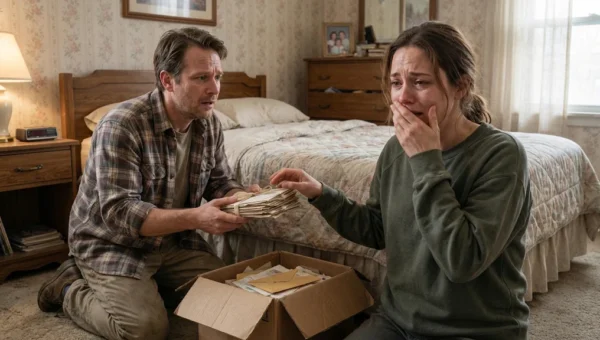
The kitchen where Brooke threw me out still had birthday balloons taped to the cabinets when she said I was “too much trouble around the kids.” I was carrying Miles’s cake in both hands, trying not to tip the frosting, and every person in that spotless room heard her.
“Your help comes with opinions, Miriam,” Brooke said. “We need peace. You need to stop coming over.”
My son, Adam, looked down at his coffee.
That hurt more than Brooke’s words. I had raised Adam through layoffs, fevers, and one very bad year when his father left us with a stack of unpaid bills. Now he was forty-one years old, married, and studying the dark surface of a coffee cup while his wife dismissed me in front of her friends.
Behind Brooke, Ella stood by the sliding glass door with her paper crown in both hands. Miles pressed his palms to the glass. I had made that crown with Ella the night before. She’d drawn crooked stars on it and told me they were supposed to be crooked because perfect things made her nervous.
I had told her she didn’t have to be perfect.
That was the opinion Brooke meant.
“She cried because she got one answer wrong,” I said.
Brooke crossed her arms. “That’s exactly what I mean. You undermine me.”
“I told her one wrong answer didn’t make her stupid.”
“You’re getting difficult at your age.”
Her friends looked at the floor. Adam finally spoke.
“Mom, maybe just give us some space.”
“Space,” I repeated.
Brooke smiled, like she had been waiting for that word. “Don’t make this dramatic. You’ll be asking to come back by Monday.”
I set Miles’s cake on the counter. The cardboard box made a soft scraping sound against the stone. Then I untied the little blue apron Ella had given me the previous Christmas. There was still flour on one pocket from that morning.
“Your children deserve peace,” I said. “So I’ll respect your decision.”
Brooke’s smile stayed put.
“Starting today, I won’t provide childcare, run errands, or manage your household.”
She gave a small laugh. “We’ll survive.”
“I hope you do.”
I touched two fingers to my lips and waved to Ella and Miles through the glass.
I did not go inside that room. I did not argue. I did not tell the guests how many mornings I had arrived before sunrise.
Adam followed me as far as the front door.
“Please don’t make a scene,” he whispered.
I looked at him then. “She already did.”
I drove home with the smell of buttercream still on my coat. I don’t know why that detail stayed with me. Maybe because I had spent four years making sure their children had warm food, clean clothes, and somebody who would sit beside them when things felt too big. I had believed that counted as family.
By three that afternoon, I sent Adam and Brooke an email. It was plain and short. I would no longer collect the children from school, deliver groceries, cover emergencies, or handle household tasks. I had also been paying supplemental school fees after giving thirty days’ notice, and that payment would end on the stated date.
I added one line about the children. Any promises I had made directly to Ella and Miles would still be honored.
Then I opened the locked drawer beneath my desk.
Inside was the executed $90,000 promissory note Brooke had signed in front of her own lawyer. The loan had funded inventory for her parenting business. The agreement gave her an interest-only grace period after launch, but it also required quarterly financial reports, proper use of the funds, and timely payments when the grace period ended.
I had not kept that paper because I wanted to punish her.
I kept it because I had spent twenty-eight years as a forensic accountant, and I knew better than to confuse love with a missing paper trail.
The next morning, I called Arthur Vance. Arthur had worked with me years ago, back when we both still wore real shoes to the office instead of slippers at home. He handled my estate documents and knew Adam since he was a boy.
“I want all loan questions sent to you,” I told him.
Arthur was quiet for a moment. “Are you sure?”
“Yes.”
“That’s not the same as calling the loan.”
“I know. I’m separating the two things.”
That mattered to me. I was angry, but I wasn’t going to use legal papers like a kitchen knife. If Brooke had followed the agreement, she would have had time. If she had not, Arthur would deal with it without me standing over her shoulder.
For the first week, Brooke acted as if nothing had happened. She posted pictures of a breakfast bowl on social media with the words mindful mornings and healthy boundaries. One picture showed a white mug beside a stack of parenting books.
I knew she had taken it in my kitchen.
The same morning, Adam texted me at 6:22.
Can you still do school pickup Thursday?
I answered, “No. I’m no longer handling school runs.”
He wrote back, “It’s just this once.”
I stared at that message longer than I should have. I wanted to write ten paragraphs. Instead, I said, “No, Adam.”
He sent a thumbs-up.
That was our conversation.
I had been working thirty-five hours a week for them, sometimes more. I picked up the children, made dinner, washed their clothes, bought groceries when Adam’s commissions came in light, and handled the small emergencies that make a family run. I had even postponed a Maine trip I had planned for years because Brooke needed help launching her business.
I had told myself I was helping my son.
The truth was less flattering. I liked being needed. I liked knowing which cereal Miles would eat and how Ella wanted her socks folded. I had let that need cover up the fact that nobody had asked what the arrangement was costing me.
The first paid sitter lasted nine days.
She quit after Brooke sent her seventeen messages about how the children’s lunches should be packed. The second sitter left after Brooke called during pickup because Miles had worn the wrong jacket.
Adam called me that evening.
“Brooke says you should at least explain the routine.”
“She has the routine,” I said. “She made it.”
“Mom, please.”
“No.”
He breathed hard into the phone. “You’re really not coming back?”
“I’m not going back to unpaid work in a house where I’m not welcome.”
He did not say sorry. I could hear Brooke talking in the background.
The next week, Adam missed two sales appointments because he had to leave work for school pickup. His commission checks were already uneven, and he had depended on me to cover the gaps. Brooke’s inventory bill arrived at the same time. A shipment of branded journals, planners, and child emotion cards needed payment.
She had built the business around looking calm.
There was nothing calm about the numbers.
Arthur called me on a Thursday afternoon. “I’ve reviewed the company reports and the escrow records.”
I was sitting at my own kitchen table, eating toast over the sink.
“What did you find?”
“Fourteen thousand dollars moved from the business loan account into personal spending.”
I put the toast down.
“What kind of personal spending?”
“Retail purchases, home décor, a resort deposit, and two payments to a personal card.”
I closed my eyes. Not for long. I had trained myself out of that habit during audits. Facts first.
“Was the money marked as a business expense?”
“Some of it was. Poorly.”
“And the quarterly reports?”
“Late. Then incomplete.”
Arthur explained that Brooke had also started using company funds to cover household overdrafts. That violated the loan terms and the bank’s operating agreement. The commercial lender had flagged the account, so Arthur prepared a formal Notice of Default and demand for inspection.
I felt sick, but not surprised.
“Send it,” I said.
“Miriam, once it goes out, there’s no pretending this is informal family money.”
“It stopped being informal when she signed it.”
Arthur sent the notice that afternoon.
Brooke called me eleven minutes later.
I let it go to voicemail.
Her message was thirty-one seconds long. I listened once.
“You’re doing this to your own grandchildren,” she said. “If you cared about them, you’d release the money.”
I deleted the message.
That was my part in the mess. I had kept money quiet for too long. I had let Brooke think a loan was a gift because I hated seeing Adam worried. I had called it grace. Maybe some of it was fear. Fear that if I asked for proper records, my son would feel caught between us.
He had been caught between us anyway. He had simply chosen the person who made the most noise.
The thirty days ended on a Monday. At 9:10 that morning, the private school sent the tuition balance to Adam. The amount included the supplemental fees I had been covering and two late charges.
At 9:42, the headmaster called him.
At 10:18, Adam called me.
I was outside Ella’s soccer field. I had promised to watch her weekend games, and I kept that promise. I sat on the metal bleachers with a thermos of tea and did not bring a basket of laundry or a grocery list.
My phone rang again.
Then again.
On the tenth call, I answered.
Adam was crying so hard he could barely speak. He was sitting in his car outside the school, he told me. I could hear the turn signal clicking.
“Mom, I need you.”
I said nothing.
“Please. I don’t know what to do.”
“Tell me.”
“The bank froze the business line. The school says we owe them. Brooke says you have to fix it.”
“You mean Brooke wants me to fix it.”
“She says you’re doing this because you’re mad.”
“I am mad.”
He made a broken sound. “The house payment is short. The sitter quit. I missed my quota. Mom, I can’t do this.”
“You could have helped me when I was standing in that kitchen.”
“I know.”
“No, Adam. You didn’t say anything.”
“I know.”
He kept crying. There it was. The thing he had avoided for four years, finally sitting in his car with him.
“Come meet me,” I said. “Not at your house. The coffee shop on Turner Road.”
He arrived twenty minutes later with red eyes and both hands shaking. I had brought the loan schedule, the bank reconciliation, and the email I sent on the day Brooke dismissed me.
He sat across from me.
“I’m sorry,” he said.
I believed that he was sorry. That did not make him brave.
“Can you release the money?” he asked.
“No.”
“Can you forgive the loan?”
“No.”
“Can you come back for just a little while? Until we get stable?”
I looked at him. He was still my son. His face had the same small crease beside his mouth that he had as a boy when he was trying not to cry.
“I’m not cleaning that kitchen again,” I said. “I’m not driving the children every morning. I’m not paying your bills. I’m not giving Brooke another dollar.”
He rubbed both hands over his face.
“She says you’re ruining us.”
“Brooke’s business was never carrying its own weight.”
He looked at the papers.
I pointed to the numbers. “The business only looked profitable because I absorbed the childcare, the groceries, the errands, and the time. The interest-only period kept the debt quiet. Once I stepped out, the real cost showed up.”
Adam stared at the $14,000 transfer.
“She used the loan for this?”
“Yes.”
He nodded slowly. “I knew she spent too much. I didn’t know.”
“You didn’t want to know.”
That was the cruelest thing I said to him. It was also true.
The lender required a monitored repayment plan. Arthur arranged it, but there were conditions. Brooke had to sell excess inventory, stop personal spending through the company, provide regular reports, and repay the diverted funds. The commercial credit line stayed restricted.
They sold the expensive journals and moved the children into public aftercare. Brooke stopped posting about effortless family mornings. Her followers noticed the empty shelves and the quiet weeks. Some asked questions. She stopped answering them.
Adam and I did not become close again in one coffee meeting. That would have been too easy. He started coming to my house on Sundays, sometimes sitting at the table without saying much. I let him. I made tea, but I did not make excuses for him.
I saw Ella and Miles away from their home. We went to the park. I took them for ice cream on Miles’s birthday, and Ella wore another crooked paper crown. I did not ask them what Brooke said about me. I did not speak badly about their mother.
When Ella hugged me, she whispered, “You’re not in trouble, Grandma.”
“No,” I told her. “I’m not.”
By October, Arthur had the repayment plan in writing. Brooke had downsized the business and hired an accountant who was not related to her. Adam was looking for steadier work. Their life was smaller, but it was finally based on numbers they could see.
I booked my trip to Maine for the following week.
The cottage in Camden was small, with a porch that faced a strip of water and a road where bicycles passed in the morning. On my second day there, a postcard arrived from Ella. She had drawn a blue crayon crown across the front and written my name in letters that leaned uphill.
I held it in one hand and my tea in the other.
For the first time in years, the morning belonged only to me.
No school pickup. No grocery list. No phone waiting for Brooke to tell me I was too much trouble.
Just the porch, the quiet water, and Ella’s crooked crown under my thumb.