PART 1
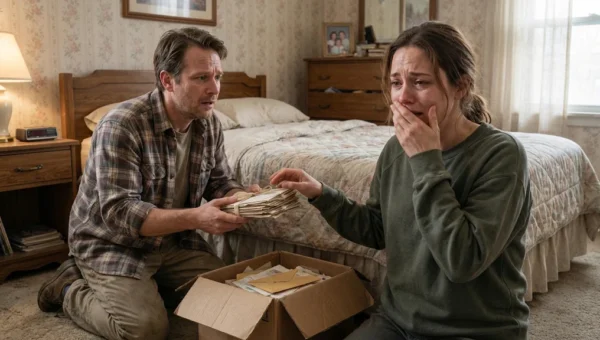
The manila folder was sitting on the breakfast table right next to Zack’s coffee mug. It contained a clean petition for dissolution of marriage, twenty-four pages stapled neatly at the top left corner, with pink Post-it flags marking where each of us needed to sign.
Zack stared at the papers, then at me. His mug stayed halfway between the table and his mouth, steam curling up into his graying beard.
“Divorce? After thirty years?” Zack gasped.
“Yes,” I said. My voice was steady. It surprised me a little, because my hands had been trembling when I brewed the coffee twenty minutes earlier.
“Kelly, this is crazy. I love you! I never cheated on you!”
“True,” I replied. “You never drank or gambled either.”
He set the mug down so hard a few drops splashed onto the clean pine tabletop. “Then why? Is there someone else?”
“No, Zack. Want the truth? It began when you bought the river property without telling me, and it ended when I found the locked metal box in the garage attic last Tuesday.”
His face went completely blank. For five seconds, the only sound in our kitchen was the electric hum of the refrigerator.
We had built what everyone in our small Ohio town called a solid life. Zack was a retired shop foreman from the auto stamping plant, a man who kept his tools oiled, paid his bills on the fifth of every month, and never raised his voice in public.
I had worked twenty-eight years as an administrative assistant at the county health department. We raised two daughters, put them through state college without debt, and told our friends we were looking forward to quiet years in the four-bedroom colonial house we had paid off three summers ago.
To our girls, Zack was steady as bedrock. But bedrock doesn’t bend, and bedrock doesn’t listen.
The crack had started four years ago. Our younger daughter, Megan, was twenty-four then, working two retail jobs and living in a drafty apartment forty miles away. Her car transmission blew on a snowy Thursday night in January. She called us crying because she had six hundred dollars to her name and the shop quoted her eighteen hundred to put in a rebuilt unit.
I had seven thousand dollars sitting in our joint money market fund. I went to the desk, pulled out the checkbook, and told Zack I was going to wire Megan the eighteen hundred so she wouldn’t lose her job.
Zack took the pen out of my hand. He set it down on the blotter, clicked it shut, and looked at me with that calm, reasonable smile he used whenever he wanted to treat me like a child.
“Kelly, she has to learn financial discipline,” he said. “If you bail her out every time she hits a bump, she will never grow up. She can take the city bus.”
The bus didn’t run to the warehouse district where her second shift started at 5:00 in the morning. I told him that. I pleaded with him for two hours. He didn’t yell. He simply logged into our bank portal on his desktop computer, changed the transfer limits, and moved six thousand dollars into an account under his name alone. He said it was to protect our family reserve from emotional impulses.
I took five hundred dollars cash from my own paycheck and gave it to Megan.
She walked four miles in freezing rain three nights a week until a coworker felt sorry for her and offered a carpool.
Six months after that, Zack came home on a Saturday afternoon with dirt on his boots and a yellow carbon receipt in his shirt pocket. He had put down a fourteen-thousand-dollar deposit on seven acres of scrub brush and mud near the Muskingum River. He called it an investment for our retirement. He hadn’t asked me. He hadn’t even mentioned looking at land. When I asked how we could afford fourteen thousand dollars when our daughter couldn’t get eighteen hundred for a transmission, he patted my shoulder and said, “A man has to secure his family’s future, Kelly. Real estate builds equity. Transmissions just lose value.”
I swallowed it. I swallowed it because women of my generation were taught that if a man doesn’t drink, doesn’t hit you, and doesn’t run around, you count your blessings and make Sunday dinner.
Then last Tuesday morning, Zack drove into town to help his brother pull an engine out of an old pickup.
A drip had started in the upstairs hallway ceiling right beneath the pull-down stairs to the garage attic. I climbed the wooden ladder with a flashlight to look for a roof leak. Behind a stack of plastic storage tubs filled with old holiday garlands, I saw a green steel lockbox tucked between two ceiling joists. It was half-hidden beneath an old fiberglass insulation batt.
Beside the box, caught under a dusty piece of plywood, was a small brass key on a string.
PART 2
The key turned smoothly with a dull click.
I expected old deeds or maybe savings bonds from his grandfather. Instead, the first thing I saw was an accordion folder stuffed with bank statements from an institution in Columbus, sixty miles away from our local branch. The account had been opened eight years ago. It had only Zack’s name on it.
Every statement showed monthly deposits of four hundred to six hundred dollars, transferred from an account marked “Shop Overtime & Scrap.”
For thirty years, Zack had told me that scrap metal bonuses and overtime pay at the stamping plant were rolled into his regular biweekly direct deposit, which went straight into our joint checking. I had spent decades cutting coupons, buying off-brand canned tomatoes, mending work coats, and debating whether we could afford to take the girls to Cedar Point for a weekend. Meanwhile, he had skimmed thousands of dollars every year into a private ledger.
The running balance on the latest statement was $92,410.
Underneath the statements lay three separate loan agreements. In 2021, when our older daughter Sarah and her husband lost their catering business during the shutdowns and fell three months behind on their mortgage, Zack told them to their faces that we were on a fixed retirement budget and had nothing to spare. He had watched our daughter weep at our kitchen counter while her two-year-old played with plastic spoons on the floor.
Those papers in the green box told a different story.
In September of that same year, Zack had lent $35,000 to his younger brother, Wayne, to purchase a commercial bass-fishing boat. The contract was typed on standard legal stationary, formal and signed. Down at the bottom, in the repayment terms, Zack had written in his unmistakable block handwriting: “Zero interest. Pay back when boat charters begin profit.”
Wayne had never run a charter business in his life. The boat sat in a gravel driveway three miles away, covered in blue plastic tarps that were already shredding in the wind.
I sat on the dusty attic floorboard in the dim yellow beam of my flashlight, holding those papers against my knees.
I didn’t scream. I didn’t throw anything. The air in that attic smelled like old pine and dust, dry and still. Thirty years of my life felt like a theatrical production where I had been assigned the role of the frugal, worrying housewife while the director kept the real script locked in his back pocket.
I took my phone from my pocket and photographed every single page. Every bank statement, every loan contract, every receipt for the river parcel, and the title documents for a used tractor he had bought Wayne two summers ago for another $8,500.
Then I put every paper back into the exact slot in the accordion folder. I locked the green box, slid it back between the joists, pulled the pink insulation over it, and wiped my fingerprints off the metal latch with the hem of my shirt.
When Zack came home at 5:30 that evening, smelling like motor oil and exhaust, I had dinner on the stove. Meatloaf, mashed potatoes, and green beans.
“Wayne’s truck is running again,” he announced, kicking off his boots by the back door. “Just needed a new alternator and some wiring cleanup. Saved him four hundred bucks.”
“That was nice of you,” I said, setting the butter dish on the counter.
“Family helps family, Kelly. That’s how it’s done.”
He sat down and ate three helpings. I watched him chew. I watched his fingers, thick and calloused, break a roll in half. For thirty years I had believed those hands were working only for our shared table.
The next morning, the minute his truck backed out of the driveway to go meet his buddies for morning coffee at the diner, I drove forty miles south to Lancaster. I didn’t go to the lawyer in our town who played golf with Zack on Thursdays. I hired an attorney recommended by a retired supervisor from my old department, a sharp woman named Eleanor Vance who looked at my phone photos for forty-five minutes without saying a word.
When Eleanor finished, she looked up over her reading glasses.
“Your name isn’t on this Columbus account,” she said.
“No,” I replied.
“It doesn’t matter,” Eleanor said quietly. “Ohio is an equitable distribution state. Every dollar earned during the marriage is marital property, regardless of whose name is printed on the check. And hiding assets in an undisclosed account during marriage is what the court calls financial misconduct.”
She outlined the path. We could file quietly, request a full forensic accounting of the hidden funds, and seek