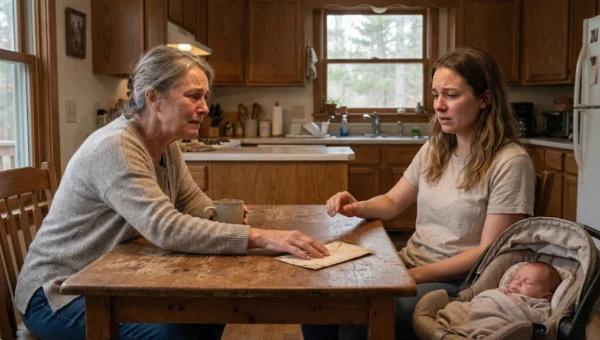
I got one thing wrong when I came home: I thought the hardest part would be getting used to sharing the kitchen again.
I’d been driving a truck for eleven weeks. I was used to stopping when the route told me to stop, eating whatever was open, and sleeping with one ear on the engine. Home was supposed to be the part I didn’t need to plan.
Robert had told me Madison and Evan needed a place for a couple of weeks. Their apartment had a pipe leak, he said. They’d stay in the spare room. I said fine from a rest stop outside Flagstaff, and figured that was that.
By the time I pulled into our place outside Tucson, the two weeks had turned into almost two months. There were shoes by the door that weren’t ours, a stack of delivery boxes in the hall, and a small whiteboard on the fridge with meal notes in Madison’s handwriting.
Still, Robert came out to meet me. He squeezed my shoulders, took my bag, and said he was glad I was home. I let myself believe him.
The next morning, I was up at six. I’d planned to make breakfast for everybody. I made boiled eggs, toast, and coffee, then put it all on paper plates because the dishwasher was full.
I knew the meal looked plain. I also knew Madison had sent a list of things she couldn’t eat.
Madison came into the kitchen in silk pajamas, looking at her phone. She glanced down at the plate.
“What is this?”
“Breakfast,” I said.
She looked over at Robert. “Dad told you I need protein pancakes.”
Robert was tightening the belt on his robe. He didn’t look at me.
“Your list said no greasy food,” I said.
It wasn’t the kind of thing worth a fight. I’d been home less than twelve hours. So I set the coffee down and started looking for the pancake mix.
I found it behind three boxes of cereal. Madison took over the stove and made her pancakes, and Evan came in halfway through and asked if there was any turkey sausage. Robert smiled at them like this was a normal Sunday.
I told myself it could be worse. Nobody had asked me to sleep in my truck.
That first week, I tried to be useful. I brought in groceries, fixed the sticky back door, and found the leak under the bathroom sink that Madison said had started the whole apartment mess. It was a loose fitting. Took me fifteen minutes.
Evan thanked me. Madison said she’d been meaning to call someone.
Robert kept busy in the kitchen. He’d always liked cooking, but now he seemed to be making different meals for every person in the house. He’d stand at the counter with his phone open, checking Madison’s list. No onions. Low fat. Extra protein. I didn’t mind the work. What bothered me was how often he looked at me as if he was waiting to see whether I’d complain.
I didn’t complain. That was partly because I was tired, and partly because I wanted the house to feel like mine again without having to say it out loud.
One evening, I asked Robert how long Madison and Evan planned to stay. He dried a plate with a dish towel and said their apartment manager still hadn’t fixed the pipe.
“Did they give you a date?” I asked.
“Not yet.”
I could have called Madison myself. I didn’t. I was the one who’d been away, and I didn’t want my first week home to turn into a hearing.
That weekend, Robert and I went to the grocery store together. He put the low-fat yogurt in the cart without checking the label, and I noticed. It was the brand Madison had asked for. Then he put back the coffee I liked because it cost more than the store brand.
It was a small thing. I bought my coffee anyway.
I’m mentioning it because I thought those little signs meant we were finding our way back to the old routine. Robert didn’t ask Madison what she wanted every time he picked something up. He asked me if I needed anything. We drove home with the windows open and talked about a truck I’d seen with a mattress tied to the roof.
For a few days, it felt better.
Then Madison started asking Robert to help with bills. She did it at the kitchen table while I was sorting my mail. She used a quiet voice, like she didn’t want to make me uncomfortable. She said Evan’s work hours had been cut, and the apartment deposit had eaten through their savings.
Robert said they’d figure it out.
I kept sorting the mail. I told myself I didn’t know the full story and that this was between a father and his daughter. I’d sent Madison money before. Once for a car repair, once when she was in college. I never asked for it back, and I didn’t want to start keeping score now.
But I did keep score. I noticed every time she asked him instead of asking both of us. I noticed because I wanted to be asked, and I was ashamed of that.
A week later, Robert told me Madison had found a place to move. It was a small rental near her work, and Evan could get there by bus. They needed help with the first month and the deposit.
“How much?” I asked.
“I don’t know exactly,” he said. “We can talk about it.”
The phrase we can talk about it had been doing a lot of work in our house.
I asked whether Madison had a job lined up. Robert said she’d been working part time, and she’d get more shifts once her schedule changed. I asked whether we had enough in savings to help. He said yes, then turned back to the stove.
I should’ve asked to see the numbers. I didn’t. I’d been gone long enough that I wanted to believe there were still parts of our life Robert could handle without me checking his work.
The next few weeks were quieter. Madison stopped making comments about breakfast. Evan fixed the gate latch after I mentioned it was loose. Robert and I started sitting outside after dinner, where the evening air cooled down enough to make it pleasant.
He told me Madison was going to be okay. I said I hoped so.
There was even a day when the house felt like ours again. Madison and Evan were out looking at rentals, and Robert made coffee the way I liked it. He set my cup beside the chair where I usually sat. I remember the coffee had one little bubble of foam stuck to the side. I wiped it with my thumb and thought, good, we’re getting back to normal.
I was wrong about that too.
The bank called the following Tuesday, while I was in the garage looking for a socket wrench. The woman asked whether I had questions about a home equity application. I thought she had the wrong person.
I told her I hadn’t applied for one.
There was a pause. She confirmed our address and said the application listed Robert and me as the borrowers. The requested amount was $68,417.
I asked if the money had already gone through.
She said the application was still under review. She could send me a copy after verifying my identity. I gave her the information she asked for, then went back inside.
Robert was wiping down the counter. Madison was in the living room on her phone. I told him the bank had called about a loan application.
He put the cloth down.
Madison looked up. Nobody said anything for a second.
Robert told me he’d planned to talk to me. I asked when. He said he hadn’t known how to bring it up because he knew I’d be upset.
I did not raise my voice. I asked whether he’d applied for the loan.
He said the money was for Madison and Evan. Their apartment plan had fallen through, and they’d found another place, but they needed more than we’d first thought. The loan would’ve given them enough to move and cover a few months while Evan’s hours came back.
“Did you apply for this without me?” I asked.
Robert said he thought I’d understand once I saw the amount and the plan. He said he wanted to keep Madison from falling behind. He said he’d hoped the bank would call both of us before anything happened.
I asked him if he’d signed my name.
He didn’t answer right away.
That was the first time my hands started shaking. I had to put them flat on the counter. The house was quiet except for the refrigerator making the same short buzz it had made for years.
Robert said he hadn’t meant to hurt me. He said Madison was scared, and he didn’t know how to tell her no.
I knew that feeling. I’d been the one to make excuses for her when she was young. I’d let her borrow money and then acted as if it was a gift so she wouldn’t have to feel bad. I had helped build the habit Robert was now trying to manage.
But that didn’t mean he could put my name on a loan.
The bank emailed the application the next morning. I printed it at the library because our printer was out of ink. I read it in the truck while I sat in the parking lot. The address was ours. The loan amount was right. Robert’s signature was on the first line.
My name was on the second.
I looked at the last letter in the signature. It leaned the wrong way. It was close, but not close enough. I’d signed forms beside Robert for thirty years. I knew how my own name looked when I was tired, and how it looked when I was in a hurry. I didn’t make that turn at the end.
I drove home with the application on the passenger seat.
Robert was sitting at the kitchen table. Madison stood at the counter, holding a mug with both hands. Evan was not there.
I put the paper in front of Robert.
“You signed my name.”
He looked down at it. Then he said, “I thought I was helping her.”
That was the line that finally got through to me. Not because he said it cruelly. He sounded tired. He sounded like a man who’d run out of ways to explain himself and was still hoping the explanation might be enough.
I’d spent eleven weeks on the road trusting that the person at home would handle things the way we always had. I had treated that trust like a standing order. I hadn’t asked what it meant when the house changed around me, because asking might have made the answer plain.
Robert had wanted to help Madison. I believed that. I also believed he’d made a choice that left me out of our own life.
I called the bank from the table. They put a hold on the application and told me what papers they needed to close it. I asked them to note that I had not signed. The woman on the phone spoke in the same careful voice as before, and I appreciated that. No drama. Just the steps.
Madison tried to explain that she hadn’t asked Robert to sign for me. She said she thought he’d talked to me. I believed her, mostly. She had been in the room when he told me about the loan, and she hadn’t said anything then. She had let me find out from a bank.
I asked her to pack her things.
Robert looked at me like he wanted to say something. Then he lowered his eyes to the application.
Madison started crying. She said the new rental was gone now, and they had nowhere to go. I hated hearing that. I didn’t change my mind. I told her she could stay until Friday, but there would be no loan, and there would be no more financial paperwork signed without me sitting there.
She said she understood.
I didn’t know if she did. I didn’t know if I did, either.
The bank canceled the application two days later. I went in person with Robert and showed them my license. Robert answered their questions. He didn’t try to blame Madison. We signed the papers to withdraw the request, and I asked them to put a note on our file that no new loan could be opened without speaking to both of us directly.
That part got handled.
Madison and Evan found a smaller rental, one that didn’t need the amount they’d asked for. I paid the deposit directly to the landlord, not because I was forgiving what happened, but because I didn’t want her sleeping in her car. Robert and I agreed we wouldn’t lend them any more money for a while.
We didn’t agree on much else.
A few days after Madison left, Robert put his overnight bag by the front door. He said he was going to stay with his brother for a few nights. I asked if he was coming back. He said he didn’t know how to answer that.
I didn’t ask him to stay. I didn’t tell him not to go.
I helped him carry the bag to the porch. He set it down, then turned around as if he might say something. He didn’t. I left the door open while he walked to the car.
The loan was canceled. Madison had a place to live. Robert had his bag.
I still have the copy of the application in my desk. The last letter of my name leans the wrong way. The front door is still the one I fixed that first week home.
I haven’t decided whether to close it.