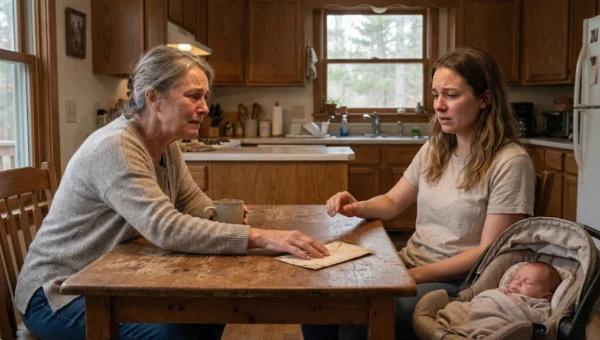
The ballerina in the music box had a loose head. I kept the box in my closet for eleven months before I learned why my aunt had left it to me.
By then, my cousins had divided up her house, her jewelry, and almost $3 million in investments. I got the box, which smelled like old drawer dust and had a strip of yellow tape across the bottom.
It was not a fair trade, obviously. I knew that before anyone said it out loud.
My aunt Lorraine had been dead for three weeks when the lawyer read the will. I was 56, living outside Bakersfield, and I’d spent most of my life believing my mother had left me and never tried to come back. Lorraine had helped raise me after that. I thought I understood what the box meant.
I didn’t.
Lorraine’s house was in a nicer part of town, with a pool that nobody in the family had used in years. My cousins Brent and Kelly got the house. They also got the jewelry Lorraine had worn to church and the investments she’d talked about as if they were just a savings account with better manners.
The lawyer read the line about my inheritance twice, maybe because he could tell the room had gone quiet.
“One music box,” he said. “From the upstairs sitting room.”
Brent’s mouth twitched. Kelly looked down at her hands. I stared at a water ring on the conference table because I didn’t want either of them to see my face.
It wasn’t that I expected Lorraine to leave me millions. I had a job, a small house, and a car that needed its brakes looked at. I wasn’t waiting around for an inheritance. But I had been there for her. I’d taken her to appointments and picked up groceries, and I’d answered the phone when she called at 10:40 at night because she couldn’t sleep.
The money didn’t hurt as much as the message seemed to.
After the meeting, Brent caught up with me by the elevators. He was 59 and still had the habit of laughing before he said something uncomfortable.
“Don’t take it personally,” he said.
“I wasn’t.”
“You know what I mean. The box probably isn’t worth much.”
“I know.”
“I’ll give you five dollars for it,” he said. “Save you the trouble of moving it.”
I looked at him. He laughed again, not mean exactly. More like he wanted me to help him pretend it was funny.
“No, thanks,” I said.
That was the whole exchange. No scene. No raised voices. But I thought about the five dollars on the drive home, and I thought about it again while I carried the box inside.
I put it in the closet.
For the first few weeks, I didn’t open it. I had the feeling that if I did, I’d find something too small to matter and feel foolish for caring. The music box had come from Lorraine’s upstairs sitting room. I remembered it sitting on her dresser when I was a kid, though I can’t say I remember every year right.
I do remember its tune. It played “Beautiful Dreamer,” badly, with a little skip in the middle. I’d sit on the carpet while Lorraine wound the key and tell her the ballerina looked like she was going to fall over.
“She’s doing her best,” Lorraine would say.
That line stuck. I don’t know why. There were probably a hundred ordinary things she said to me that summer, but I remember that one.
Lorraine had been my mother Nadine’s older sister. When I was 13, Nadine left town. That’s how Lorraine put it. My mother had a drinking problem by then, and the family version was that she got tired of being responsible and took off. I heard it so many times I stopped asking questions.
I lived with Lorraine after that. She took me to school, signed the forms, and made sure I had a coat when winter came. She wasn’t soft, but she showed up. I loved her for it. I also let her decide what I was allowed to know.
My mother died when I was 31. I heard about it from Lorraine, who called me during a break at work.
“She passed last night,” she said.
I sat down on a box of printer paper in the supply room. I asked where she was. Lorraine told me the town and the funeral date. I asked if Nadine had ever asked about me.
“She knew where you were,” Lorraine said.
It wasn’t an answer, but I didn’t push. I was 31 and mad at my mother for leaving, even though she’d been dead for half a day. I told Lorraine I didn’t want to go to the funeral. I didn’t go.
That choice belongs to me. I know that.
I found out later that Lorraine had kept a photo of Nadine in a drawer beside her bed. It was just a picture of my mother holding me at about two years old. I saw it once and didn’t ask to keep it. I wasn’t ready to have anything that looked like proof of love.
So when I finally took the music box out of the closet, I was half expecting another photo. Maybe a note from Lorraine. A little apology for the money, though I wasn’t sure what she’d be apologizing for.
The box was walnut, or something made to look like walnut. Dust sat in the carved flowers around the lid. The ballerina inside had a chipped arm, and her head wobbled when I tipped the box.
I pressed the winding key. The spring didn’t catch.
The yellow tape on the bottom had a date written on it in Lorraine’s small block letters. April 14, 1997. I turned the box over twice, looking for a latch or a seam. It was just wood, scratched and dark around the edges.
I put it back in the closet.
Then I took it out again.
That went on for another month, which is not a flattering thing to admit. I’d walk past the closet, remember the box, and decide I had more important things to do. The thing is, I had been taught not to make too much of anything my mother left behind. I didn’t know if that was Lorraine protecting me or training me.
I didn’t trust my own reasons for wanting the box.
My friend Marisol said I should take it to an antique repair shop. She’d seen a place near the old highway and sent me the address. I put the box in a grocery tote and drove over on a Saturday morning.
The repairman’s name was Ed. He had a magnifying lamp on his counter and a little radio playing an old country song. I remember there was a coffee stain shaped like Texas on a stack of receipts. It was the kind of thing I notice when I’m nervous because my brain needs something harmless to count.
Ed wound the key and listened.
“That spring’s shot,” he said.
“Can it be fixed?”
“Probably. The dancer’s loose too.”
He lifted the box carefully and checked the hinges. I told him it had been my aunt’s. He asked how old it was. I said I didn’t know. He turned it over and noticed the tape.
“What’s under here?”
“I thought it was just covering a crack.”
Ed ran a thin tool along the base. One corner lifted with a small click. He stopped and looked at me.
“I didn’t do that,” he said.
“I saw.”
The floor of the box came up in one piece. Under it was a shallow space lined with felt. There was a tiny microcassette recorder tucked inside, with a tape already loaded. The tape had no label.
I didn’t touch it at first. I just stood there looking at that little black machine, while Ed leaned over the counter and took his glasses off.
“Did you know this was here?”
“No.”
He waited.
I hated that he waited. I hated that I had no answer that sounded normal.
Ed asked if I wanted him to test it. I said yes, then immediately said no, then said, “Just check if it works.”
I didn’t want to hear a message from Lorraine. I didn’t want to hear a message from my mother either. I wanted the box repaired and put back in my closet, where it could stay a box and not become a problem.
Ed put fresh batteries in the recorder. The tape turned. A woman’s voice came through, thin and scratchy, with a soft click at the start.
I knew my mother’s voice. I knew it before I knew what she was saying.
“Is that your mother?” Ed asked.
I nodded. I had to sit down.
The recording stopped after less than a minute. Ed didn’t ask if I wanted to hear it again. He handed me the recorder and the box, and I paid him for the batteries and the hour he’d spent taking it apart.
I drove home with the recorder on the passenger seat. I didn’t play it until I was parked in my own driveway. I sat with both hands on the steering wheel and watched a man across the street pull a blue bin up to his garage.
Then I went inside and called Brent.
I could have called Kelly. I called Brent because he had made the five-dollar offer, and I was still mad about it. That’s not a noble reason. It’s the real one.
“I found something in the music box,” I said.
“What kind of something?”
“A tape recorder. It’s Mom’s voice.”
He stopped talking for a second.
“Your mom’s?”
“Yes.”
“Are you sure?”
“I know her voice.”
He said he’d come over. I almost told him not to, but I didn’t. I didn’t want to hear the tape alone, and I didn’t want him to be able to say I had imagined it later.
Brent got there 35 minutes after I called. He didn’t bring anything. He stood by my kitchen table while I set the recorder down.
“Do you want me here?” he asked.
“No,” I said. “But stay.”
He took the chair nearest the door. I sat with the box between us. The ballerina had slipped sideways inside, and I had to turn it gently to make her settle.
My hand shook when I pressed play. Not a lot. Enough that the button clicked twice.
There was a scrape, a breath, and then Nadine spoke.
“I’m recording this because Lorraine said she’d take the message. I don’t know if she will.”
Brent shifted in his chair. I looked at him.
The tape hissed. My mother cleared her throat. I remembered that sound from when I was little. She used to clear her throat before singing along with the radio, and she was always off-key.
“I’m not asking you to forgive me,” she said. “I just want you to know I didn’t stop trying.”
The tape crackled. I leaned closer.
Then came the line that changed the way I understood the last 43 years.
“I sent you nineteen letters, and Lorraine sent every one back.”
The tape clicked off.
Nobody spoke for a few seconds. Brent’s hand was tight around the edge of his chair. I could hear the refrigerator running behind me.
“Did she say nineteen?” he asked.
“Yeah.”
“That could mean anything.”
“It means she said nineteen.”
“I don’t mean it like that.”
“I know.”
I played it again. The words came out the same. My mother had sent letters, and Lorraine had sent them back. The person I had been taught to blame had tried to reach me. The person who raised me had kept the letters from me.
It was too much to take in all at once, so I started with the easiest question.
“Why would Lorraine hide this?”
Brent rubbed the heel of his hand over his mouth.
“I don’t know.”
“You had to know something.”
“I didn’t.”
“You were in the house.”
“I was a kid. I didn’t know about a tape.”
I wanted to accuse him of lying. He was 18 when I was 13, and old enough to know the difference between a story that didn’t add up and one that did. But I also knew how much Lorraine controlled the family. If she said something was settled, people let it stay settled.
I asked him if he remembered the letters.
“No,” he said. “I swear.”
I believed him. Not because I trusted him completely, but because I didn’t have a reason not to. That’s a small distinction. It matters.
Brent asked if there was anything else inside the box. Ed had shown me the lining and the empty space. I told him no. Brent picked up the box and ran his thumb over the raised flowers on the lid.
“She gave you this for a reason,” he said.
“I’m starting to think so.”
He put it down carefully. Then he did something that surprised me. He apologized for the five-dollar offer.
“I shouldn’t have said that,” he said.
“No, you shouldn’t have.”
“I thought I was being funny.”
“You thought it didn’t matter.”
He looked at the box. “I guess.”
That was not a fix. But it was the first honest thing either of us had said since he came in.
The next day, I called Lorraine’s lawyer. I asked if he knew anything about letters Nadine had sent. He said he hadn’t found any in the files he’d reviewed. The will didn’t mention the box or the tape. He told me I could look through the house if Brent and Kelly agreed.
I didn’t ask for the house. I didn’t ask for money. I asked to see the desk in Lorraine’s bedroom.
Kelly met me there two days later. She’d always been the one who knew where everything was. She took the keys and opened the drawers while I stood beside her.
“I don’t think Mom kept anything like that,” she said.
“Maybe she didn’t.”
“You heard the tape?”
“Yes.”
Kelly’s face changed a little. She sat on the edge of the bed.
“She said she sent nineteen letters?”
“That’s what Mom said.”
Kelly looked down at the keys in her hand. “I don’t remember Mom talking about letters.”
“I don’t remember her talking about my mother at all.”
That wasn’t fair. Kelly had been nine when my mother left. She was not responsible for what Lorraine told me, even if she had grown up believing it too.
I said, “Sorry. That came out wrong.”
She didn’t say it was fine. She just opened the lower drawer.
Inside were old tax papers, birthday cards, a box of batteries, and three bundles of mail held with rubber bands. The rubber had broken down, leaving black crumbs on the envelopes.
I didn’t have to read the names. I recognized Nadine’s handwriting from the few cards I’d seen when I was small. The letters were addressed to me, at Lorraine’s house. Every envelope had a red mark across the front. Return to sender.
I counted them once. There were nineteen.
My fingers got stiff as I picked up the first one. It was dated September 1997, five months after the date on the music box. The last one was from 2003. All of them had come back to Lorraine.
Kelly leaned beside me. She didn’t touch them.
“Mom said she never heard from Nadine,” she said.
I looked at her.
“She did say that,” Kelly went on. “I remember. She said Nadine didn’t bother.”
I had no answer.
One envelope had been opened and taped shut again. I pulled out the letter. It was three pages, folded into thirds. The paper smelled faintly of old lotion. That’s another thing I remember. My mother used cheap rose lotion when she was alive. I don’t know if that smell was still in the paper or if my mind put it there.
The letter didn’t say anything big. Nadine asked if I was still playing softball. She wrote that she had a job at a grocery store and was trying to get a place of her own. She said she hoped I still had the red sweater she’d bought me.
Then she wrote, “I know you’re mad. I’m not asking you to stop being mad.”
I sat on the floor with the letter in my lap. I was 56 years old, in my aunt’s room, holding a message meant for a girl who had been 13.
I had spent years telling myself I didn’t care about the red sweater. I couldn’t even remember what happened to it.
Kelly sat down beside me.
“I’m sorry,” she said.
I put the letter back in the envelope.
“Did she know Mom was sick?” I asked.
“I don’t know.”
“Did she know where my mother lived?”
“I don’t know.”
It was the first time I understood how many people had used those words to protect themselves. Maybe me too.
I took the envelopes home. I didn’t take the jewelry. I didn’t take anything else from Lorraine’s room. I left the paper bundles on my kitchen table for a week, then put them in a plastic file box because I couldn’t keep seeing them every time I went to make coffee.
The questions came in pieces. Did Nadine write because she wanted me back, or because she wanted to feel better? Did she keep drinking? Did she become someone I could have lived with? Did Lorraine believe she was doing the right thing?
I never got to ask either of them.
I called the number listed for my mother in the old funeral paperwork. It was disconnected. I searched for the town from the tape, but I already knew she was dead. I wasn’t looking for a living person. I wanted to find the spot where she had been when she recorded the message, as if that would tell me what she was thinking.
It didn’t.
I called Brent again. This time I asked him to come over because I wanted to hear the tape with another person there. I did not tell him what I planned to do with the letters. I wasn’t sure.
He came after work. I made coffee and let it sit until it went cold. He asked if I wanted him to take the letters for safekeeping.
“No.”
“I didn’t mean anything by it.”
“I know. I’m keeping them.”
He nodded. He looked older than I remembered, which is a cheap thing to say about someone who is three years older than you. We were both getting older. That’s all.
I put the microcassette in the recorder and pressed play. My mother said the same things. The tape hissed. Her voice dropped in and out, and there was a faint ticking sound behind her words, like a clock or a fan.
Brent listened without moving.
When the tape ended, he said, “I wish I’d known.”
“So do I.”
“Do you think Aunt Lorraine wanted you to hear it?”
“I think she knew I’d find it.”
“That’s not the same thing.”
“No.”
I still don’t know whether Lorraine left me the box as an apology or because she wanted me to carry the truth after she was gone. Maybe both. She might have been afraid I’d confront her. She might have thought the recording would do what she couldn’t bring herself to do in person.
I had loved her. That didn’t go away just because I found the letters. It made the letters harder to hold, not easier.
A week later, Brent and Kelly asked me to meet them at the lawyer’s office. They wanted to talk about the investments and the house. I expected them to ask if I planned to challenge the will. I hadn’t planned to, but I had not fully decided what I thought I was owed.
Brent spoke first.
“We’re not going to sell the box,” he said.
“I didn’t ask you to.”
“We know. But we thought you might want it kept with your things.”
“It is with my things.”
Kelly said they’d pay for the repair if I wanted. I said I could cover it. She looked like she wanted to say more, then stopped herself.
That was enough for that meeting. No one promised to make things right. No one offered me part of the estate. I wouldn’t have taken it, I don’t think. Maybe I would have if the number had been different. It’s easy to sound principled when nobody is offering you three million dollars.
I had no money claim to make. The will was legal, and the house and investments had belonged to Lorraine. What I had was nineteen letters, one tape, and a mother’s voice I’d refused to hear while she was alive because I thought she had chosen not to come back.
I still think she did leave. The recording didn’t turn her into a perfect mother. She had a drinking problem. She had left me with Lorraine. I can be angry about that and still believe she tried.
Those things can sit together. I don’t like it, but they can.
I had the box repaired. The ballerina’s head was secured, though the little tune still skips in the middle. The repairman fixed the spring and put the hidden floor back in place. I keep the recorder and tape in a small case beside it. I don’t play the recording often. The machine sounds rough, and I don’t want the tape to wear out.
Sometimes I wind the music box and let it play. The ballerina turns in a slow circle, still a little crooked. When the music catches, I can hear the same uneven bit I heard as a kid, the part Lorraine used to say the dancer was doing her best through.
I used to think my mother had stopped trying. The letters say she hadn’t. Lorraine stopped them, and I can’t ask her why. I also can’t know what would have happened if those envelopes had reached me. Maybe nothing good. Maybe something ordinary and hard, which would still have been more than what I got.
I keep one of the returned envelopes on the shelf. The red mark is faded, but my name is still there in my mother’s handwriting.
I didn’t leave because I stopped loving you.