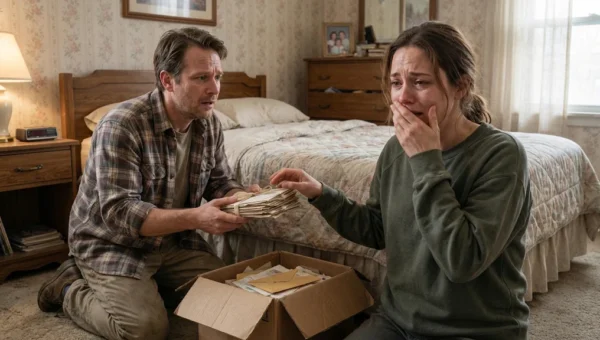
“Liv needs to be taken care of.”
My dad said it while he was cutting his birthday cake, like he was reminding me to take leftovers home. My brother Wes stopped chewing. I looked at the cake because I didn’t know where else to look.
Dad had just told us his house, savings, and investments would all go to Liv when he died. Not me. Not Wes. Not his grandchildren. Liv.
I was 32. Liv was 26, six years younger than me, and Dad was 63. I know the numbers sound like the start of a bad joke. They weren’t funny at our table.
We live outside a little old textile town in South Carolina. Dad’s house is the same one I grew up in, where the hallway still has a pencil mark beside the pantry showing how tall I was in fifth grade. My mom, Denise, died eight years ago. After that, Dad kept the house and most of the furniture, including her chipped blue bowl that he uses for his keys.
Liv came into his life four years ago. They married last fall.
I didn’t hate her. I want to be clear about that. I didn’t know her well enough to hate her. I thought she was too young for Dad, and I didn’t like how quickly she started making decisions about the place. I also knew I was being judgmental. Those things sat next to each other in my head, and I never sorted them out.
When Dad made the announcement, he didn’t sound angry. That almost made it worse.
“Your mother would’ve wanted Liv looked after,” he said.
Wes put his fork down. “What about the kids?”
Dad pressed the knife into the cake again. “I’ve thought it through.”
Liv leaned back in her chair. I noticed her ring catch on the edge of her water glass. She smiled, but it wasn’t the huge movie-villain smile I keep picturing when I’m mad. It was just a small smile that said she thought the hard part was over.
I said nothing. That’s the part I’m ashamed of. I drove home afterward and let my kids ask why Grandpa was giving his house away to his wife. I told them it was grown-up business, though they were old enough to hear that their grandpa had made a choice.
I could’ve called him the next morning. I could’ve asked what he meant by “your mother would’ve wanted.” Instead, I spent the first week telling myself not to make trouble. Then I started noticing things I’d seen before and explained away.
At first, they were small. Liv had changed the lock on the side door after she found it sticking. Dad used to leave that door unlocked when I came by with groceries. Now I had to text and wait. It was sensible, probably. Still, it made me feel like I needed permission to enter the house where I’d learned to ride a bike in the driveway.
Then Dad stopped taking the call from his old accountant, Mr. Sloan. He said Liv was handling the paperwork now because she was better with computers. I didn’t know that to be true or false. I only knew Dad used to complain about email and call it “that little envelope thing.”
At Sunday lunch, Liv asked how much Wes owed on his truck. She said it was a normal question because Dad had offered to help him once. Wes changed the subject. I told myself Liv was just trying to understand the family. I mean, she was married into it. That’s what people say when they want to be fair.
I kept telling myself that.
Dad gave her a set of his house keys in front of me one afternoon and said, “She’s the one who lives here now.” I was standing with two bags of groceries. He didn’t mean to hurt me. That was obvious. It still landed where it landed.
I started visiting less, which meant Liv got more say in what happened at the house. That was partly my doing. I’m not proud of that, but I need to say it plainly. I let my hurt look like distance, then acted surprised when the distance grew.
The inheritance announcement was the first time I heard the plan out loud. The next time I saw Dad, I asked if he’d changed his will.
He shrugged. “I changed what I want done.”
“That’s not the same thing.”
“Don’t start, Mara.”
I had come prepared to be calm. I’d rehearsed the first sentence on the drive over. Then he used my name like I was a child being told to get off the furniture, and I went right back to being twelve.
“I’m asking what happened.”
“Nothing happened. I’m married to Liv. I want her secure.”
“She has a job.”
“She has a life with me.”
I wanted to say she had a life with him that was younger than my daughter. I didn’t. I said, “And your grandkids?”
He sighed. “They have parents.”
I left before I said something I couldn’t take back. On the porch, I could hear the old wind chime my mom had hung there. One of its tubes made a little dull clink that never sounded right. I had heard it all my life. For some reason, that day I could barely stand it.
After that, I got nosy. Not in a proud way. I called Mr. Sloan and asked if Dad had signed papers. He wouldn’t discuss Dad’s finances with me. He said that in the patient voice people use when they’re trying not to tell you you’re being rude.
“I’m not asking for numbers,” I said.
“You’re asking about a private client.”
“I’m his daughter.”
“And I’m his accountant.”
That was that.
I drove to Dad’s house the next day with a box of Mom’s old recipe cards. It was a weak excuse. The cards had been in my closet for years, and I could’ve mailed them. I wanted to see what was going on, and I knew it.
Liv answered the door. She was wearing Dad’s old sweatshirt, the gray one with the frayed cuff. I had bought it for him for Father’s Day years ago. That sounds petty, but I noticed it right away.
“I thought he was expecting you,” she said.
“He is. I called.”
She looked down at the recipe box. “What’s that?”
“Mom’s cards.”
“Those are yours. Why bring them here?”
I didn’t have a good answer. “He might like to see them.”
She moved aside, but she didn’t step away from the doorway. I squeezed past her and went to the kitchen.
Dad was at the table with a stack of mail. He had one of Mom’s cards in his hand, the one for apple cake. The ink had faded where she’d written “more cinnamon if you like it spicy.” Mom wrote that on everything, even things that didn’t have cinnamon.
“I thought you said you were bringing the cards,” he said.
“I did.”
He placed the card down carefully. “Thanks.”
I sat across from him. Liv stayed by the counter. I remember there was a tiny tear in the paper on the sugar bag, and the sugar had spilled in a thin line near the wall. I don’t know why I remember that. Maybe because everything else was so ordinary.
“Dad, do you remember Mom’s lawyer?”
He looked at me over his glasses. “What lawyer?”
“Mr. Harlan. The one who did the estate papers after she got sick.”
Dad rubbed his thumb along the corner of the recipe card. “That was a long time ago.”
“It was eight years.”
“Feels longer.”
Liv pulled out a chair, then didn’t sit. “Why are we talking about this?”
I looked at her. “Because Dad said Mom would’ve wanted you to get everything.”
She shook her head. “He told me what he was doing. I didn’t tell him to.”
“I didn’t say you did.”
“Your face says it.”
I was caught. I couldn’t make myself deny it. I was angry at Dad, but Liv was the one in the room, so I kept pushing at her.
Dad put the card back in the box. “I’m not changing my mind.”
I asked if he’d talked to Mr. Harlan. He said yes. I asked when. He said he couldn’t remember. Liv said they’d gone to see him in February. It was June.
I asked if the house was already in Dad’s name.
Dad stared at me for a few seconds, then said, “It’s my house.”
That should’ve been the end of it. It wasn’t. After I left, I remembered a blue folder in my mom’s desk. Not a deed or anything dramatic. Just a folder labeled “House papers,” in the same square handwriting she used on the labels for freezer containers.
I’d seen it after the funeral. I’d put it back because it seemed like something Dad should handle. I’d forgotten it existed until that afternoon.
I called my aunt Marcy, Mom’s older sister. She had helped Mom sort bills during the last year she was sick. I asked if she remembered the folder.
“Oh, the trust papers?” she said.
I sat down on my front steps. “What trust papers?”
There was a pause. Then Marcy said, “I thought Randall told you.”
He hadn’t.
Mom had worked with Mr. Harlan to set up a trust after her cancer came back. She had been worried about the house and the money she’d inherited from her parents. Dad had been in and out of the hospital that year with a bad heart rhythm. She wanted him to stay in the house as long as he wanted, but she wanted what she had brought into the marriage to pass to her grandchildren after he died.
The word “trust” made me think of rich people and expensive lawyers. Mom was not rich. She worked at a dental office for 28 years and kept coupons in a jar. But she had inherited a small rental property from her parents, and she’d sold it before she got sick. She used the money to pay off the house and put the rest into investments.
“Was it really set up that way?” I asked.
“Yes,” Marcy said. “I was there when she signed it.”
I had to ask the question I didn’t want to ask. “Why didn’t Dad tell us?”
“I don’t know, honey. You’ll have to ask him.”
I called Mr. Harlan. He was old enough that I remembered him wearing suspenders when I was a kid. He asked me to come to his office with proof I was Mom’s daughter. I brought my birth certificate and Mom’s death certificate, and I felt ridiculous carrying them in a folder like I was applying for something.
Mr. Harlan showed me the trust. He explained it slowly. Mom had moved the house and her investment account into it. Dad had the right to live in the house and use the income from the account while he was alive. He could manage the property. He couldn’t leave those things to Liv, because they weren’t his to give away.
When Dad died, what remained would go to Mom’s grandchildren. My children, and Wes’s son.
I asked if the will could undo the trust.
“No,” he said. “The will can cover what Randall owns outside it. It can’t change this.”
“How much is outside it?”
“I can’t tell you that. I can tell you what your mother put in the trust.”
I left with a copy. I put it in my passenger seat and didn’t touch it at first. I kept thinking about Mom at that office, signing her name while she was sick. I also thought about Dad. Had he forgotten? Had he known and decided to ignore it? I couldn’t tell from the papers.
I was angry enough that I wanted a clean answer, and I didn’t have one.
For a few days, I did nothing. I kept the copy in my glove box. I went to work. I made dinner. I took my daughter to a dentist appointment and listened to her complain that the office smelled like grape toothpaste. The trust sat beside my insurance card.
Then Dad called. He sounded tired.
“Liv says you’re trying to get a lawyer to take my house.”
“I’m not.”
“You went to Harlan’s office.”
“I asked about Mom’s papers.”
“He told you there’s nothing to worry about.”
“He told me the house and the account are in Mom’s trust.”
Dad was quiet. I heard him tap something on his end of the call, the way he taps his thumbnail on a table when he’s thinking.
“I thought I could change that,” he said.
“You told me you’d talked to Mr. Harlan.”
“I talked to him about my will.”
“Did you tell him you wanted to leave the house to Liv?”
“I told him I wanted Liv provided for.”
It was almost the same line he’d used at the cake. I asked if he wanted me to bring the papers over. He said no. Then he asked if I still had Mom’s blue bowl.
That was how the call ended. Not with an apology. With the blue bowl.
I told Wes what I’d found. He wanted to call Dad right away. I asked him not to. I was worried if we came at Dad together he’d think we were trying to take something from him, which was true in one sense. We wanted him to follow Mom’s plan. But we also wanted the house. We wanted our kids to have a piece of the family that still felt like Mom.
Wes said, “He’s allowed to be mad.”
“I know.”
“You’re doing it because you feel bad you stayed away.”
That stung because it was true. I didn’t tell him that. I said I’d handle the papers at the next family dinner. Dad had invited everyone over for his birthday do-over, because the first cake had been store-bought and apparently he wanted a proper one. He said this on the phone, like nothing was wrong.
I almost didn’t go. Then I thought if I didn’t, Liv would be the only one there when Dad talked about his plans. I was still scared of making things worse. I went anyway.
The dinner was on a Thursday. I brought a pan of green beans and Mom’s blue bowl, though Dad hadn’t asked for it. I put it on the counter and kept touching the rim with my thumb. It had a little rough spot from when I dropped it when I was sixteen.
Liv set the table. She had used the good plates. Dad was showing my son how to open the old kitchen window that stuck in summer. Wes sat at the end of the table and didn’t say much. Everyone was acting normal with so much effort it was almost funny.
Dad raised his glass after the meal. “I want to say something about my plans.”
Liv looked at him. I could tell she already knew what he was going to say.
He started talking about making sure she was safe. He said he’d changed his will and wanted her to have his savings. He said the house would be hers, too. His voice got softer when he said “the house.” That was where Mom used to sit at the kitchen table and cut coupons. That was where Dad had carried her to the car on the last day she could walk.
I put my fork down.
“Dad, the house isn’t yours to leave.”
The room stopped. I hate that sentence. I hate that I said it in front of everybody. I hate that I had to.
He turned toward me. “What are you talking about?”
I took the trust papers out of my purse. I’d put them in a manila envelope, and the flap had come unstuck while I drove over. The pages were bent at one corner.
“Mom put the house and her investments in a trust,” I said. “You can live there. You can use the money. You can’t leave those things to anyone.”
Dad’s glass tipped in his hand. He caught it, but not before some of his drink spilled across the table. Liv reached for a napkin and knocked her fork onto the floor.
“That isn’t right,” Dad said.
I slid the first page across to him. “Mr. Harlan confirmed it.”
He read the first few lines. His mouth stayed open a little. Then he sat back, and I saw how tired he looked.
“Denise never told me that,” he said.
I didn’t know what to say. I wanted to tell him she had. I wanted to tell him he’d forgotten. I didn’t know either thing.
Liv picked up the napkin she’d dropped. “So what happens to me?”
The question wasn’t smug. It was scared.
I looked at her and wished I’d understood that earlier. She had moved into a house that still belonged to a dead woman in every way that mattered. Dad had told her it was his. I’d been sure Liv wanted it. Maybe she did. But she had also believed him.
“Dad can leave you whatever he owns outside the trust,” I said. “And you can stay in the house while he’s alive.”
“After?”
I didn’t answer right away.
Dad picked up the page and read it again. “After I die, it goes to the grandkids.”
“That’s what Mom wrote.”
He put the paper down. His thumb moved over Mom’s signature. It looked smaller than I remembered.
Liv looked at him. “Did you know about this?”
“No.” He spoke too fast. Then he rubbed his forehead. “I don’t think I did.”
I could’ve used that opening to demand an apology. I could’ve asked why he’d told us we meant nothing to him. Instead, I asked if he wanted me to call Mr. Harlan the next morning.
Dad nodded. “I guess I need to.”
Liv folded the napkin over the spill. “I’m not asking for something that isn’t mine.”
No one spoke for a second.
I believed her then. I think I did. I also knew belief didn’t fix the part where she’d enjoyed the idea of getting the house, or the part where Dad had looked at his own children and decided they didn’t need a thing from him. People can mean well and still hurt you. I’m learning that late.
The next morning, Dad and Liv met with Mr. Harlan. Dad updated his will to leave Liv his personal savings and anything else that was his to leave. He didn’t try to challenge the trust. The house stayed in the trust, and Liv could live there for the rest of Dad’s life. Afterward, the house and the remaining account would go to the grandchildren.
That was the legal part. The family part took longer.
Dad didn’t apologize to me at once. For two weeks, he called to talk about small things. The lawn mower. A bill. Whether my son still liked baseball. I answered because I wanted to hear his voice, though I didn’t want to admit that.
Then, one Sunday, he said, “I’m sorry I made it sound like you didn’t matter.”
I was unloading the dishwasher. I had a plate in my hand and kept drying the same wet spot with a dish towel.
“Okay,” I said.
“I don’t expect that to fix it.”
“It doesn’t.”
“I know.”
That was all. I could feel myself wanting to make it easier for him. I’ve done that all my life. I told him I’d bring the kids over next weekend.
Liv was there when we arrived. She had made coffee. She asked if I wanted it in Mom’s blue bowl, then caught herself and laughed a little.
“I mean the blue bowl for the sugar,” she said. “I’m still learning what goes where.”
I almost laughed, too. It wasn’t a warm, close moment. It was just a small one.
Dad put the trust papers in the kitchen drawer with his tax forms. I asked him to keep a copy somewhere safer, and he said he would. I checked a month later. The copy was still in the drawer. That sounds like Dad.
He has not changed his mind about leaving Liv what he can. I don’t love that, but it’s his choice. I’ve stopped saying “everything” when I tell the story, because it wasn’t everything. It was the house and the money Mom put away, and that was plenty.
The trust didn’t make our family whole. It didn’t give Mom back, and it didn’t undo the way Dad said it at the table. It did tell me Mom had thought about the kids, even when I wasn’t there to hear her say it.
At the next dinner, Liv passed me the blue bowl, and Dad didn’t say whose it was. I took it carefully, because the rough spot on the rim was still there.