PART 1
My mother tucked twenty-dollar bills into novels her whole life, so after the burial we sat on her living room floor and fanned every paper edge in the house. We spent three days shaking cookbooks, encyclopedias, and Reader’s Digest anthologies over her braided rug. We found an envelope with seven hundred dollars behind the pantry soup cans, but between the covers of her bookshelves, we turned up nothing.
When the house was empty, my brother Mark took one heavy, leather-bound Webster’s dictionary off her nightstand. He didn’t care about looking for words; he just liked the dark calfskin and the gold foil lettering along the spine.
Two years went by. My life settled back into the quiet routine of managing the reference desk at our town library on Elm Street.
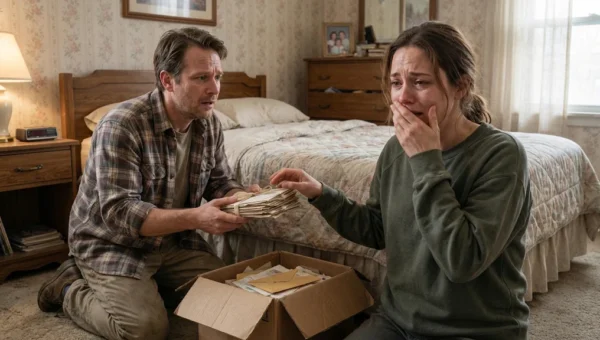
Then last Thursday evening, Mark drove forty minutes to my kitchen without calling first. He set that same thick dictionary right on my laminate table. The leather along the back binding had dry-rotted and cracked straight down the middle.
“I dropped it on the floor when I was moving my desk,” Mark said. His hands were dusted with crumbled book glue. “Look inside the hollow of the spine.”
I pulled the cardboard backing away. Tucked tight into the crevice between the binding cloth and the stitched pages was a short strip of gray 35-millimeter microfilm, wrapped in waxed paper and secured with a yellowed strip of cellophane tape. It had no labels.
“You know how to read these at work, right?” Mark asked.
I took the film to the library the next morning before our doors opened at nine. I threaded the film through the spools of our Minolta reader on the second floor and turned the focus dial until the black-and-white negative snapped into view.
It was not cash, and it was not a family diary.
The first frame was a scanned petition from the family branch of the county circuit court, stamped October 14, 1979. The heading read: *In the Matter of the Placement and Sealed Custody of an Unnamed Female Minor.*
My parents’ names, Robert and Helen Henderson, were typed on the second page. But they were not listed as mother and father. They were listed under a section titled “Temporary Custodial Guardians by Voluntary Surrender.”
I sat in the dark microfilm room, listening to the cooling fan of the projector.
I was born in July of 1976. In October of 1979, I was three years old. I had grown up believing I was born to Helen in the county hospital five miles away.
I called an attorney I knew through our town preservation board, and on Friday morning he walked me over to the county courthouse to file an emergency petition for an unsealed certified copy of the complete file. Because both people named as my legal parents were deceased, the presiding judge signed off on the release by Tuesday afternoon.
A clerk handed me a sealed kraft envelope containing twenty-eight photocopied pages.
Mark met me on the wooden bench outside the records office. My fingers shook as I sliced the envelope with my thumbnail.
The first page inside was an amended birth decree. It showed that on November 2, 1979, my legal name had been changed from Claire Diane Vane to Claire Marie Henderson.
I had never heard the name Claire Vane in my fifty-two years of living.
Mark looked over my shoulder, his finger coming down hard on the typewritten surname on the original surrender form.
“Vane,” Mark whispered. His voice went completely thin. “Rose Vane. That was Grandma’s neighbor on Maple Street.”
Rose Vane was the quiet, unmarried woman who lived in the green cottage three doors down from my grandmother. She was the woman who had baked apple tarts for every birthday I had as a child, the woman we had called Aunt Rose all our lives.
PART 2
Mark and I sat on that courthouse bench for nearly twenty minutes without speaking. The paper felt heavy between my fingers.
On the fourth page of the decree, there was a certified medical statement signed by a physician in Canton, Ohio. It recorded the birth of a female infant on July 8, 1976, to Rose Marie Vane, age twenty-two, unmarried, employed as a telephone operator. The father was listed as unknown.
Beside that was the signed voluntary relinquishment agreement. Rose Vane had signed her name in neat, slanted cursive at the bottom of the page. Two lines below her signature were the names of my parents, Helen and Robert Henderson.
The agreement specified that Helen and Robert would assume all legal and financial responsibility for the child, but with one handwritten stipulation entered into the court record: *The child shall remain in geographic proximity, and the natural mother shall retain informal visitation rights under the guise of an extended family friend, so long as the true maternity is never formally disclosed to the child.*
I looked at Mark. His eyes were wide, staring at our parents’ signatures.
“Did you know?” I asked. My voice sounded flat and unfamiliar in my own ears.
“I was seven when they brought you home from Ohio,” Mark said, leaning his elbows on his knees. “I swear to you, Claire, Mom told me you had been staying with our great-aunt because you were born sickly and had to be in a hospital with better doctors. I never doubted it. Mom kept baby clothes in the cedar chest and baby pictures of you in the silver album.”
“She kept pictures of me after I was three,” I said.
I remembered that album clearly. There were no photographs of me as a newborn. There was only a studio portrait taken when I was a toddler in a yellow dress, sitting on a wooden bench with curly brown hair. I had always assumed the earlier pictures were lost during the move from Ohio when my father changed jobs.
We got into my sedan and drove straight to the small cemetery behind Saint Luke’s church. Rose Vane had passed away six years ago, four years before my mother died. Her grave was marked with a modest granite footstone that read simply: *Rose M. Vane, 1954–2020. A Gentle Soul.*
I stood over the grass, looking at the carved letters.
I remembered Rose coming to my high school graduation in 1994. She had sat in the fourth row, two seats down from my parents, wearing a lavender linen suit. She had given me a small gold locket with an engraved ivy leaf on the front. At the time, I thought it was just the generous gift of a friendly neighbor who had known our family forever.
When I had my own daughter in 2002, Rose was the first person to arrive at my house with two handmade flannel blankets. My mother had stood in the kitchen doorway watching her hold the baby, her arms crossed over her apron, her face tight and quiet. I had thought my mother was just protective.
Now, every holiday dinner, every birthday card signed *With Love, Aunt Rose*, and every drop-in visit on Maple Street took on a different shape.
“Why did Mom hide the film in the dictionary?” Mark asked, looking down at the gravel path. “If she wanted us to never know, why didn’t she just burn it?”
“Because she couldn’t bring herself to destroy the legal truth,” I said. “And she was terrified I would find it while she was alive.”
I turned back toward the car. There was only one person left alive who had lived on Maple Street during those years: Rose’s older sister, Evelyn, who was now eighty-four and living in an assisted living apartment on the south side of town.
PART 3
We walked into the Sunnyvale Senior Living lobby at three that afternoon. Evelyn was sitting in an armchair by the courtyard window, knitting a blue baby sweater with a ball of wool resting in her lap.
When she looked up and saw me standing in the doorway with Mark, her needles stopped clicking.
She took off her wire-rimmed glasses and let them hang on the chain around her neck. She looked at my face, then at the manila envelope I was holding against my coat.
“You found the papers,” Evelyn said quietly. She did not sound surprised. She sounded tired.
“We found the court records from nineteen seventy-nine,” I said, pulling a wooden chair up close to hers. “Evelyn, why did Rose give me away?”
Evelyn set her knitting basket on the floor and smoothed the wool across her lap.
“Rose was twenty-two, Claire,” Evelyn said, her voice raspy from age. “She worked night shifts at the switchboard. In nineteen seventy-six, a girl having a baby without a husband in our county was treated like a disgrace. Our father told Rose that if she kept the baby, she could not live under his roof, and she didn’t have enough money to rent a room of her own.”
“Then why didn’t she let a family outside the county adopt me?” I asked.
“Because she couldn’t bear to let you disappear,” Evelyn said. She reached out with a thin, spotted hand and touched the sleeve of my coat. “Your mother, Helen, had suffered three miscarriages after Mark was born. The doctors told her she would never carry another pregnancy to term. Helen was desperate for a daughter. Rose was desperate for you to have a decent home, a yard, and two parents who could provide for you.”
Evelyn leaned back into her chair, looking out at the maple trees in the courtyard.
“They made a pact,” Evelyn continued. “Your mother paid the medical bills from the birth in Canton, and your father hired a private attorney who handled sealed placements. But Rose made one non-negotiable demand: she had to be able to see you grow up. Helen agreed, but Helen was terrified every single day that Rose would change her mind. That was why the court sealed the file, and that was why your mother made Rose swear on a Bible that she would never tell you she was your mother. Rose lived three doors down just so she could watch you walk to the school bus every morning.”
I sat in that small room, the scent of lavender hand lotion and old paper around us, and I felt forty years of my life rearranging themselves in my mind.
I remembered walking down Maple Street when I was ten, pushing my bicycle with a flat tire. Rose had come out onto her porch with a glass of lemonade, taken the wrench from her garden shed, and helped me tighten the chain. She had looked at my hands and told me, “You have your mother’s long fingers.”
I had thought she meant Helen. She was talking about herself.
“Did my father know about the microfilm?” I asked.
“Your father died in nineteen ninety-six,” Evelyn said. “Helen was the one who kept the copy of the court record. About ten years ago, when Rose got sick with the cancer, Rose asked Helen if they could finally tell you the truth together. Helen refused. Helen told her that if you knew, you would hate them both for lying to you for thirty years. Rose died with that promise unbroken.”
Tears ran hot down my cheeks, but I didn’t wipe them away.
“She loved you, Claire,” Evelyn whispered. “Every choice she made was to keep you safe and close enough to see.”
ENDING
Mark and I drove back to my house in the fading autumn light.
We didn’t talk about anger or betrayal. When you are fifty-two years old, you understand that young people backed into corners in the nineteen seventies made terrible, desperate bargains just to survive. Helen had loved me with a fierce, possessive devotion that bordered on terror, and Rose had loved me with a silent, disciplined grief that kept her standing on the sidelines of my entire life.
That evening, I went up to my bedroom and opened the small wooden jewelry box I had kept since high school.
I took out the gold locket Rose had given me for graduation. For thirty years, it had remained empty. I had never put a photograph inside because I had never found one small enough to fit the tiny oval frame.
I took the scissors from my sewing drawer and pulled out the faded snapshot from my mother’s silver album, the one of me sitting on the wooden bench at three years old, just before my name was changed. Then I found an old newspaper clipping from the local gazette showing Rose receiving an award for thirty years of service at the telephone company.
I trimmed both tiny portraits until they fit into the two halves of the locket.
On the left was the mother who gave me up so I could eat. On the right was the little girl who didn’t know she was being watched with love from three doors away.
I snapped the locket shut and hung the chain around my neck.
I walked down the hallway to the kitchen, where the cracked leather dictionary still sat on the table. I picked up the heavy book, carried it into the living room, and placed it back on the center of the wooden shelf, right between the family Bible and the history books.
The secret was out of the binding now, but the home was still standing.