PART1
My father skipped my graduation and told relatives he had been too busy to watch me receive my degree. I pretended it did not matter, even when I saw his truck parked outside the building that morning. After the ceremony, the dean handed me a small package. Dad had left it at the office before he drove away. Inside was his old wristwatch and a note saying I should wear it when I was ready to hear why he had never attended an important day in my life.
I thought it was an apology. The watch stopped at 2:17, the exact time my mother died. When I opened the back, I found a tiny photograph tucked beneath the gears. The person standing beside her was not my father.
It was a man I had never seen before in my life, smiling and holding my mother’s hand on a beach somewhere I did not recognize. The shock of it made my knees unsteady right there in the quiet administrative office, the diploma tube heavy and awkward under my arm. For twenty-two years, my father had played the role of the grieving widower who dedicated every breath to raising his only child after a sudden car accident took my mother away. He lived in the same drafty house, worked the same grueling shifts at the metal foundry, and carried an aura of perpetual exhaustion that made me feel guilty for ever asking for new shoes or college tuition help.
He had always blamed himself for the accident, claiming he was the one who sent her out to the grocery store on that rainy Tuesday afternoon. That was the core story of my childhood. We were survivors clinging to each other in a cold house, bound together by the ghost of a saintly mother and a heartbroken father.
Standing in the hallway with the ticking-stopped watch cold in my palm, that entire foundation cracked down the middle. I walked out to my old sedan in the campus lot, my graduation cap tossed onto the passenger seat, and drove straight home with my hands gripping the steering wheel until my knuckles turned white. The house looked smaller than it had when I left it that morning, the peeling white paint on the porch rail looking more pathetic than quaint. His truck was already parked in the gravel drive, the engine block cool.
I let myself in through the back door, stepping over the threshold where my father had greeted me with a silent nod three hours earlier. He was sitting at the kitchen table in his work shirt, staring at an empty coffee mug as if he had been frozen in place since dawn.
When I dropped the silver watch onto the Formica table, it slid with a sharp metallic clatter. He did not jump. He did not look surprised. He simply closed his eyes for a long moment, his shoulders sinking another inch beneath the weight of a secret he had carried for over two decades.
PART 2
You found it, he said, his voice dry and raspy like sandpaper rubbing against wood.
I stood across from him, my chest heaving with a mixture of fury and terror. Who is that, Dad? Who is that man with Mom? Why was his picture hidden inside your wedding watch?
My father slowly reached out, his calloused thumb brushing the edge of the silver casing before pulling his hand back as if the metal burned him. That man is Arthur Vance, he whispered. And your mother was never going to the grocery store the day she died. She was packed and leaving us. She was taking you with her, and Arthur was waiting for them at the motel three towns over.
The words hit me like physical blows. I stepped back, my back hitting the pantry door. You are lying. Mom loved you. You always said she loved this life, this town, us.
She loved the idea of something better, my father corrected bitterly, though there was no triumph in his voice, only a bottomless hollow fatigue. She met Arthur at the library where she volunteered. He had money, or at least the promise of it, and he wore suits that did not smell like machine oil and iron. I found out about them three weeks before the crash. I found the letters tucked inside a cookbook. When I confronted her that morning, she did not apologize. She told me she was taking my four-year-old daughter away, and that I would only see you on holidays if I behaved.
A cold numbness crept up my arms. If she was leaving, why did she die in the car?
That is the part that haunted me every single day of my life, he said, finally looking up to meet my eyes, his own eyes bloodshot and rimmed with red. She drove off in a rage after our fight. She was crying so hard she could not see the road near the old mill bridge. The truck hit a patch of black ice, and she went over the guardrail. I was the first one at the scene because I followed her car, hoping she would calm down. I pulled her out of the wreckage before it caught fire, but she was already gone. Arthur never showed up at the hospital. When he heard she crashed, he packed his bags and left the state by nightfall. I had to bury the wife who was running away from me while pretending to the whole world that I had lost an angel.
I stared at him, my mind desperately trying to reconcile the monster I had just imagined with the stoic, broken man sitting before me. But why did you lie to me all these years? Why make her a saint?
Because you were my little girl, he said, his voice breaking for the first time. How do you tell a child that her mother chose someone else over her? How do you poison a kid’s memory of the only parent she had left? I took the blame. I let everyone think I was the stern, difficult husband who lost his wife to bad luck, because the truth would have ruined you.
PART 3
I walked out of the kitchen and wandered through the quiet rooms of the house, looking at framed photographs on the hallway walls with entirely new eyes. Every picture of my mother now looked like a performance, a trapped expression behind a forced smile. I realized then why my father had always been so distant, why he never remarried, and why he looked at me with a mixture of fierce protection and quiet sorrow whenever I achieved something milestones like graduations, driving tests, or birthdays. I was the physical manifestation of the worst day of his life, yet I was also the only reason he had kept breathing.
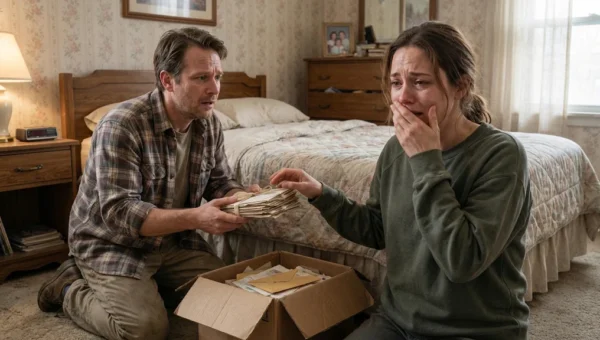
By evening, I returned to the kitchen. My father was still sitting at the table, now with a small cardboard box between his elbows. Inside were old bank statements, a police report from the accident that I had never been allowed to see as a kid, and a second letter—not the one from the watch, but a letter my mother had written to Arthur Vance the night before she died.
I sat down opposite him and picked up the paper. The handwriting was neat, looping, and entirely unfamiliar. She wrote about how suffocating her life with my father was, how she could not bear another winter in a mill town, and how she was bringing me to start fresh. There was no mention of my father’s abuse or cruelty, only a cold, practical detachment that hurt worse than anger. She simply wanted out.
You kept all of this? I asked softly, tracing the edge of the police report.
I kept it so I would never forget why I had to forgive her, and why I had to forgive myself, my father said. I wanted to burn it a thousand times, but hiding it felt like keeping the truth alive so nobody could rewrite our history again. Today is your graduation. You earned that degree on your own merit, not because of her memory or my sacrifice. But you deserved to know the foundation you were standing on.
I placed the papers back into the box and slid it toward him, then reached across the table and placed my hand over his calloused knuckles. He flinched slightly in surprise before turning his hand over and gripping mine tightly, his grip trembling as the years of silence finally began to dissolve between us.
ENDING
We sat together in the fading twilight for a long time without turning on the overhead light, the hum of the old refrigerator filling the quiet space where so many ghosts had lived. The lie that built my childhood was gone, replaced by a messy, painful truth that did not make my mother a saint or my father a villain, but simply two human beings who broke under impossible pressure.
The next morning, I took the old silver watch to the local jeweler down on Main Street. He opened the back, replaced the rusted spring, and set the hands moving forward again past 2:17. When I put the watch on my wrist, it felt heavy and loose, sliding slightly down my forearm with every movement. I did not take it off. It was not a memento of a perfect mother or a bitter inheritance. It was simply the proof that we had survived the wreck, and that real life only starts when the stories we tell ourselves finally come to an end.