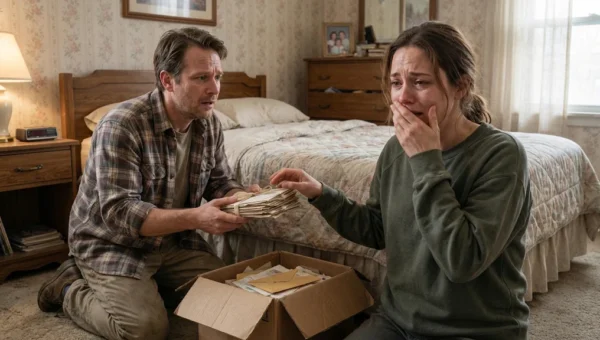
PART 1
For twenty-two years, my husband Robert called my painting business a harmless little hobby.
Whenever friends came over to our split-level home in Oak Ridge, he would smile over his gin and tonic and steer them away from the converted sunroom off the kitchen. If someone noticed the faint smell of linseed oil or caught sight of an easel through the glass doors, Robert would chuckle and wave his hand. “Susan likes to dabble when the laundry is done,” he would say. “It keeps her out of trouble.”
He never allowed a single one of my canvases on our walls. Our living room held framed department store prints of European courtyards, picked out by his mother before she passed. He told me real homes needed polished decor, not experiments from the backyard porch. I accepted it because I loved him, because my small commissions for local pet portraits and church programs brought in just enough grocery money, and because I thought he was simply an orderly, traditional man.
Then the county hospital foundation asked local artists to donate works for their annual charity gala.
I spent three months working on a large oil landscape of the old stone bridge over Indian Creek at sunrise. I stretched the thirty-six-by-forty-eight canvas myself. When I carried it out to Robert’s sedan on the evening of the auction, he looked at it in the trunk and sighed.
“Don’t get your hopes up, Susan,” he said, adjusting his cuff links in the rearview mirror. “People bid on the vacation packages and the country club passes.
These charity crowds just buy art to be polite. We will be lucky if it clears the reserve so you don’t have to haul it back into the basement.”
At the gala, they placed my painting on an easel near the double doors of the ballroom. Bidding started at five hundred dollars.
I stood near the coffee station, holding my small beaded clutch, watching the digital auction board update on the wall. The price climbed past twelve hundred dollars in five minutes. Then two men in tailored suits began counter-bidding across the floor. By nine o’clock, the auctioneer took the stage for the final live lot.
The gavel came down with a sharp crack at $18,000.
The room broke into polite applause. My fingers went completely cold against my bag. Eighteen thousand dollars. It was more than I had earned in five years of selling prints out of my craft shed.
Robert stood beside me with his champagne glass frozen halfway to his mouth. His neck went stiff, his jaw working like he had bitten into gravel.
A woman in a navy silk dress walked over from the high-top tables near the stage. She had silver hair cut blunt at her shoulders and wore a heavy gold watch. She walked directly up to me, smiling with genuine warmth, and offered her hand.
“Mrs. Miller?” she said. “I am Evelyn Cross. Your light work on that stone bridge is remarkable. I have been looking for an original like this for two years.”
“Thank you,” I managed to say, shaking her hand. “That means the world to me.”
Evelyn turned her eyes toward Robert, who had taken a deliberate step back toward the curtain line. Her smile vanished in an instant. Her eyebrows drew together as she looked at his face, then down at his hands, then back to his eyes.
“You still use the name Charles?” she asked.
Robert did not answer. He grabbed Evelyn firmly by the crook of her elbow, his knuckles white against her dark silk sleeve.
“You have mistaken me for someone else, ma’am,” he said, his voice flat and hard.
He pulled her away from me toward the side corridor before she could say another syllable. But as he dragged her back, Evelyn’s hand reached behind her hip and pressed her white cardstock bidding paddle into my palm.
I looked down at the back of the card.
Scrawled in blue ballpoint ink was a street address across town: 414 North Elm Street. Underneath the address was a single date: October 14, 2004.
October 14, 2004 was our wedding day.
Robert returned forty seconds later, breathing hard, smelling of mints and sweat. He snatched the paper from my fingers, saw the address, and crumpled it inside his fist.
He leaned close to my ear, his voice barely a rasp over the chatter of the ballroom. “If you go there, Susan, our marriage is over.”
PART 2
Robert did not speak a single word on the thirty-minute drive home.
He drove with both hands locked at ten and two on the steering wheel, staring straight through the windshield. When we pulled into our driveway, he left his car running, got out, walked directly to the trash barrel by the garage, and dropped the crumpled bidding card into the bottom.
I stayed in the passenger seat until he went inside and shut the front door.
Once the kitchen lights went on, I stepped out into the damp night air. I fished the paper out from under an empty detergent jug. The paper was crushed, but Evelyn’s handwriting was clear: 414 North Elm Street. October 14, 2004.
I folded it into the coin purse inside my clutch and went into the house.
Robert was standing at the kitchen island, pouring three fingers of bourbon into a tumbler. He had already pulled off his bow tie and left it crumpled on the granite counter.
“Who was that woman, Robert?” I asked. I kept my voice low and calm, standing near the refrigerator. “Why did she call you Charles?”
“She is an unstable client from my old regional firm,” he said without looking at me. He took a long swallow of the whiskey. “Her family lost a lot of money in an investment trust fifteen years ago. She blames every partner who worked the accounts. She confuses faces. She made a scene because she saw an opening.”
“She knew our wedding date,” I said.
Robert slammed the glass down on the counter. The amber liquid splashed over the rim, pooling against the marble.
“She knew a date that means something to you, Susan, because people like her look up public records before they come to these charity functions. She wanted to rattle you, and you fell right into it.” He leaned both hands on the island and stared directly into my eyes. “I gave you a life. I gave you twenty-two years in this house. You sold one painting tonight, and now you want to tear our family apart over the ramblings of a stranger in an auction hall?”
“I am asking an ordinary question,” I told him.
“You heard what I said at the hall,” he replied. His voice was cold, deliberate, and entirely steady. “You stay away from Elm Street. If you go digging into things that don’t concern you, I will pack my bags and you will manage this property on your own. Let’s see how far your art takes you then.”
He walked down the hallway into the master bedroom and locked the door behind him.
I sat at the kitchen table until five in the morning. I didn’t cry. I thought about twenty-two years of small, quiet erasures. I thought about the time I wanted to sell prints at the county fair, and he told me it was tacky. I thought about the four separate times a local gallery owner reached out to visit my studio, and Robert answered the house phone, telling them I was purely an amateur who did not take outside representation.
At seven o’clock on Monday morning, Robert left for his consulting office downtown.
The minute his car turned the corner of our street, I took my purse and my car keys.
North Elm Street was on the old north side of the river, an industrial pocket where textile warehouses had been converted into small print shops, auto repair garages, and artist studios. Number 414 was a two-story red brick warehouse with weathered green double doors and a brass plaque by the buzzer: *Cross & Vane Fine Art Restoration*.
I sat in my sedan across the street for ten minutes, watching the morning traffic. Then I got out, walked up the concrete steps, and pushed open the heavy wooden door.
The smell inside was familiar: linseed oil, dammar varnish, dry canvas, and turpentine.
Evelyn Cross sat at a large oak drafting table under three industrial lamps, wearing a gray linen smock and magnification glasses. She was holding a tiny camel-hair brush, working on the corner of a nineteenth-century portrait.
When the brass bell above the door chimed, she looked up. She took off her glasses and set the brush down across a ceramic rest.
“I wondered if you would come, Susan,” she said quietly.
“Tell me why you know my husband,” I said. “Tell me why you called him Charles.”
Evelyn stood up, walked to a metal filing cabinet in the corner of the room, and pulled out a wide gray archival box. She carried it over to a clean wooden work table in the center of the studio and lifted the lid.
“His legal name is Charles Robert Miller,” Evelyn said, looking directly at me. “And before he married you, he was married to my sister, Claire.”
PART 3
The air seemed to leave the room.
Robert had told me he was a lifelong bachelor when we met at a community college lecture series in the spring of 2003. He had told me his parents were gone, his extended family was scattered across the west coast, and he had spent his thirties working eighty-hour weeks in corporate accounting. We had a quiet civil ceremony with twelve guests.
“Claire was a landscape painter,” Evelyn continued, her voice tight with decades of kept anger. “A real one. She studied in Philadelphia and Chicago. In 2001, she started a gallery on 5th Street with an inheritance from our grandfather. Charles did her books. He managed her contracts. He handled every dollar that came through the door.”
She reached into the gray archival box and pulled out a large, glossy exhibition catalog from 2002.
On the cover was a photograph of an oil painting. It was a study of a riverbank at dusk, painted with the exact same sweeping brush strokes, the same violet undertones, and the same distinct treatment of morning light on water that I had spent thirty years teaching myself to render.
Beneath the image was the title: *Claire Cross Miller – Solo Retrospective*.
“Claire was brilliant, but she had severe clinical depression,” Evelyn said. “She trusted Charles with everything. By 2003, Charles had systematically transferred the gallery’s operating accounts into his own private LLC. He took out two loans against her copyright catalog. When Claire found out, she confronted him in this very building.”
“What happened to her?” I whispered.
“She filed for divorce,” Evelyn said. “She demanded a full forensic audit of the books. Two weeks before the court hearing, she had a massive breakdown. She checked into a residential care facility in Vermont. Charles settled the divorce out of court through her appointed guardian. He walked away with nearly four hundred thousand dollars of her business assets, changed his operating name to his middle name, Robert, and vanished from the regional art scene.”
Evelyn reached back into the box and pulled out a folded copy of a county court settlement.
At the bottom of the page, dated October 14, 2004, was a final judgment order.
“October 14th wasn’t just your wedding day, Susan,” Evelyn said. “That was the exact date the judge signed the final decree dissolving Claire’s marriage to Charles and releasing him from criminal liability for the missing gallery funds. He married you the very same afternoon the ink dried on his theft.”
I stared at the black-and-white signature on the legal paper. It was Robert’s sharp, slanted handwriting. The same signature he used on our mortgage. The same signature he used on our joint tax returns every April.
“Why did you buy my painting for eighteen thousand dollars?” I asked. My throat felt scraped raw.
“Because the moment I saw that canvas on the auction easel, I knew,” Evelyn said softly. “You have Claire’s palette. You have her exact technique with the pallet knife on the stone arches. Claire was a private instructor for three years before she got sick. Did you ever take classes at the municipal arts center in 1999?”
The memory hit me with sudden clarity.
In the autumn of 1999, before I ever met Robert, I took a twelve-week master class in landscape composition at the community center. The instructor was a quiet, thin woman with kind eyes who taught me how to mix raw umber with French ultramarine to get the deep shadow under running water. Her name was Claire.
Robert had never loved my art. He had been terrified of it.
For twenty-two years, every time I picked up a brush, every time I stretched a canvas in the sunroom, I was painting with the exact hand of the woman he had ruined and robbed. Every brush stroke in my sunroom was a reminder of the crime that bought his first corporate consulting firm.
He didn’t keep my paintings off the wall because they were amateur.
He kept them off the wall because he couldn’t bear to look at his own guilt hanging above his fireplace.
ENDING
I drove home from North Elm Street with a brown envelope containing copies of Claire’s gallery catalog and the 2004 settlement agreement sitting on the passenger seat.
When I pulled into the driveway, Robert’s sedan was already there. It was only two in the afternoon.
I walked into the house through the front door. Robert was standing in the empty space between the living room and the kitchen, wearing his overcoat, holding two leather suitcases by his feet.
“You went,” he said. He didn’t ask it. He knew.
“I went,” I said.
He picked up the suitcases and took two steps toward the front hallway. His face was gray, his mouth set in a thin, bitter line. “I warned you, Susan. I told you what would happen. You threw away twenty-two years of stability for the stories of a bitter old woman who hates my success.”
“Her name is Evelyn,” I said, setting the brown envelope flat on the hall console table. “And your first wife’s name was Claire.”
Robert stopped. For three seconds, his eyes flickered to the brown paper, then back to my face. The arrogance dropped out of his posture, leaving only the hollow, defensive look of a man whose long-running trick had finally run out of room.
“You don’t know the whole story,” he muttered, looking down at his shoes. “Claire was impossible. She would have lost that gallery anyway. I kept us afloat.”
“You took her money,” I said. “And then you spent twenty-two years telling me my work was a silly little hobby because you were terrified someone would walk into this house, see my paintings, and realize where I learned to hold a brush.”
Robert didn’t answer. He couldn’t.
He picked up his bags, walked past me through the front door, and pulled it shut behind him. The engine started, his tires crunched over the driveway gravel, and he drove away toward town.
I stood in the silence of the front hall for a long time.
That afternoon, I called my daughter in Charlotte. I told her the truth, calmly and clearly, without yelling and without tears. Then I called an attorney whose office was two blocks from the county courthouse.
Two weeks later, the hospital foundation sent the official consignment check for the auction. After the foundation’s thirty percent charitable cut, the balance came to $12,600, made out directly to Susan Miller.
I opened a separate business account at a bank Robert had never used.
By the end of October, Robert’s attorney sent over a separation proposal. He wanted to keep the house and give me a small monthly maintenance stipend. I rejected it within twenty-four hours. My lawyer filed a formal request for a complete forensic accounting of our marital assets going back to 2004, including the seed money used to establish his consulting firm. When Robert’s counsel saw the paper trail from the 2004 settlement, they changed their tone.
The house was put on the market in November. When it sold in the spring, we divided the equity straight down the middle.
I moved into a two-bedroom brick bungalow four blocks from the river, not far from the arts district. The second bedroom has three tall north-facing windows that let in clean, indirect light from dawn until late afternoon.
On the wall above my dining table, I did not hang a print of a European courtyard.
I hung my own work: a forty-inch canvas of the old stone bridge over Indian Creek, painted with deep ultramarine shadows and warm morning light across the water. Beneath the frame, in the lower right-hand corner, my name is signed in bold, dark oil paint, clear enough for anyone who walks through the door to read.