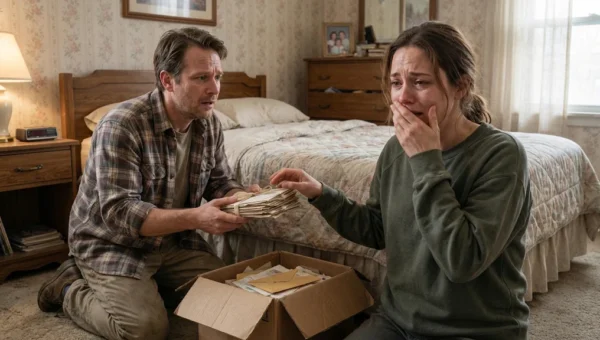
The smell of butter frosting always sticks to the curtains for days, but on my sixtieth birthday, the kitchen just smelled like cold linoleum and old cardboard. Arthur set the brown cardboard box right on the edge of the table where I usually fold the laundry. He didn’t wrap it. He just slapped a strip of clear packing tape across the top flap and told me to cut it open with the paring knife.
“Go on, Corinne,” Arthur said. He was standing with his hands shoved deep into the pockets of his slacks, rocking back on his heels the way he always did when he was waiting for everyone else to admire how generous he was being. “Open it up. We all chipped in on that one.”
His mother, Eleanor, was sitting by the window with her purse clutched in her lap like she was waiting for a bus to take her back to Abilene. Her husband, Paul, stood right behind her chair with his hand resting on the wooden back, looking down at me with that small, flat smile he wore whenever he was about to foreclose on a tractor or talk a widow down on her land price. I knew that smile. I had looked at it across our kitchen table for thirty years, ever since Arthur brought me home to the ranch house my daddy built with his own two hands back in fifty-four.
I sliced through the tape and pulled back the flaps. Inside, nestled in gray molded cardboard that smelled of a hot warehouse, sat a red plastic upright vacuum cleaner with a faded yellow cord wound crookedly around the hooks. It wasn’t even a brand I would have picked out at the hardware store down on Elm Street. It looked like something they had pulled off a clearance pallet at the salvage outlet after the box got wet.
Arthur laughed that short, dry laugh he makes when he thinks he has made a clever point. “Well? Don’t you love it? Save your back, Corinne. God knows you’ve been complaining about the old one making a racket when you do the rugs.”
“Thank you, Arthur,” I said. My voice sounded thin, like dry paper tearing in the wind. I didn’t touch the plastic handle.
“Is that all the thanks I get?” Arthur said, his voice dropping down into that teasing register he used when he wanted me to look small in front of his people. “After all the trouble we went through to haul it up from the truck? Show some appreciation, for heaven’s sake. It’s your sixtieth.”
I turned around to slide the cardboard box out of the way so I could set the birthday cake down on the table before the candles melted completely into the icing. The box was heavier than it looked, and when I shoved it back against the wall, the bottom seam caught on something stiff tucked underneath the flaps. It was a folded piece of heavy blue-tinted paper, the kind they only use down at the county courthouse when they are filing liens or registering property deeds.
I didn’t think much of it at first. I figured Arthur had picked up some old scrap paper from his desk at the grain elevator to use as packing material so the vacuum wouldn’t rattle around in transit. But then my eyes caught the top header printed in bold black capitals.
DEPT OF RECORDS AND PROPERTY. NOTICE OF ENCUMBRANCE.
“What’s that you’re digging into now, Corinne?” Paul asked, and his voice didn’t sound quite as easy as it had a second before.
He took half a step forward, his boot heels hitting the floorboards with a sharp, heavy thud.
I unfolded the paper with two fingers. The grease from the cake box had left a faint smear right across the parcel description, but the figures underneath were clear enough to read without my reading glasses. It was a legal claim against our property, our house, the land my daddy left me clear of debt before he passed. And the claimant wasn’t a bank in Amarillo or the feed and seed cooperative. It was Paul’s own machinery leasing company out of Midland.
The total listed on the bottom line was forty-three thousand six hundred and forty-six dollars.
I stopped breathing. The kitchen went so quiet I could hear the pilot light clicking away inside the white enamel stove in the corner. Forty-three thousand six hundred and forty-six dollars. It was the exact sum total of every single check I had written out of my personal savings account over the past four years to bail Arthur out of his bad cattle futures and his truck repairs and his brother’s stupid machinery debt.
“Arthur,” I said, and my hand started shaking so hard the blue paper fluttered against my thumb. “What is this?”
Arthur didn’t answer right away. He looked at Paul, and Paul looked at Eleanor, and for three seconds nobody in that room moved a muscle. Arthur finally cleared his throat, stepping over toward the table with his jaw tight. “Give me that, Corinne. You’ve had too much wine. You’re making a scene over nothing.”
“It’s not nothing,” I said. I backed away from the table, holding the paper up where the light from the overhead fixture hit the seal. “This is our house. You put a lien on my house. Through your daddy’s company.”
“It’s a formality,” Arthur snapped, his face turning that dull, mottled red that always meant he was about to lose his temper because he couldn’t talk his way out of a corner. “Business protection. You don’t know anything about how these things work. My father was just securing the partnership interest.”
“Partnership,” I said. I stared at him, really stared at him, seeing the way his hairline was thinning at the temples and the way his collar was buttoned too tight around a thick, dishonest neck. “There is no partnership. This is my house. My daddy built it before you ever set foot in this county.”
I didn’t wait for him to cobble together another lie. I turned around and walked out of the kitchen, down the short hallway past the pantry, and pulled open the bottom drawer of the oak roll-top desk in the back study. My hand went straight to the back corner, underneath the old tax receipts from nineteen-ninety-eight, until my fingers found the cool, stiff grain of the black leather notebook.
I had kept that notebook in the same drawer for four years. Every time Arthur came home with his shoulders slumped and told me about a bad calf crop or a sudden equipment breakdown down at the yards, I would get the ledger out. He always promised to pay me back as soon as his quarterly bonus came through from the grain union. He would stand right there by the desk, leaning over my shoulder while he watched me write down the date and the amount, using his own pen with that peculiar, slanted handwriting where the capital *A*s always leaned too far to the left.
I carried the black book back into the kitchen and dropped it right on top of the red plastic vacuum cleaner.
“Thirty-two entries,” I said, and my voice didn’t shake anymore. It felt cold, like water drawn straight from the bottom of the well in January. “Thirty-two times you looked me in the eye and swore you needed help with cash flow until the grain checks cleared. Every single entry matches the numbers on this county notice right down to the last dollar. And look at the handwriting, Arthur. Look at the way you wrote the figures on your own anniversary cards.”
Paul took another step forward, but Eleanor was faster. She pushed herself out of the chair by the window with a sharp rasp of wood against the floor, her face twisted up like she had swallowed something bitter. Before I could pull my hand back, she lunged across the corner of the table, grabbed the blue county notice out of my fingers, and ripped it straight down the middle with a harsh, tearing sound that echoed off the white tile.
“You were never supposed to see the original!” Eleanor shouted, her voice cracking right up at the top of her register as the scraps fluttered down into the frosting of the half-eaten birthday cake. “You were just supposed to sign the quitclaim when the lawyer brought it over next month! You’re sixty years old, Corinne, and you don’t know a damn thing about what your husband owes his own family!”
Arthur reached out to grab her arm, his face going pale beneath the freckles. “Ma, shut up. Just shut your mouth.”
“No, I won’t shut up!” she screamed, pointing a crooked finger right at my chest. “She thinks she owns everything just because her daddy died with a shovel in his hand! We put every cent of that loan into the partnership, and you’re damn right we took a lien to protect our name!”
The room went dead silent again, heavier this time, like the air right before a summer hailstorm breaks over the plains. Arthur looked like he wanted to sink right down through the floorboards. He opened his mouth to say something, but before a sound came out, his cell phone started vibrating in his shirt pocket with a short, sharp buzz.
He pulled it out, glanced down at the screen, and froze. The caller ID didn’t show a name. It showed a local number saved with three small black dots, the exact same way he saved the numbers for the commercial lenders down in Midland when they were closing a deal behind my back.
The phone kept buzzing against his palm, a steady, rhythmic thrum that sounded like a trapped bee against a windowpane.
“Answer it, Arthur,” I said softly. I didn’t raise my voice at all. “Go on. Tell them we’re busy celebrating my birthday.”
Arthur let out a long, ragged breath, his thumb hovering over the green button while his mother stood beside him breathing like a winded heifer. I didn’t wait for him to pick up. I reached down, picked the black leather notebook off the vacuum cleaner, and tucked it securely under my arm.
“Where do you think you’re going with that?” Arthur muttered, finally looking up with his eyes wide and desperate. “Corinne, don’t be ridiculous. We can talk about this in the morning. Let’s just sit down and, “
“I’m not sitting down, Arthur,” I said, walking past him toward the back door that led out to the gravel drive. “And you can tell whoever is on that phone that they’ll have to talk to a real lawyer about the rest of those thirty-two entries.”
I stepped out onto the back porch, letting the screen door slam shut behind me with a dry, familiar rattle. The evening air was cool against my face, carrying that dry, scrub-oak smell from the river bottoms, and for the first time in thirty years, the house behind me didn’t feel like a trap. I walked straight out to my station wagon, climbed into the driver’s seat, and locked the doors. Sitting alone in the quiet dark with the black notebook resting safely on the passenger seat, I reached into my purse, pulled out my phone, and dialed the number of the real estate attorney whose office I should have visited the day I wrote the very first check.