PART1
At fifty-eight, you think you know how your children view you. You think the sacrifices you made in silence, the quiet choices you carried alone after their father passed away, left some sort of steady mark on their hearts. You hope they look back and see a mother who tried her best to keep the lights on and the plates full during the years when every grocery bill felt like a high stakes math problem.
But standing in my quiet kitchen last November, listening to my daughter Clara hang up the phone on me for the fourth time in a month, I realized how thin that illusion really was.
Clara did not just stop calling. She launched a campaign of emotional exile. It started the afternoon I told her no. She had called to ask for six thousand dollars to help cover the remaining balance for a destination wedding in Tulum. Not a small family gathering at a local park or a modest church basement reception with punch and folding chairs, but a week long tropical event complete with private beach dinners and professional drone photography. When I told her my savings were tied up and that I simply could not write that check, her voice hardened into something I barely recognized.
“You paid rent for Kevin when he lost his apartment last year,” she said, her tone sharp enough to draw blood. “You gave him four thousand dollars without blinking an eye.
But when it is my turn, when I am trying to have one special week that is actually about me, suddenly you are too broke. You have always favored him, Mom. Everyone in this family knows it.”
I tried to explain about Kevin. I tried to remind her that Kevin had been recovering from a severe bronchial infection that left him out of work for three months, that the money I gave him was to keep him from getting evicted onto the street in the middle of winter, that it was a loan we had structured with repayment terms. But Clara was not listening. She was locked inside her own grievance, building a fortress out of perceived slights and comparisons. She told me she was done trying to compete for my attention, told me not to bother attending the wedding, and clicked the disconnect button before I could draw another breath.
For eight months, the silence between us was absolute. No texts on Mother’s Day, no quick check ins on Sunday afternoons, no casual photos of her cat or her dress fittings. It hollowed me out in a way that sleep could not fix. I would sit on the back porch with my coffee, staring at the empty bird feeder, wondering where I had failed as a mother. I had raised them both in the same house, worked the same double shifts at the clinic, and tried my hardest to divide my love evenly. Yet here I was, an outcast over a rejected wedding subsidy, branded as the mother who loved her son more.
Then came the phone call that upended everything.
It was a Tuesday evening, just past seven. My phone rang with an unfamiliar number flashing on the screen. When I answered, a voice I barely recognized as Mark, Clara’s fiancé of two years, spoke through a background of heavy airport noise, gate announcements, and the distant hum of jet engines.
“Helen?” he said, his breathing shallow and erratic. “Helen, you need to listen to me. I am at the airport. I am flying back home alone. The wedding is completely off.”
My stomach dropped into a freefall. “Mark? What are you talking about? Where is Clara?”
“She is not coming back with me,” Mark said, his voice cracking. “She found the folder, Helen. She found the folder you kept in the back of the metal filing cabinet in your closet. And… well, she is sitting in her apartment right now, and she asked me to call you because she said she could not bear to hear your voice herself. But that is not even why I am calling you right now. She found the bank records. She saw that Kevin’s childhood savings account was almost completely emptied for his medical treatments years ago, and that hers was untouched. But tucked right behind those statements was something else. A letter. A letter you wrote years ago, before we even met. And Helen… she told me to tell you that you need to come over to her place right now, tonight, before you hear the rest of it from anyone else.”
PART2
The drive across town took twenty-two agonizing minutes. Every traffic light seemed to stretch into eternity, glowing a mocking, hypnotic red against the damp autumn pavement. My hands gripped the steering wheel so tightly my knuckles turned chalk white, and my mind raced through every possible scenario. A folder. The old metal filing cabinet in the back of my bedroom closet. The one that sat beneath a heavy stack of tax returns from the nineties and photo albums from when the kids were toddlers.
I knew the exact folder Mark was talking about. It was a thick, manila accordion folder labeled simply with our last name. Inside were birth certificates, social security cards, adoption papers from their father’s side, and two distinct savings account booklets issued by the local credit union when Clara and Kevin were infants. Every month, through good years and lean ones, I had deposited twenty-five dollars into each account, vowing that my children would have a small cushion when they turned twenty-one to help with college books or a first car down payment.
When Kevin was nine, he developed a severe immune system disorder that required a series of specialist consultations and specialized therapies not fully covered by our modest health insurance. Day after day, the bills piled up like autumn leaves. When the collection notices started arriving and the clinic threatened to suspend his treatments, I had no other choice. I went to the credit union, sat across the desk from a loan officer named Mrs. Gable, and emptied Kevin’s account down to the last four dollars. I used every penny of it to pay off his medical debt.
I never told Kevin. I never told Clara either, because children do not need to carry the crushing weight of their family’s financial survival. I figured when the time came, I would quietly make up the difference for Kevin out of my own retirement savings so neither of them ever felt shortchanged. Clara must have found those statements while looking for something else in my closet during a visit last year, or perhaps she went digging when she was helping me pack up some old boxes. She would have seen the depleted balance on Kevin’s ledger and the untouched, healthy balance on her own. To her suspicious, grievance-primed mind, it looked like a smoking gun. It looked like definitive proof that I had funded her brother’s life while keeping mine locked away for her.
That was the conclusion she had jumped to, and that was why she had cut me off. She thought I favored him with cold hard cash. But Mark had mentioned something else. A letter. A letter tucked behind the statements. A letter I had written decades ago, during a dark and frightening period of my life, a letter I had prayed neither of them would ever lay eyes on.
When I finally pulled up to Clara’s apartment building, my heart was hammering against my ribs like a trapped bird. I parked in the visitor slot, killed the engine, and sat in the dark cabin for a full minute, trying to steady my breathing. I thought about turning the car around and going back home. I thought about letting the silence win. But motherly instinct is a stubborn, relentless thing. Even when your child slams the door in your face, the moment they call out from the dark, you walk toward the sound.
I climbed the concrete steps to the second floor, walked down the dim hallway, and stopped in front of apartment 204. I raised my hand and knocked twice.
The door swung open almost immediately. Clara was standing there in the entryway. Her face was pale, devoid of any makeup, and her eyes were rimmed in angry, exhausted red. She looked smaller than she had eight months ago, hollowed out by whatever realization had just detonated her life in Mexico. She did not invite me in, but she stepped back from the threshold, leaving a narrow path for me to pass.
“You came,” she whispered, her voice flat and brittle, like dry winter twigs.
“Mark called me,” I said, stepping past her into the living room. The room was a disaster zone of open suitcases, half folded dresses, and scattered travel documents. “Clara, what is going on? What did you find?”
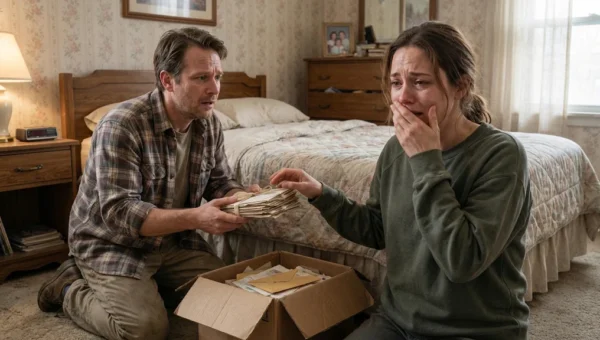
Clara walked over to the small wooden kitchen island. Lying flat on the laminate surface was the old manila accordion folder. Propped against it was a single sheet of lined yellow notebook paper, folded in half with my handwriting visible on the front.
She did not look at me. She pointed a trembling finger at the yellow paper.
“I thought you loved him more,” Clara said, her voice cracking with a sudden, violent wave of emotion. “I saw the bank statements, Mom. I saw how you drained his account and left mine alone. I thought you treated me like an afterthought, like I was just the girl who stayed out of trouble while he got all your resources. But that is not even why the wedding is off.”
She picked up the yellow paper and held it out toward me, her hand shaking so badly the paper fluttered in the indoor draft.
“Read it, Mom,” she choked out. “Read what you wrote on July twelfth, nineteen ninety-four. Read the part about who Kevin’s real father actually was.”
PART3
The air in the small apartment seemed to thicken, pressing down on my chest until I could barely draw a breath. Time stopped dead in its tracks. Nineteen ninety-four. The summer Kevin was two and Clara was an infant. The summer the shadows in our house were longer and darker than any mother should ever have to endure.
I looked down at the yellow paper in Clara’s hand, and the memories rushed back with the force of a tidal wave. Back then, my marriage to my late husband was already fracturing beneath the weight of his unacknowledged gambling debts and his fierce, unpredictable rages. In a moment of absolute weakness and profound loneliness during a separation that lasted four months, I had made a terrible mistake. I had sought comfort elsewhere, with a man named Arthur Vance, a quiet accountant who passed through our town for work and vanished just as quickly as he arrived. When I discovered I was pregnant shortly after reconciling with my husband, the guilt was so overwhelming, so suffocating, that I wrote down the truth in a private confession letter. I sealed it in an envelope, slipped it into the back of our financial records where I thought it would remain buried forever, and tried my best to bury the secret in my own heart.
I raised both children as my husband’s. When my husband passed away years later, no one had ever questioned the lineage. I loved both of my children with every fiber of my being. To me, biology was just a technicality; motherhood was forged in the sleepless nights, the fever-tossed days, the quiet triumphs, and the endless sacrifices. I never intended for either of them to know. I had intended to take that secret to my grave.
“I found it when I was looking for our birth certificates for the destination wedding visa paperwork,” Clara said, her voice dropping to a harsh, accusing whisper. “I opened the folder, and that letter fell right out onto the floor. I read it, Mom. I read every single word. And then… I did something stupid. I told Mark.”
My breath caught in my throat. “You told Mark?”
“How could I not?” she cried, tears finally spilling over her lashes and cutting tracks through the dust on her cheeks. “My whole life was unraveling in my hands. I found out the brother I grew up with, the boy you spent all your savings to save when he was sick… he is not even my real brother. We share a mother, but not a father. And the worst part, Mom… the absolute worst part is that Mark and I went to get our premarital genetic screening done last month for the legal requirements in Tulum. The clinic results came in this morning, right before the ceremony rehearsal.”
She covered her face with her hands, her shoulders shaking with deep, wracking sobs.
“What are you saying, Clara?” I asked, a cold dread washing over me that made my knees feel like water. “What do the results have to do with the letter?”
Clara dropped her hands, her eyes locking onto mine with a look of sheer, unadulterated horror.
“Mark is Arthur Vance’s son,” she whispered.
The room tilted. The suitcases, the kitchen island, the walls seemed to spin around me in a sickening blur. I reached out and caught the edge of the counter to keep from falling.
“That is impossible,” I breathed, my voice barely a rattle.
“It is not impossible,” Clara wept hysterically. “Arthur Vance had a son from a later relationship before he died five years ago. Mark kept his father’s last name on his birth certificate, but he never talked about him much because his parents divorced when he was young. When we sat down at the hotel lobby in Mexico this morning and looked over the lineage documents the local registry required for foreign marriage licenses, Mark mentioned his father’s name and hometown. And I remembered the name from your letter. Arthur Vance. Accountant. From Cincinnati. It was the exact same man, Mom. The exact same man.”
She stepped back, wrapping her arms around herself as if she were freezing cold in the seventy-degree room.
“We are half siblings,” Clara sobbed, the words tearing out of her throat like jagged glass. “Mark and I have been living together, planning a wedding, talking about having kids… and we share the same biological father. That is why the wedding is off. That is why he is at the airport. And it is all because of a secret you kept buried in a dusty folder for thirty years.”
ENDING
The silence that followed her confession was heavier than any physical blow. I stood there in the center of her apartment, surrounded by the wreckage of a dream wedding and a shattered family tree, and I realized the terrifying truth of the world. Some secrets are not just paper locked away in a drawer. They are ticking time bombs, waiting for the right generation, the right coincidence, the right digital test or legal form to detonate and tear apart everything you thought you built with your own two hands.
Clara turned away from me, walking over to the window to stare down at the empty street below where Mark’s taxi had driven away. Her back was rigid, her shoulders hunched against the grief that had suddenly rewritten her entire existence. She did not yell anymore. She did not accuse me of loving Kevin more, or of playing favorites with our money, or of ruining her destination wedding with a lack of funds. Those petty grievances had burned away in the harsh light of a much more brutal reality.
“Get out, Mom,” she said quietly, her voice hollow and drained of all fight. “Just… please leave. I need to figure out how to pack up my life, and I cannot look at you right now. Every time I see your face, I am going to remember that you knew. You always knew.”
I wanted to reach out to her. I wanted to cross the room, take her trembling shoulders in my hands, and tell her that I was sorry for the sins of my youth, that I never meant for my hidden mistakes to reach across the decades and poison her happiness. But I knew words were useless now. Apologies could not unwrite a letter written thirty years ago, and they could not untangle a genetic knot that fate had tied behind our backs.
I picked up my purse from the kitchen counter, my fingers stiff and cold. I looked at the old manila folder sitting beside the yellow paper, the silent witness to a lifetime of secrets and sacrifices. I did not touch the letter. I left it right where it was, knowing that the damage was already done, and no amount of hiding could ever put the past back into the dark where it belonged.
As I walked out of her apartment and closed the door behind me, the hallway was dead silent. I rode the elevator down to the lobby in total numbness, my mind replaying the sound of her voice telling me to leave. I drove home through the dark streets of a city that suddenly felt entirely unfamiliar, acutely aware that while I had spent my whole life trying to protect my children from the consequences of my choices, the truth had simply waited for its moment to collect the debt in full.