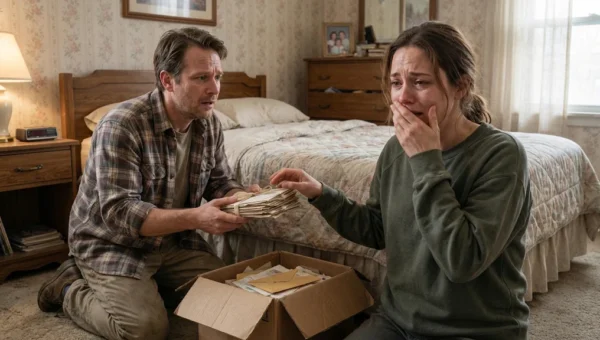
The laminate table in my kitchen still had tiny smudges of blue frosting near the edge where Caleb had smeared his thumb three days earlier. I had left the little paper plates stacked by the sink because the energy of hosting six six-year-olds had completely drained me. When my father didn’t show up for the party on Saturday, I didn’t think much of it beyond a passing sting of disappointment.
He had called around noon to say his arthritis was acting up and the noise of a children’s birthday party was simply too much for his head. I told him I understood, wrapped up a slice of leftover cake in foil, and went back to breaking down empty juice boxes.
What bothered me, though, was the memory of the previous year. My brother Julian had thrown a housewarming barbecue that stretched well into the evening, complete with a loud sound system and half the neighborhood kids running through the flower beds. My father had driven three solid hours from his house in Kingston just to sit on Julian’s patio and hand over a thick white envelope that everyone at the table knew held a check. He hadn’t complained about the noise then. He hadn’t complained about his arthritis either. So when he skipped Caleb’s party under the guise of quiet, the note just felt a little off, like a piano key striking a half-step flat.
Two days later, on a Tuesday morning at 9:14, my front door rattled. I was standing by the stove waiting for the kettle to whistle, wearing an old grey sweatshirt with a bleach stain on the hem. When I pulled the door open, my father was standing on the porch with his heavy wool coat buttoned all the way to his chin even though the spring air was turning mild. He didn’t say hello or ask about how Caleb liked his new bicycle. He just stepped past me into the hallway, carrying a rectangular steel lockbox that looked heavy enough to crack a toe if he dropped it.
He set the box down on the kitchen table with a dull thud that made the remaining paper plates jump. The metal was dark grey, the kind with a key cylinder and two heavy latches on the sides that you usually only see in old office supply closets or basement utility shelves.
He kept his hand flat on the top of it for a second, breathing a little hard through his nose like he had run up the porch steps instead of walking them.
“Is Julian looking for you?” he asked, and his voice was dry as corn husks.
I frowned, leaning back against the edge of the counter with my hands tucked into the pockets of my sweatshirt. I didn’t like the way his eyes looked, sharp and darting toward the front window like he expected someone to pull into the driveway behind him. “Julian called yesterday about some lawnmower part he left in your garage,” I said slowly. “Why? What’s going on?”
My father shook his head, his fingers tapping once against the cold grey paint of the lockbox lid. He didn’t answer my question directly, which was his habit whenever he was bracing himself to tell me something difficult.
He reached into his coat pocket, pulled out a small brass key on a greasy ring, and laid it right beside the handle.
“You take this,” he told me, and his voice dropped to that low, grating tone he used when he was dead serious about something. “Put it somewhere nobody looks. Not the bedroom closet, and not the basement rafters. Put it deep where your brothers won’t find it if they come sniffing around.”
I stared from his face down to the key and back up again, feeling a cold little knot tighten right behind my ribs. “Dad, what is inside this thing?” I asked, my voice rising a little in spite of myself. “Why are you talking about Julian and Marcus like they’re detectives?”
He looked at me then, really looked at me, with those pale blue eyes that missed nothing when we were growing up. “Something they will hurt you to get back,” he said.
Those were the exact words he used before he turned around, walked back out through the screen door without another word of explanation, and drove away down our gravel drive. I stood on the porch with the key cold in my palm, watching the dust kick up behind his old Buick until the tail lights disappeared around the curve of the maples.
The rest of that Tuesday dragged like wet wool. I hid the grey box beneath the bottom shelf of the linen closet, shoved behind three old sleeping bags that smelled faintly of mothballs and lake water. Every time a car slowed down on the blacktop out front, my stomach gave a small, nervous twitch. I kept thinking about my brothers, Julian and Marcus, and the way they had been acting around our father lately. They had been visiting him in Kingston three or four times a week, bringing him groceries, offering to handle his property taxes, and making a great public show of being dutiful sons after years of barely calling on holidays.
My phone rang at 4:45 that afternoon while I was browning beef for dinner. It was Marcus, his voice pitched into that breezy, over-friendly register he used whenever he wanted something from me without asking for it outright.
“Hey sis,” he said, the line crackling with static. “Just checking in. Dad didn’t leave his hearing aids at your place on Saturday, did he? He’s been acting a little foggy and we’re trying to retrace his steps.”
I gripped the wooden spoon a little tighter, staring out the window at the neighbor’s fence. “No, Marcus,” I said carefully. “He wasn’t even here on Saturday. You know he stayed home.”
“Right, right, the noise,” Marcus muttered, though he didn’t sound like he believed his own excuse. “Well, if he stops by or drops anything off, let us know, okay? He’s been misplacing some papers and we just want to get his affairs sorted out before the summer gets busy.”
The way he said *sorted out* made the hairs on the back of my neck stand up. Julian and Marcus had both bought new trucks within the last year, sleek four-door machines with leather interiors and financing notes that had to run three times what my husband and I paid for our sedan. They lived in developments across town with manicured lawns and zero-lot lines, constantly talking about investments and partnerships and family trusts. I was the only one of the three children who lived in an older house with a sagging porch and didn’t drive a car with a monthly payment over six hundred dollars. I was also the only one who hadn’t asked Dad for a loan since the year Caleb was born.
By Thursday morning, the silence of the house and the weight of what my father had said started wearing down my resolve. The box was still sitting back behind the mothballed sleeping bags, mocking me with its quiet. I didn’t want to open it. Part of me wanted to pack it back into the trunk of my car and drive straight to Kingston to dump it back on his kitchen table and tell him I didn’t want any part of whatever war he was fighting with my brothers.
Instead, I pulled the box out onto the kitchen table while Caleb was at school. The metal felt heavy and cold. I picked up the little brass key my father had left behind, slipped it into the small slot beneath the rusted latch, and gave it a hard twist. It didn’t pop open right away. I had to wiggle it and press down on the lid to release the spring mechanism, and then it gave a sharp *clack* that sounded entirely too loud in the empty kitchen.
Inside, the box was packed tight with papers, thick manila folders, and a small black USB flash drive wrapped in a square of blue flannel. I lifted the top folder out first. It was a certified copy of the deed to my father’s house and the surrounding thirty acres of timberland in Ulster County, but right across the signature line, in red ink and neat block letters, someone had written *Revoked* with a date from three weeks prior.
Beneath that were pages of bank statements from the credit union in town, printed out month by month going back nearly two years. I stared at the numbers until they stopped blurring. Tens of thousands of dollars were moving out of my father’s primary savings account and into an LLC I had never heard of, one bearing the initials J&M Holdings. The signatures on the transfer authorizations didn’t look like my father’s shaky, looping cursive. They looked practiced, stiff, and rushed, like someone had traced them over a lightbox using a fine-point pen.
At the bottom of the stack was a legal affidavit bearing the stamp of a notary public in Poughkeepsie, detailing a comprehensive durable power of attorney that gave Julian and Marcus full control over every asset my father owned, including his medical directives and his pension. Attached to the affidavit was a handwritten note from the notary himself, expressing concern over the grantor’s lack of formal legal representation during the signing.
My hands were shaking so badly I dropped the last page back into the box. The blue flannel bundle caught my eye next. I unwrapped the cloth and found the small plastic drive resting in the palm of my hand like a dead insect.
I didn’t have a laptop on the kitchen counter, so I walked over to the old desktop in the spare room, the one we mostly used for online grocery orders and homework printouts. The tower whined as it booted up, the old fan coughing a little before the blue desktop screen appeared. I slid the USB drive into the slot beneath the CD drive tray and waited for the folder window to pop open.
There was only one file inside, labeled *Statement_May 12.mp 4*. I clicked it twice.
The video opened with a jumpy, poorly lit shot of my father sitting at his kitchen table in Kingston. The camera was propped up against a sugar bowl or a salt shaker, tilting slightly to the left so the background showed the old floral wallpaper peeling near the door frame. My father looked smaller than he had on my porch, his shoulders rounded, wearing the brown cardigan he wore every Sunday.
“If you’re watching this,” he said, and his voice sounded tired, raspy, and completely clear, “it means Julian and Marcus found out I canceled the assignment at the bank.”
He paused, clearing his throat, looking down at his hands before lifting his face back to the lens. “I was a fool,” he continued, and the confession sounded heavy, forced out of him like pulling an old tooth. “I signed those papers back in January because they told me it was just for tax management after your mother passed. They said it would keep the county from taking the homestead when I went into care. I trusted them because they were my boys. But last month I saw the ledger from the credit union. They didn’t leave enough to pay for my burial plot, let alone keep the roof from leaking.”
He took a slow, rattling breath, his eyes fixed on the camera lens with a terrifying kind of stillness. “I tried to talk to Julian about it last week. He told me I was losing my mind and that the doctors would back him up if I made a fuss. That’s why I didn’t come to little Caleb’s party. I couldn’t risk them following me out here while I still had the originals. I brought them to the only one of my children who never came to my house with her hand out.”
The video ended with a sharp click as the recording stopped. I sat there in the quiet spare room for a long time, staring at the little media player icon on the screen until the monitor went dark and entered sleep mode. The house felt entirely too small. The sunlight moving across the floorboards seemed harsh and unnecessary.
The knock on the front door came at 2:15 that afternoon.
It wasn’t a tentative knock or the polite tap of a delivery driver. It was two heavy, authoritative thuds that vibrated through the floorboards right where I was standing in the hallway.
I walked to the front door without making a sound, my bare feet sinking into the braided rug. I didn’t open it immediately. I looked through the small oval glass pane in the center of the wood. Marcus was standing on the porch, his face flushed red from the wind or anger, and Julian was right behind him, leaning against the porch railing with his hands shoved deep into his pockets.
I unlocked the deadbolt with a sharp, metallic click and pulled the door open about six inches, keeping the security chain latched across the gap.
Marcus leaned in immediately, his voice tight and uneven. “Open the door all the way, Clara. We know he was here.”
I didn’t move. I kept my hand on the edge of the door, staring at my brother through the narrow gap. “Who was here, Marcus?”
“Don’t play games with us,” Julian called out from the railing, stepping forward and crowding into Marcus’s shoulder. “Dad’s car was spotted coming down this road on Tuesday morning. He’s confused, Clara. He doesn’t know what he’s signing or what he’s doing. He took something from his house that doesn’t belong to him, and if you’ve got it inside, you need to hand it over right now before this gets very complicated for you.”
They looked so sure of themselves, standing there on my porch in their clean jackets and expensive shoes, acting like they were performing a public service for an old man who had lost his wits. But behind their eyes, there was that thin, desperate panic of people who knew the floor was about to drop out from under them.
“He’s not confused at all,” I said, and my voice sounded steadier than I felt. “He knows exactly what he signed. He knows about the accounts in Kingston, Julian. He knows about the deeds.”
Julian’s face didn’t go white, but the skin around his mouth tightened into a hard, white line. “You don’t know what you’re talking about,” he snapped, his hand coming up to grip the wooden doorframe just above the latch. “That old man is out of his mind. He signed those transfers legally in front of a licensed attorney. If you’re hiding stolen property in that house, we’ll have the sheriff out here to search every room by dinner time.”
“Go ahead and call him,” I said, and I felt a strange, cold calm settle over my chest. “Call the sheriff, Julian. Tell him you want to report that your father gave his personal financial records to his daughter because you forged his name on a power of attorney.”
Marcus took a half-step back, his eyes darting toward Julian like he was waiting for him to take the lead. “You’re making a massive mistake, Clara,” Marcus hissed, his voice dropping an octave. “You think you’re protecting him, but you’re just destroying this family over some old man’s delusions. Give us the box and we’ll walk away. We won’t involve you in the fallout.”
“There isn’t any family left to protect,” I told them. “Dad told me to hide the case from you, and I did. And the local detachment of the state police already has a copy of the flash drive you didn’t know he made.”
That was a lie, but it was the right lie at the exact right second. Julian’s hand slipped off the doorframe. He stared at me for three long seconds, his chest rising and hefting under his jacket, before he looked at Marcus and gave a sharp, disgusted shake of his head.
“You’re out of your mind,” Julian muttered, though his voice lacked its earlier certainty. “Both of you.”
He turned on his heel and stalked down the porch steps, his boots crunching hard against the gravel drive. Marcus lingered for a second longer, his jaw working like he wanted to say something else, before he turned and followed his brother back toward the truck. I watched them climb inside, the heavy doors slamming shut with a double thud that echoed across the yard, and then the truck spun its tires in the gravel, throwing small stones against the siding before tearing out toward the highway.
I left the security chain latched for a full ten minutes after they were gone, listening to the wind move through the maples along the fence line.
The investigation took four months to wind its way through the county courts in Kingston, and during that time, my brothers didn’t call, didn’t write, and didn’t show up at holidays. The credit union accounts were frozen, the fraudulent power of attorney was voided by a judge in chambers, and my father’s property was safely transferred into a proper family trust that didn’t include my brothers’ names.
He didn’t move in with us, but he started driving out on Thursdays just to sit on our back porch and watch Caleb build tracks in the dirt with his toy tractors. He didn’t talk much about what happened, and neither did I. We just sat there in the late afternoon sun, drinking sweet tea out of jelly jars while the traffic hummed softly on the distant highway.
On a warm Friday in late August, I walked into the kitchen and found the grey metal lockbox sitting right in the center of the table. It was completely empty. The latches were open, the brass key was missing from the ring, and the lid was tilted back to catch the light from the window.
Dad was sitting out on the wooden bench by the garden, his old hands resting on his knees as he watched Caleb chase a stray orange cat across the lawn. The box was just a piece of painted steel now, its secret gone, but the kitchen felt quiet in a way it hadn’t in years. I picked up the empty case by its handle, carried it down to the basement, and put it away on a dark shelf behind the old paint cans where nobody would ever need to look for it again.