PART 1
The day I arrived at my son’s house with an aluminum walker and two suitcases, my daughter-in-law Lauren taped a printed schedule to the refrigerator.
I was sixty-six years old. Two weeks earlier, I had undergone a total right hip replacement at St. Jude Hospital. My son Mark insisted I give up my apartment lease in town, move into his spare ground-floor bedroom, and let them look after me until I was back on my feet.
I had three thousand dollars in checking and a modest monthly pension from twenty-eight years as an elementary school clerk. I thought living with family would be a comfort.
The schedule changed that immediately.
Lauren had divided the refrigerator door into neat grid lines using black electrical tape. My name was at the top. Underneath, she had listed strict times for breakfast, medication, physical therapy walking laps down the hallway, and lights-out.
By the third week, she started measuring my food with a gray digital kitchen scale.
If I wanted two scrambled eggs instead of one, Lauren would stand over the stove with her arms crossed. “Eggs are four dollars a carton, Martha. Mark works sixty hours a week at the distribution center. We have a budget.”
At dinner, she scraped half a cup of boiled rice and three ounces of baked chicken onto my plate. When I asked for an extra roll, she looked across the table at Mark.
“She is wasting groceries, Mark,” Lauren said, her voice completely flat. “She sits in that recliner all day and doesn’t burn three hundred calories. We can’t afford to throw food away.”
Mark did not look at me. He kept his eyes on his phone, buttering his own bread. “Just eat what Lauren gives you, Mom. You need to drop twenty pounds anyway so your joint doesn’t wear out again.”
I went to bed hungry three nights that week. But the food wasn’t the worst part.
The worst part was my own head.
I have always kept a meticulous checkbook register. I have never forgotten a bill, a birthday, or where I laid my glasses. Yet Mark began correcting me constantly. When I asked where my blue cardigan was, he told me I had donated it to Goodwill six months ago, even though I clearly remembered hanging it in the guest closet.
When I asked about the water bill, he told me I had asked the same question ten minutes earlier.
“Your memory is slipping, Mom,” Mark told me one evening, handing me a glass of tap water. “The doctor said post-operative brain fog is common. You have to stop arguing with Lauren. You aren’t remembering things right.”
I began keeping a spiral notebook by my bedside table, writing down every conversation and the exact time it happened. I wondered if I was losing my mind.
Then, on a Tuesday evening while Mark was working a late inventory shift, Lauren set my dinner plate on the kitchen table. It was two tablespoons of cottage cheese and four canned peach slices.
When I picked up the ceramic plate to carry it to the sink, I saw a folded square of lined notebook paper resting on the woven placemat underneath.
I opened it in my lap while Lauren had her back turned at the sink.
Written in blue ballpoint ink was a single sentence: *Count the pills before you trust anyone.*
My hands shook so hard I almost dropped my fork.
The next morning, while Lauren took the family minivan to run errands, I walked out to the corner on my cane and used the landline at the corner pharmacy to check my prescriptions.
The pharmacist knew me. He looked up my profile and frowned over his counter.
“Mrs. Miller, your oxycodone refill was picked up three days ago,” he said. “Signed for at the drive-through window under your name.”
I had never seen that refill. I was only taking over-the-counter tylenol and low-dose aspirin.
I walked back to the house with my heart pounding against my ribs. In the kitchen, I walked straight to the refrigerator and studied Lauren’s printed schedule with fresh eyes. Down at the bottom, printed in tiny bold type under evening routines, were two names I had never seen before: *Lorazepam 1mg* and *Oxycodone 10mg*.
I had never been prescribed lorazepam in my life.
I took the warning note out of my pocket, staring at the handwriting. As I did, the garage door opened. Footsteps came through the laundry room.
Lauren walked into the kitchen. She saw the note in my hand.
She did not yell. She didn’t look angry. Her face was completely pale, her eyes wide with terror.
She turned around, reached for the deadbolt on the back door, and turned the lock with a loud click.
“You need to hear what your son did,” she whispered.
PART 2
Lauren walked to the dining room window and pulled the blinds shut.
Her hands were trembling worse than mine. She pulled out a wooden chair, sat down, and pointed to the seat across from her.
“Sit down, Martha. Please,” she said.
I stayed on my feet, leaning heavily on my cane. “You wrote this note.”
“I did,” she whispered. “I wrote it because Mark checks my phone every night. If I called you or texted you, he would have seen it on the family plan logs.”
“What does Mark have to do with my medication?” I asked. “The pharmacy told me somebody picked up thirty tablets of oxycodone under my name on Saturday. Mark told me I was losing my memory. He told me the doctor said I had brain fog.”
Lauren rubbed her face with both hands. When she looked up, her eyes were bloodshot.
“Mark lost his job at the distribution center six weeks ago,” she said.
The kitchen went dead quiet.
“He goes to work every morning at six,” I said. “I hear his truck leave.”
“He sits in the parking lot at the municipal park or drives around the county,” Lauren said. “He was fired for failing a drug screening. He owes sixteen thousand dollars to two different online payday lenders. They started calling our home phone in August. When you had your surgery, Mark realized your post-op care gave him access to scheduled painkillers.”
I felt the room tilt around me. I had to grip the back of the chair to keep my balance.
“The schedule,” I managed to say. “You put those drugs on the refrigerator.”
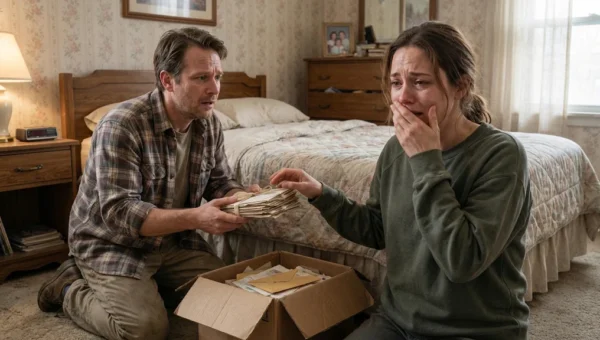
“Mark made me print that,” Lauren said, her voice breaking. “He wanted a paper trail in the house in case anyone asked why you were confused. He’s been crushing half a tablet of lorazepam into your evening applesauce every single night. That’s why you couldn’t remember where your sweater was. That’s why you couldn’t remember what day it was.”
“And the food?” I asked, my voice rising. “You weighed my bread! You told Mark I was wasting groceries!”
Lauren looked down at the table. A tear slipped off her cheek and hit the wood.
“Mark told me that if we spent one extra dollar on your groceries, we wouldn’t have enough to pay the electric bill,” she said. “He told me that if I contradicted him, he would take our daughter and leave the state. But yesterday morning, I found three empty prescription bottles in his truck toolbox. He didn’t just take your oxycodone, Martha. He went to your old landlord last Friday.”
My fingers tightened on the cane. “Why would he go to Mr. Henderson?”
“He told Mr. Henderson you were showing early signs of dementia and couldn’t live independently again,” Lauren said. “He asked Mr. Henderson to refund your eighteen-hundred-dollar security deposit directly to him as your legal caregiver.”
PART 3
I sat down in the wooden chair.
For thirty-four years, Mark had been my only child. When his father died of a coronary when Mark was twelve, I cleaned office buildings at night so he could play Little League and wear brand-new sneakers every September. When he married Lauren eight years ago, I gave them seven thousand dollars from my savings toward their first down payment.
I thought I knew my son. I thought he was just stressed about money, short-tempered because of long hours, and caught between a wife and an aging mother.
“Where is he now?” I asked.
“He went to the credit union,” Lauren said. “He has your power of attorney papers from your surgery. He’s trying to get them to add his name to your pension direct deposit.”
I did not cry. Something hard and cold settled into my chest.
“Get your purse, Lauren,” I said. “We’re leaving.”
“Martha, if he comes home and sees us gone—”
“Get your purse,” I repeated, my voice louder and firmer than it had been in two months. “And get your daughter’s birth certificate from the lockbox.”
We were out of the house in ten minutes. Lauren drove the minivan. We stopped first at the county credit union on 4th Street.
I walked into the lobby with my walker, my chin up, and asked to speak directly with the branch manager, Mrs. Alva. I had banked there since 1986.
Mrs. Alva took me into her glass office. I sat across from her and put my photo ID on the desk.
“Mrs. Miller,” she said, looking concerned. “Your son was here forty minutes ago. He presented a limited medical power of attorney signed prior to your hip replacement and requested to redirect your monthly state pension into a joint account.”
“Did you process it?” I asked.
“No,” Mrs. Alva said. “The document you signed was a healthcare directive, not a general financial power of attorney. I told him he needed your physical presence and a notarized affidavit. He was quite upset when he left.”
“I want to revoke that directive immediately,” I told her. “I want my passwords changed, my pension locked to my personal checking only, and a security note placed on my file that no relative has access to my accounts.”
It took twenty minutes to sign the revocation papers.
From the credit union, Lauren drove us to the police precinct on Elm Street.
Sitting in a small interview room with a detective named Alvarez, I told the truth. I showed him the refrigerator schedule. Lauren handed over the photo she had taken of the prescription bottles hidden in Mark’s truck toolbox, along with the printout from my pharmacy showing the forged drive-through signature.
Detective Alvarez called the pharmacy while we sat there. The drive-through window had high-definition security footage. The pharmacist pulled the Saturday timestamp.
It was Mark in the driver’s seat of his pickup truck, handing over my insurance card and signing my name on the electronic pad.
ENDING
Mark was arrested at five o’clock that evening when he pulled into his driveway.
He didn’t make a scene. A neighbor told me later that Mark just stood by the driver’s door of his truck with his hands behind his back, staring down at the asphalt while two patrol officers cuffed him.
He was charged with obtaining a controlled substance by fraud, identity theft, and elder neglect.
That night, Lauren and her seven-year-old daughter Chloe stayed with me in an extended-stay motel near the bypass. Lauren sat on the edge of the second double bed, her hands in her lap, looking like she expected me to throw her out into the street.
“You don’t have to stay with me, Martha,” she whispered. “I let him do it for three weeks. I was scared, but I let him do it.”
I looked at the girl sleeping soundly under the thin polyester blanket.
“You put the note under my plate,” I said. “You locked the door. You got me to the bank. A coward would have let him take the pension.”
Two weeks later, the charges were formally filed. Mark’s court-appointed attorney reached out to ask if I would sign an affidavit supporting pre-trial diversion. Mark sent me a three-page letter from the county detention center, written in pencil on yellow lined paper. He told me he was sick, that the debt had made him desperate, and that he only wanted to keep the family afloat until he found another warehouse position.
I read the letter once, folded it, and placed it in the center drawer of my desk. I did not sign the affidavit.
I used twelve hundred dollars of my savings to pay the deposit on a small, sunny first-floor garden apartment three miles from the elementary school where I used to work. The building has wide doorways, a walk-in shower with grab bars, and an enclosed back porch where my ferns can get morning light.
Lauren filed for legal separation in October. She found a job working mornings in the cafeteria at the middle school, and three days a week she drops Chloe off at my apartment after the bell rings.
Chloe sits at my kitchen table doing her spelling worksheets while I chop carrots for beef stew. There are no scales on my counter. There are no tape grids on my refrigerator.
Yesterday afternoon, Chloe looked up from her lined notebook and asked if she could have two cookies before dinner instead of one.
I walked over to the ceramic jar on the counter, took out two oatmeal cookies, and set them on a clean paper napkin in front of her.
“In this house,” I told her, “we eat until we’re full.”