The ticking of the brass carriage clock on the mantel had always been the loudest thing in Clara’s house, right up until the day she stopped breathing. For fifteen years of marriage, Duane and I lived in the shadow of that woman’s quiet, heavy rules. She had given Duane her father’s heavy gold pocket watch on our wedding afternoon, pressing it into his palm while looking right past my veil with eyes the color of stagnant pond water.
She told him then, in her dry, papery voice, never to let me touch it. I had laughed it off back then, figuring it was just another one of her petty little ways of marking territory. Duane had slipped it into his velvet-lined valet tray upstairs, and there it stayed, season after season, collecting a thin film of dust while the world outside our kitchen window turned from green to brown and back again.
The watch finally gave out on a Tuesday when the rain was coming down sideways against the glass, making that dull, rhythmic thud that usually made me want to bake bread or scrub the baseboards until my knuckles turned red. Duane had already left for the lumber yard by seven, and I was up in the bedroom changing the linens when I noticed the silence. The old pocket watch wasn’t making its usual faint, metallic heartbeat from the dresser top.
I picked it up, expecting to find the crown unscrewed, but the hands were frozen at 4:12. I didn’t think much of it beyond a passing pang of superstition. Duane had inherited the thing like a holy relic, and seeing it still felt wrong, like a clock stopping in a room where someone had just passed away.
When Duane came home that evening smelling of wet pine and diesel, I handed it to him right there in the front hallway before he even kicked off his work boots. He just stood there for a minute, looking down at the gold casing with that familiar, cautious crease between his eyebrows that always meant he was trying to anticipate his mother’s ghost telling him he was doing something wrong. He asked me if I would mind dropping it off at Miller’s jewelry shop on Main Street during my lunch hour the next day, because he had too many truck deliveries coming in to get downtown before closing.
I told him I would, though I reminded him what his mother had said about me touching it. He gave a tired, half-apologetic sort of grin, the kind that always made me soften up despite myself. “Mom’s been gone three years, honey,” he said, setting his lunch box on the hall table. “I think the statute of limitations on the watch rule has expired.”
The next afternoon, the bell above the door at Miller’s let out a thin, tinny chime as I walked in out of the damp. Old Mr. Miller was behind the glass counter with his jeweler’s loupe jammed into his left eye socket, squinting down at the works of a silver pocket watch that looked older than the state of Pennsylvania. He didn’t look up right away, just gave a little grunt of acknowledgment while I laid Duane’s heirloom on the green felt mat between us. I told him the mainspring had given out after fifteen years of sitting in a drawer, and asked if he could take a look inside without charging me an arm and a leg.
He picked it up with his tweezers, turned it over twice in his palm, and pressed a tiny release catch on the rim. The back cover clicked open with a sharp, clean sound.
Mr. Miller didn’t reach for his screwdrivers. He just stared down into the tiny brass gears for a long, still second, his breathing going shallow through his nose. I watched the skin around his eye wrinkle up as he leaned in closer, shifting the loupe to get a better angle under the overhead fluorescent strip. After a minute, he looked up at me over the top of his glasses, his expression flat and strangely cautious. He asked me if the watch had ever been serviced or repaired by anyone else since Duane’s family had owned it. I told him not that I knew of, explaining that Clara treated the thing like an altar piece and wouldn’t even let a dusting rag come near it. Mr. Miller nodded slowly, reached back down with his thin steel tweezers, and slid them deep into the narrow space behind the balance wheel. When he pulled them back out, a tiny, tightly folded strip of yellowed notebook paper was pinched between the tips.
He laid the paper flat on the green felt like it was something fragile enough to turn to ash if the air hit it too hard. There was handwriting on it in faded purple fountain pen ink, neat and sharp like Clara’s old grocery lists. Mr. Miller didn’t read it out loud, but he pushed it across the counter toward me with the tip of his finger. “You might want to take that home and show your husband,” he said, and his voice had lost all its usual dry retail cheer. I thanked him, paid him five dollars for his trouble without even leaving the watch for repair, and walked out into the gray afternoon with the folded paper burning a hole in the pocket of my wool coat.
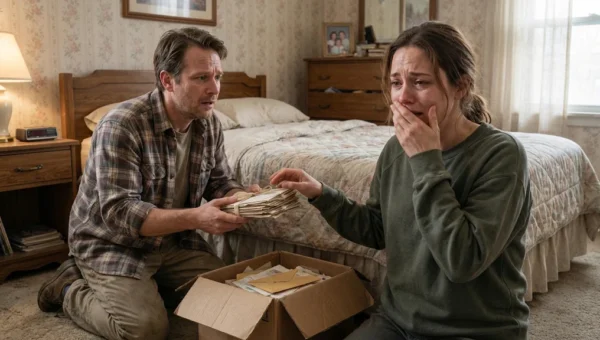
Duane was sitting at the kitchen table when I got back, unlacing his work boots with his head bowed down toward the floorboards. I didn’t say anything fancy; I just walked over and laid the little slip of paper right beside his coffee mug. He looked up at me, confused, and then down at the yellowed paper. He unfolded it with thick, clumsy fingers that had spent too many decades hauling timber and stacking oak planks. He stared at the name and the date written there in Clara’s sharp ink for a long time, the silence in the kitchen stretching out until the hum of the refrigerator sounded like an engine idling in the next room. Then he sat down hard in the wooden chair, the wood groaning under his weight, and looked up at me with eyes that had suddenly gone completely hollow. “That’s the day,” he whispered, his voice cracking right down the middle, “that’s the day Mom told me my father died.”
The date on the paper was nineteen years before our wedding day, which meant it was thirty-four years ago in total, right down to the month. Duane had always believed his father had gone out to check the north fence line during a heavy October blizzard and simply never came back from the timber, his body swallowed up by the drifts until the spring thaw made identification impossible. Clara had raised him alone on a widow’s pension and quiet grit, never letting another man cross her threshold, building an entire household around the holy tragedy of a husband lost to the cold. Duane reached out and touched the paper again, his finger tracing the ink as if he could rub the letters out just by pressing hard enough. I pulled out the chair next to him, sat down, and covered his heavy, calloused hand with mine. Mr. Miller had told me before I left the shop that the name written there belonged to a man who had registered a truck in Youngstown the very week Clara claimed her husband died in the snow, but Duane didn’t need the Youngstown part yet. He just needed to sit there while the floor beneath his entire childhood finally gave way.
We stayed like that for a long time as the kitchen grew dark and the rain turned to sleet against the windowpanes. Duane didn’t yell or smash anything, which somehow felt worse than if he had lost his temper. He just kept looking at the tiny slip of paper like it was a map to a country he had never been allowed to visit. He talked about his mother then, not with anger, but with a strange, heavy pity that took me completely by surprise. He realized why Clara had never let me near the watch, why she had handed it to him on our wedding day with that fierce, terrifying look in her eye. It wasn’t because she disliked me, though God knew she had her opinions; it was because she knew that sooner or later, a curious wife would take a stopped watch to a repair shop, and the little lie she had folded up inside the brass works would finally see the light of day. She had locked her shame inside a ticking machine and made her son guard it like a sacred duty for fifteen years.
The gold watch casing stayed open on the kitchen table all evening, right beside two cold cups of coffee that neither of us touched. Duane didn’t put the paper back inside, and he didn’t try to wind the gears. He just reached across the wood, took my hand in his, and squeezed it until my fingers ached. We sat there in the quiet house as the storm outside finally blew itself out, letting the old ghost of his mother’s careful story drift away into the corners of the room. The watch didn’t need to be fixed anymore, and neither did we.