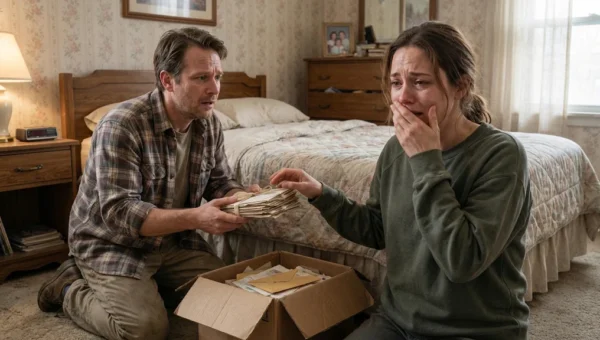
The morning sun hit the brass key rack by our back door at just about seven-fifteen, throwing a long, thin shadow across the white linoleum floor where I stood holding a blue bank ledger. I did not raise my voice when I laid the printout on the oak kitchen table next to Martha’s half-empty teacup. I had learned a long time ago that arguing too early only gives people time to change their story, and there was more history behind those numbers than anyone at the breakfast table seemed willing to remember.
The figures were right there in black and white ink, stamped with the exact dates of the past ten months. Two thousand two hundred and fifty dollars drawn every thirty days like clockwork, routed straight to an account in the city under our daughter Chloe’s name.
Martha did not even look up from her crossword puzzle right away. She just reached out with her silver pen, tapped the corner of the crossword grid, and said she was just helping out. She told me Chloe needed a soft place to land after things got so complicated between us. I probably would have dropped it right there and let the ledger slide back into the drawer if not for one small, stubborn detail that refused to sit right in my head. Eighty-two thousand five hundred dollars total across ten months for an apartment that was supposed to be a temporary cushion was a lot of money, even in this economy.
I kept thinking about how hard I worked for every dollar that went into that joint checking account, and how long I had kept my mouth shut just to keep the peace under our roof.
I am not proud of how long I waited to check on things myself. I was scared. I was scared the answer would hurt more than the wondering, and I hated myself a little bit for letting fear make a coward out of me. For months I had watched Martha slide her phone facedown whenever I walked into the kitchen, and I had pretended not to notice the way her shoulders went tight every time the first of the month rolled around. We had not spoken a real, honest sentence to Chloe since she packed up her sedan and drove out of our driveway nearly a year ago without so much as a goodbye wave.
She had made it clear she wanted nothing to do with my oversight or my rules, and Martha had acted like a grieving widow ever since.
By Saturday morning, the silence in the house had turned into something heavy enough to choke on. The kitchen smelled of stale coffee grounds and the damp paper towels I had used to wipe the counters earlier. I packed a cardboard box with fresh oranges, a loaf of sourdough bread, and a few jars of tomato sauce from the pantry, telling myself I was just being a dutiful father dropping off supplies. Martha was still upstairs in the bedroom when I grabbed my car keys off the hook. I did not call Chloe ahead of time because I knew she would just screen the call or make up some excuse about being busy with her graphic design clients. I just needed to see the front door with my own eyes and put an end to the guessing game that was eating holes in my stomach.
The drive across town took twenty-four minutes through the usual weekend traffic on Route 9. My hands felt stiff on the steering wheel, wrapped around the leather until my knuckles turned white. Every stoplight seemed to stretch out forever, giving me too much time to think about all the ways Martha could explain away the ledger if I caught her in a corner. When I finally pulled my truck into the gravel lot behind Chloe’s apartment building, the morning air was cold enough to frost my breath against the windshield. I sat there for a full minute with the engine idling, staring up at the second-floor balcony where Chloe’s potted geraniums used to sit. The railing was completely bare, save for a stray pigeon pecking at a bit of dirt in the corner.
I carried the box of groceries up the concrete outdoor stairs, my boots making a hollow thumping sound against the gray steps. When I reached apartment 204, I stood there for a second, listening for the sound of Chloe’s television or the familiar hum of her old refrigerator through the thin wood. The hallway smelled of boiled cabbage and cheap carpet cleaner, nothing like the lavender soap Chloe always insisted on buying. I raised my knuckles and gave the door three short, firm raps. Nobody answered right away, so I knocked again, harder this time, shifting the heavy box of groceries to one arm. I heard the deadbolt click from the inside, and a wave of cold air rolled out into the hallway as the door swung open.
A young man with a shaved head and a gray hoodie stood in the doorway, staring down at my cardboard box with a polite, confused look on his face. He looked to be in his late twenties, with ink showing on his forearm where his sleeves were pushed up. He shifted his weight from one foot to the other, blocking the entryway entirely. “Can I help you?” he asked, his voice entirely unfamiliar. I just stared past his shoulder into the living room, where a bicycle was leaning against a plain white wall that used to be painted a warm butter-yellow. The sofa Chloe loved was gone, replaced by a brown leather recliner I had never seen before in my life.
“I am looking for Chloe,” I said, and my own voice sounded thinner than I meant it to. The young man scratched the back of his neck and looked down at my shoes before meeting my eyes again. “You got the wrong apartment, man. I subleased this place back in November.” November meant she had been gone for months before Christmas, long before Martha started writing those checks every thirty days. The grocery box felt suddenly heavy in my arms, the edges biting into my fingers as the math finally caught up with me in that dingy hallway. “Who are you paying rent to?” I asked, my voice dropping an octave. He blinked, looking slightly annoyed now. “I send it to the management company downtown. My name is Leo.”
I did not yell at him. I just nodded slowly, thanked him for his time, and walked back down the stairs without leaving the box of oranges on the mat. The drive home took twice as long because every red light felt like a personal insult, and my foot kept pressing down on the accelerator a little harder than it should have. When I pulled back into our driveway, Martha’s sedan was parked right where I had left it. I walked through the back door without taking off my heavy coat, carrying the unopened box of groceries straight to the kitchen counter and setting it down with a dull thud that made the teacups rattle. Martha was standing by the sink rinsing a single ceramic mug, her back turned to me.
She did not turn around when she heard the door slam, which told me right away that she had been waiting for this exact sound. “You went over there, didn’t you?” she asked quietly, her voice barely louder than the running water from the faucet. I stood behind her for a long moment, watching the way her shoulders slumped under her green cardigan. All the anger I had built up on the drive back suddenly flattened out into something cold and tired. “She moved out in November, Martha,” I said, and the words felt hollow in the small room. “The kid living there now never even heard of our daughter. So where has my money been going for the last ten months?”
Martha turned off the water then, wiping her hands on a dishtowel with agonizing slowness before she finally looked me in the eye. Her face was pale, but there was no surprise in her eyes, only a terrible, resigned sort of relief. “She didn’t want your help, Virgil, and she sure as hell didn’t want your conditions,” Martha said, her voice shaking with a ragged edge that did not sound like her at all. “When she walked out of here last year, she told me she was cutting ties with both of us if I didn’t back her up. But she was trying to launch that restoration business downtown, and she needed seed capital without you holding the purse strings over her head.” I just stared at her, my hands flat against the cold laminate counter. “So you lied to me every month for nearly a year?”
“She needed a soft place to land,” Martha repeated, her voice rising just enough to crack. “And if I told you the truth, you would have marched down there with your checkbook and your demands and you would have ruined the only chance she had to stand on her own two feet without owing you a single dime.” The kitchen went dead quiet again, the kind of heavy silence where you could hear the refrigerator motor humming in the corner. I thought about all those months sitting at this very table, pretending everything was fine while my wife treated me like a threat to our own child. It hurt worse than any argument we had ever had, because she had looked at me and decided the truth was something I could not be trusted to handle.
I didn’t yell. I didn’t throw the ledger across the room or smash the teacups on the floor, though a small part of me wanted to tear the whole house down to the studs just to feel something real. I just reached out, picked up the blue bank printout from the table, and folded it neatly in half twice until it was a small, tight square. “We are canceling the transfer order on Monday morning,” I said, and my voice was so quiet it barely sounded like my own. Martha flinched as if I had struck her, but she didn’t argue. She just lowered her head and stared down at the wooden tabletop, her fingers twisting the corner of the dishtowel until her knuckles turned red.
The house stayed heavy for the rest of the weekend, neither of us speaking more than a few necessary words about meals or the weather. On Monday at 8:02 in the morning, I stood at the counter in the local credit union branch and signed the stop-payment order with a cheap plastic pen that smelled faintly of old ink and floor wax. By noon, the automatic pipeline that had drained our joint account every month for ten months was officially dead. I drove home with the confirmation slip folded into my shirt pocket, feeling lighter in a strange, hollow way that didn’t feel like winning at all.
When I walked through the back door, Martha was sitting at the kitchen table with her phone lying flat between us, the screen dark and untouched. She looked up when I hung my coat on the brass hook, her eyes red around the edges as if she had been crying for hours. “She has a new studio space over on Fourth Street,” Martha said softly, before I could even take off my boots. “She is doing the restoration work she always wanted to do. She doesn’t need our money anymore, Virgil. But she might take a call if it’s just us.” I didn’t answer right away. I pulled out the wooden chair opposite her, sat down, and looked at the closed checkbook sitting flat and untouched on the desk, waiting for whatever came next.