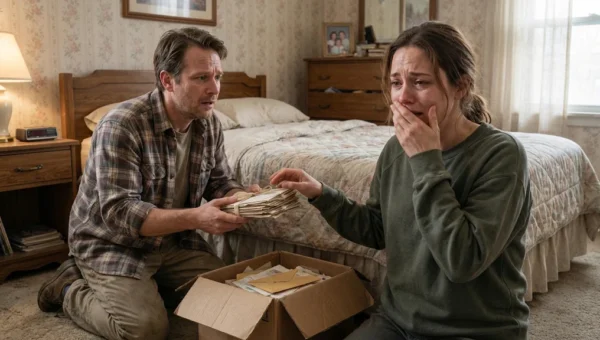
A moving company called me at 9:15 on a Tuesday morning and asked whether I wanted the boxes for my kitchen labeled fragile. I had not hired a moving company. My children had booked one for the first Saturday in October.
I sat down at the kitchen table. “I’m sorry. You have the wrong person.”
The man on the phone checked his notes. “This is for Marisol Porter, moving from 214 Maple Street to Willow Court?”
I looked through the window at my front steps, the porch swing, and the maple tree my husband had planted when our son was born. “That is my address,” I said. “But I haven’t agreed to move.”
He apologized and said he would call my daughter, whose number was on the account.
I thanked him and hung up. Then I sat for a while with my hands flat on the table.
The moving company was the first I had heard of it. The apartment was not.
Two weeks earlier, my daughter Sarah had taken me to lunch and told me she had found a place “worth seeing.” She had said it was all on one level, near the grocery store, with an elevator and a library around the corner. I told her I was not ready to leave my house. She said she understood.
Apparently, she understood that I needed more time to be persuaded.
My son Joel arrived that afternoon with a folder under his arm. He looked surprised to find me waiting in the kitchen.
“Did the moving company call?” he asked.
“Yes.”
He set the folder down. It held a floor plan, a list of furniture measurements, and a brochure from Willow Court. Sarah had circled a one-bedroom unit near the elevator.
“You planned this without me,” I said.
“We thought you’d like to see it before we made anything final.”
“The movers seem to think it’s final.”
Joel ran a hand over his hair. He was fifty-one, old enough to know that a plan made on my behalf was still a plan made without me.
“I’m sorry,” he said. “Sarah got ahead of herself.”
I looked at the floor plan. The living room was about the size of my dining room. The kitchen had room for a small table. There was no place for the piano, though nobody had yet asked whether I wanted to take it.
“I’m not angry about the apartment,” I said. “I’m angry you thought I wouldn’t notice you had already decided.”
He sat across from me. “We didn’t decide. We put down a refundable deposit so they’d hold it.”
“That is a decision.”
He did not argue. I appreciated that, and it did not make the phone call less humiliating.
The reason this conversation was happening was a fall I had taken in August. I was carrying grocery bags up the front steps when my heel caught the edge of the mat. I landed on my left knee and bruised my wrist. Nothing broke. I did not call either of my children. I sat on the porch until the pain eased, then brought the groceries in one bag at a time.
My neighbor, Lorraine, saw me the next morning and asked why I was walking carefully. I said I had slept badly. She knew me well enough to call Joel anyway.
He came that evening with a bag of ice. I told him the truth. I also told him the fall had been a small thing and that the mat was already gone.
He looked at the empty spot by the door. “You could have called me.”
“I didn’t want to make a fuss.”
“You don’t have to make a fuss to ask for help.”
At the time, I heard a criticism. I had been alone for four years since my husband died, and people often treated the word alone as if it meant incapable. I was still driving, still doing my own laundry, still taking a water aerobics class twice a week. One fall did not erase those things.
But I knew the steps had become harder. I had begun carrying laundry in a canvas bag so I could keep one hand on the railing. I moved my winter boots to the front closet instead of the basement. I told myself these were adjustments, not warnings.
Sarah called that night. She lives an hour and a half away and has two teenagers. She said she was scared when Joel told her about the fall. I told her I was sorry she had worried. She asked if I would consider visiting Willow Court. I agreed because I wanted to see what she was imagining, not because I had agreed to move.
Now, with the moving company called and the brochure on my table, I understood how differently we had heard that conversation.
“I can’t keep pretending there’s no reason you’re worried,” I said to Joel. “I did fall. I didn’t tell you right away.”
He rested his hands on the folder. “We’re not trying to take your house away.”
“Maybe not. But you are trying to take the decision away.”
He looked down. “I’m sorry.”
I asked him to call Sarah. We put the phone on speaker. She answered quickly, as if she had been waiting.
“Mom, I know you’re upset.”
“I am. You booked movers.”
“I thought if the apartment was held, we’d have time to talk before the deadline.”
“You made a deposit before we talked.”
“We found out the unit might go. I panicked.”
I could hear her trying to sound calm. She had always made lists when she was frightened. When her father had been ill, she brought binders to every appointment and wrote down each instruction. I had depended on that then. I had also resented it when the lists became orders.
“I love you,” she said. “I want you safe.”
“I know.”
“You shouldn’t have to climb those stairs every day.”
“I know that too.”
There was a pause. I could hear a television in the background at her house.
“I want to make this decision with you,” I said. “Not after you have chosen the apartment, arranged the movers, and decided which of my things can fit.”
Sarah went quiet. Joel looked at me, but I kept my eyes on the phone.
“What do you want us to do?” she asked.
“Cancel the movers. Keep the apartment if the deposit is refundable and the place is still available. Then I want to see it with both of you. I also want to talk to someone who knows about home safety before I decide whether moving is the answer.”
Sarah said she could cancel the movers. Joel said he would call the apartment manager. We did not settle everything that afternoon. I felt better knowing that we had stopped pretending we had already settled it.
The following Saturday, Joel picked me up in his truck. Sarah came down the highway with coffee and a notebook. We toured Willow Court. The staff were kind. The unit was clean and bright. The elevator was wide enough for a walker, which the manager pointed out although I did not own one. I disliked that she had assumed I would need one.
The apartment had a small balcony. I stood there and looked at the parking lot. Across the street was a bus stop and a bakery. I could imagine living there. I could also imagine missing my porch swing before the first month was over.
I asked about the lease, the shuttle, the guest policy, and whether residents could keep a cat. I had no cat, but I wanted to know how many choices the building had already made for me.
Sarah filled her notebook. Joel measured the living room with his phone. I asked him to stop. He put it away.
Afterward, we had lunch at the diner by the library. Sarah told me why she had circled the unit: it was close to a pharmacy and near the main entrance. She had gone back to Willow Court alone after our first visit. She had imagined me there and felt relieved.
“I was relieved too,” I said. “Then I felt guilty for being relieved.”
She put down her fork. “I’m sorry I tried to turn your worry into an answer.”
That was the first time she had said the word tried. It was small, but it mattered. She did not call herself a bad daughter or ask me to make her feel better. She simply let the apology sit between us.
The next week, I arranged for an occupational therapist from the local aging services office to visit my house. She walked with me from the kitchen to the laundry room and watched me use the stairs. She recommended brighter lights, a second railing, and a grab bar by the shower. She also said that moving to a one-level place would reduce risk, but it was not the only reasonable choice.
I wanted the second railing and better lighting. I did not want the grab bar yet. She explained why she recommended it. I listened and decided to wait.
My children were disappointed I had not chosen Willow Court. They were also relieved when I showed them the changes I planned.
For the next month, I treated the recommendations like a list of choices, not a sentence. I had a second railing installed, moved the heavy mixing bowls to the lower cabinet, and replaced the porch mat with one that would not curl at the edge. I declined a shower bar after trying the bathroom with the therapist. I could reach the wall and use the bench I already had.
Joel asked whether I was sure about that. I told him I had listened to the recommendation and made a decision. He pressed his lips together, then said he would respect it. That was harder for him than installing the railing.
Sarah helped me test the new lights at night. We turned them off and walked from the bedroom to the bathroom, one at a time. She was trying not to hover. I was trying not to treat every question as a challenge.
The changes helped. They did not make me thirty again, or make the stairs disappear. I still had to plan when I carried laundry. I still kept a phone in my apron pocket. I also continued to water the porch plants and drive to the grocery store on my own.
One Sunday, Joel stayed for dinner. He asked if I was still considering the apartment. I said I was. He did not tell me I should move. He asked what I would miss most. I said the kitchen window, then the maple tree, then the neighbors who knew which package belonged on whose porch.
He said those were good reasons to take time. It was the first time either of them had asked what I might be leaving, instead of only what would be safer. Joel installed the lights and railing with his neighbor. Sarah came over to help me sort what I might take if I moved someday. We kept the conversation open rather than placing every decision on a calendar.
Three months later, a one-bedroom apartment opened at a smaller building near the community library. It was not Willow Court. It had no dining room, but it had a ground-floor entrance, a patio, and a bus stop across the street. I visited it twice by myself before asking my children to come.
The first time, I sat on the patio and watched a woman carry a basket of towels to the laundry room. The second time, I walked from the entrance to the grocery store and timed it. It took eleven minutes. I thought about the maple tree, the stairs, the empty bedroom upstairs, and the part of me that still wanted every thing to stay where my husband had left it.
I chose the apartment because it made my daily life easier. I chose it myself.
When I told my children, Sarah hugged me and asked when we should call the movers. I held up one finger.
“After we talk about the piano.”
Joel laughed. “I was wondering when you’d bring that up.”
The piano went to my granddaughter, who had been taking lessons for six months. I kept the bench and the framed picture of my husband playing a tune he never learned all the way through. The moving company came in November, this time after I had booked them.
On moving day, I stood in the doorway while the men carried my kitchen table down the steps. I had eaten breakfast at that table for thirty-eight years. I could remember my children doing homework there, my husband repairing a radio, and my sister putting her purse on the chair where I always sat.
Sarah put one hand on my shoulder. “Do you want a minute?”
“I have had several.”
I locked the door myself. I gave the keys to the real-estate agent after I had checked every closet. The house was not a person, but leaving it felt like leaving a person who had known me at every age.
The first night in the apartment, I woke before dawn and reached for the wall where the hallway should have been. I had to remind myself that the bathroom door was on the other side. I almost called Joel, then found the light switch and walked there on my own.
The next morning, a neighbor introduced herself from the patio next door. She had lived in the building for six years and knew where the good tomatoes were sold. We compared grocery lists. By the end of the week, I had learned which bus took me to the library and how to get the kitchen window to stay open without a book propping it.
The new apartment is smaller than my old living room. I can hear the bus brake at the corner in the morning. I miss the porch swing. I do not miss carrying laundry down a narrow staircase with one hand on the rail.
Joel calls on Sundays. Sarah comes over twice a month and brings groceries, though I carry them from the car myself. If I want help, I ask. If I do not, I say so.
The children did not move me. They were right that I needed to think about safety, and wrong to think worry gave them permission to decide. I was right to want a say, and wrong to pretend the house was still as easy to live in as it had been at sixty.
I do not know whether I will stay here forever. I know the address is mine because I chose it, and that has made the place feel like home faster than I expected. My children still worry, but now they ask before they arrange anything. I have learned to answer them honestly, even when the answer is that I can manage it myself.